
The artist, Charles Grey, painted this vivid portrait of Alexander Chesney in 1841. Grey painted with an intense sense of realism and he pays close consideration to every mark of age on Chesney’s worn face. At the time of the painting, Chesney would have been around eighty-six years of age. Grey portrays Chesney seated at a table with a legal document in his hand and a well-worn family Bible at his side. Grey chose to depict Chesney with the possible appearance of astuteness and in the act of intellectual inquest. Despite his advanced years, on his face is a resolute look of determination and, perhaps, a hint of sorrow.
Prevailing Historical Misconceptions
When initially attempting to examine the subject of Loyalism during the War of American Independence, one discovers that there is a real dearth of information within the public sphere concerning this topic when compared to the multitude of texts that address other aspects of the conflict. Indeed, historians on both sides of the Atlantic have generally neglected to account for the critical components of American Loyalism during the War for American Independence. Such negligence is somewhat pardonable when one considers that Loyalism is a complex topic that is most challenging to define in general terms. Noted British historian, Piers Mackesy reflected on the state of the surviving Loyalist documents and personal writings concerning the war and found that they were “a nightmare world: a world of insubstantial fears, jealousies, and plots.”[1] With this in mind, it seems that Loyalists have for too long lingered in the margins of the conventional histories of the conflict. These persons were the ones that lost the war, which labels them as regressive and objectionable for supporting what was perceived to be an erroneous cause that ultimately ended in utter defeat. It is that type of narrow thinking by many previous scholars that have ensured that Loyalists will continue to inhabit the margins of our historical understanding of the period.
Accordingly, a continuous reassessment is required given the individual nature of Loyalism. Pursuant of that end, W.W. Abbot observed that “[l]oyalism in the American Revolution begins with the problem of motivation – why certain Americans remained loyal to Britain.”[2] In order to push forward the boundaries of our understanding of this intricate topic of Loyalist motivation, we shall engage in an in depth examination of the life of Alexander Chesney and analysing the four essential local determinants: extent of social integration, religious affiliation, bonds of patronage and familial ties, and personal interest, the author intends to draw attention to common factors that seem to have influenced individuals that were similar to Alexander Chesney. Ultimately, by investigating these multidimensional aspects, one ought to be able to glean insights into the individual thought process that facilitated an individual’s decision to take up arms against their fellow countrymen and to remain a King’s Friend. When one first commences an examination of the circumstances surrounding the development of Loyalist narratives, one tends to find broad descriptions that are generally accepted as the archetype for every individual loyalist. However, when historians developed that model, essential pieces of the narrative begin to fall away from the main body. These critical portions then become part of an undercurrent that is frequently relegated to an unnoticed footnote within our nation’s history, if recognized at all. Moreover, we often fail to understand that these broad assertions are merely imagined individuals that inevitably exclude certain portions of the population that did not fit into the narrative.
To illustrate this point, the author would like the reader to think about the conventional narratives of the American War of Independence. American textbooks relay accounts that conjure up images of Washington, shrouded in darkness, standing at the head of a bateau crossing the Delaware River teaming with ice as an impenetrable snowstorm raged in order to attack drunken Hessians at Trenton. Next one envisions open fields dense with smoke, and the crack of musketry erupts shattering the low roar of the desperate struggle, while lines of untested, blue-coated Continental soldiers clash gallantly against columns of grim-faced British regulars in their faded redcoats. The narrative then shifts to desperate and ragged Continentals huddled around woefully pitiful campfires eating boiled leather at Valley Forge as the icy grip of winter relentlessly harasses the demoralised army, while a rough Prussian shouts out the manual of arms in French. Finally, the storyline swiftly concludes with Washington’s spirited defeat of General Cornwallis at Yorktown, which seemingly ends the war and grants the United States their hard-won independence from Great Britain.
Now that one has those famous images of the war in your mind’s eye, the author wants the reader to partially banish from their mind’s portions of those visualizations because they are only popular imaginings brought about by the perpetuation of broad narratives about the course of the war. While these images do contain elements of truth, they are merely popular conceptions of the conflict, yet these images often become models for how we think about this period. Such broad narratives are problematic and deprive the period of its abundant intricacy. Despite such deficiencies, these master narratives are necessary within the field because historians need tools to condense the immensity of human history. One way to manage this enormity is to construct general timelines and accounts of multifaceted historical periods that are then abbreviated into digestible portions. Yet, there are real downsides when historians elect to employ that tool. Akin to foundation myths, all-embracing accounts of past epochs lose the abundance and complexity of that period. Accordingly, if historians and the general public do not occasionally step back to examine these narratives more closely, we will lose many of the contextual details that make the study of history so intrinsically fascinating. For this reason, it is essential not to let these broad narratives take hold within the collective imagination of the public or, even, within academia circles.
The consequence of this historical detaching is that the easily palatable archetype often becomes the basis for a historical narrative that becomes entrenched within the minds of the general public. Of course, this popular imagining is an inaccurate account of those events and disregards the rich complexities of human history. Such notions also present problems for historians when attempting to peel back the layers of history to get at the heart of the event or period. There are genuine fallacies that serve to mislead historians when they attempt to examine the past. Historians have often been ensnared in the pitfalls of these sweeping historical narratives, which drain the period of its bountiful intricacy. In so doing, historians often neglect to account for the fact that only individuals act. While there are popular trends in history that move entire communities into action, one must remember that each individual in that society had to choose to go along with that collective action. Thus, it is the central task of the historian is to attempt to explain why those individuals acted in the ways that they did and to understand the various elements that influenced that individual to make that decision.
As follows, one should consider the stereotypical impulse about the American War of Independence that is instantly summoned to one’s mind when one thinks about those who remained loyal to King George III. When imagining a Tory or a King’s Friend, instantly an image comes into the focus, a male of aristocratic origin, wealthy, wearing a powdered wig, and dressed in the finest clothes fresh from London. The image in one’s mind may even evolve further; one may invoke the fleeting whisper of a gentleman of the King’s government who sneers at the pathetic protestations of a bunch of vulgar provincials that are always complaining about their supposed rights as Englishmen. Perhaps one even puts a name to that image, the infamous Thomas Hutchinson or William Tryon. Yet, do these common archetypes of loyalists form a truthful portrait of the average Tory in Colonial America? The answer to that question is a qualified no. The Founding Generation of American historians, who record the experiences of the war during the early to mid-nineteenth century, handed down many of these historical generalisations. Consequently, such notions have their origins in the master narratives of the period. While it is true that some Tories did fit into the aforementioned category, certainly not every individual Tory can be placed in the same class of loyalist as the maleficent and rapacious William Tryon.[3]
In truth, Loyalists came from all levels of colonial society, just as the same can be said of those on the Patriot side. Indeed, from colony to colony, different kinds of people chose one side or the other depending on local circumstances and individual reasons. For example, in New York, the majority of the large landholders tended to remain loyal, while in Virginia the same group tended to support the Whigs. Likewise, in New England, farmers of small landholdings tended to be Patriots, while in the Backcountry of the Carolinas they were inclined to remain loyal to the Crown. Evidently, an individual’s loyalty varied region by region, depending on local conditions. In addition to regional variances, there are several different types of people who were inclined to become loyalists. The first category fits into the popular narrative, a person of some means that has connections to the Metropolis whether by governmental appointment or through dependent commercial ties. The second type of person who tended were religious or ethnic minorities. These persons sought the protection of the Crown to ensure their continued existence within the Empire. The third type of loyalist tended to be recent immigrants. It is posited that the immigrant loyalist chose to side with the Crown because they felt that the British government could ensure their landholdings and they were not in the colonies long enough to socially integrate into the communities that they recently arrived in. The final category of loyalists consists of those who lived on the edges of colonial society and away from the ideological centres of the Whig movement.[4]
While past historians have, for the most part, adhered to the abovementioned general framework, more recent historians writing on the subject of loyalism have openly admitted that the elements that factored into an individual’s motives for remaining loyal are inherently complex.[5] Nonetheless, when some of these historians offer an example of a loyalist they, more often than not, use the type of loyalist that is in the first category, which is comprised of individuals from upper rungs of colonial society, who have governmental or mercantile ties to the Metropolis. To highlight one recent example, in Maya Jasanoff’s book, Liberty’s Exiles: American Loyalists in the Revolutionary World, she admits that loyalism was a multifaceted phenomenon. Nevertheless, she then trots out the loyalist archetype of Joseph Galloway, and others who are comparable, to serve as the main illustrations of loyalism. The use of prominent loyalists as examples is problematic because Joseph Galloway’s experience teaches little about the average loyalist. Apart from the common elements of loyalty to the Crown and their participatory victimisation at the hands of the Whigs, the Galloway archetype tells us little about those of the “common herd” or “middling sort.” Hence, not much can be compared to the experiences of elite loyalists and the ordinary loyalist that does not fit into those well-ordered categories. Moreover, Jasanoff oversimplifies the forces that influenced individual decisions to support one side over the other. Jasanoff states that “[w]hat truly divided colonial Americans into loyalists and patriots was the mounting pressure of revolutionary events: threats, violence, the impositions of oaths, and ultimately war.”[6] With this assertion, Jasanoff is neglecting to acknowledge the intricate factors that shaped the thought patterns of individuals as they deliberated upon which course to take.
Only a hand full of historians have even broached the question of what factors drove these individuals to support the King against their fellow colonists, which is also problematic. When attempting to determine the individual motivations of loyalists, the task seems as if it is an exceedingly monumental endeavour for historians to compress such a thorny subject into a digestible narrative. As a consequence, many historians merely state that the motives of loyalists are too diverse to define and, thus they do not even attempt to address the issue. To provide an example of this type of evasion it is prudent to return to Jasanoff. Instead of addressing the possible reasons for a colonist to support the King, Jasanoff pivots away from the problem by merely stating, “[u]ltimately choices about loyalty depended more on employers, occupations, profits, land, faith, family, and friendships than on any implicit identification as an American or a Briton.”[7] As one can discern, Jasanoff’s statement clearly lacks substance, then the text quickly moves on to more tangible and less elusive matters that support her narrative. Despite such avoidances by some historians, others have vigorously attempted to confront the issue of loyalist motivations directly. The dominant historian among this group is Robert Calhoon, who had been writing about loyalism since the late 1970s. Working in conjunction with other Loyalist historians, Calhoon compiled a compelling set of factors that determined whether individuals allied themselves with the Whigs or Tories. Restating the common problem inherent to any study of human action, Calhoon argues that “[o]ne of the things we still know far too little about is Loyalist motivation…motivation can only be inferred from behavior. But a careful analysis of the circumstances in which it occurred, can tell a great deal. And although not conclusive, this “behavior in context” approach is the best guide we have to understand the mind of the ordinary Loyalist.”[8] Calhoon’s “behavior in context” methodology is part of the loyalist calculation, though he classifies loyalism into five broad categories, he does offer the admonition that there is no general framework that can account for the stimuli for some ten thousand loyalists who actively took up arms for the Crown during the conflict.[9] That assertion is significant and is one that needs to become a historical intonation. The conventional narrative on loyalism can only be corrected when the intricacies of that phenomenon become a mantra that gets repeated in university lectures, secondary school textbooks, and within popular historical works.
Loyalism: A Convoluted and Inconsistent Narrative
With the above-mentioned points in mind, the task for current historians of the War of American Independence is to counter these conventional narratives and to conduct multiple objective inquiries that focus on the local conditions that produced the various elements that compelled individuals toward Loyalism. Calhoon, maintains that is it only by taking local circumstances and placing them into the broader context of the period, may one be able to discover the underlying currents that influenced Loyalist thought. Calhoon’s observation strikes at the very heart of the matter by bringing a series of focusing lenses upon local contingencies, which offer the intrepid seeker of truth a logical way to approach Mackesy’s nightmare world.
Following Calhoon’s lead, one must delve deep into the historical record in order to uncover information about who these people were, whom they associated with, where did they live, what was the communal composition, and what was their socio-economic backgrounds. To that end, Esther Wright’s study of the New Brunswick Loyalists and Maya Jasanoff’s extensive account of Loyalists within the British Empire offers us tantalising hints into the lives of those persons that chose or were forced into exile after the conflict.[10] From studying various groups of exiles, it has been observed that Loyalists came from all rungs of colonial society. Some twenty thousand to sixty thousand[11] Loyalists left the former colonies throughout the war. However, even if one takes a moderate number of forty-five thousand Loyalist exiles that still leaves a significant number of individuals who stayed in the former colonies after the war. That point in of itself is most intriguing and produces a deluge of questions. Despite the author’s curiosity as to the reasons why the vast majority of Loyalists stayed, such inquiries are beyond the scope of this rumination.
Given that such a substantial portion of Loyalists stayed in the newly established United States, roughly four hundred and fifty thousand, how do we attempt to discern the total population of Loyalists? In an attempt to address this question, historian Paul Smith’s examination of Loyalist militia forces during the war has done much to increase our collective understanding of the actual numbers of Loyalists who actively fought for the British. Using Lorenzo Sabine’s classic biographical collection of six thousand individual Loyalists,[12] Smith’s quantitative study determined that fifteen per cent of Sabine’s Loyalists served in provincial forces during the conflict. He then applied that measure to all Loyalists using a 1:4 multiple per family, which equates to a figure near nineteen thousand men who saw active military service with British forces. Building upon that number, Smith extrapolates that between 1775 and 1783, around five hundred and thirteen thousand Loyalists were living in the colonies.[13] Since the publication of Smith’s work in the 1980s, historians have generally accepted this number as a satisfactory estimate of the strength of Loyalist sentiment within the Colonies.
On the other hand, Smith’s data is incomplete regarding militia service numbers, and the figures are not proportional to areas with a high concentration of Loyalists. In Robert Lambert’s study, South Carolina Loyalists in the American Revolution, he calls attention to a glaring issue with the numbers regarding South Carolina. Lambert notes that Smith does not incorporate the militia records and only utilises data on the South Carolina Royalist regiment, which infers that the Loyalist population was considerably more significant in the state than is suggested by the figure that Smith calculated.[14] Even with those observations, historians still struggle to explain and understand what motivated Loyalists to side with the Crown, let alone why some of those same Loyalists chose to stay after the war. Calhoon asserts that “[n]o simple formula can account for the nearly 10,00 loyalists who bore arms during the first half of the war.”[15] Thus, in order to glean a more accurate understanding of the era, historians must ask some serious questions about the motivations and activities of individual Loyalists during the war. For instance, does the traditional jingoistic explanations of Loyalist motivations apply to all of those who choose to side with the Crown? If not, are there common elements that define loyalism? Or is the source of Loyalism purely individualistic in nature as Calhoun contends? What were the reasons behind individual Loyalists’ decision to take up arms for the Crown and against their neighbours? Were their decisions grounded in personal relationships, social circles, religious convictions, or socio-economic reasons? Or was the choice a culmination of these elements?
Given the complexities inherent within Loyalism, and in order to answer the lingering questions concerning the multifaceted influencers on individual decisions, historians must begin their examinations at the local level. Only by combining geopolitical factors with local economic and social considerations, will one be able to observe the reasons why common colonists rejected portions of the principles that underpinned the Revolution. [16] Accordingly, the individual decision to remain loyal to the Crown was a multifaceted one that incorporated four essential determinates: extent of social integration, religious affiliation, bonds of patronage and familial ties, and personal interest. By investigating these multidimensional aspects, one will be able to glean insights into the individual thought process that facilitated an individual’s decision to take up arms against their fellow countrymen and to remain a King’s Friend.
A King’s Friend: A Portrait of Captain Alexander Chesney
Writing in 1783, the Reverend Archibald Simpson commented that “All was desolation…Every field, every plantation, showed marks of ruin and devastation. Not a person was to be met in the roads. All was gloomy”[17] An equally shocked Continental Maj. William Pierce recounted the extent of the violence in a letter to St. George Tucker,
“Such scenes of desolation, bloodshed and deliberate murder I never was a witness to before!…Wherever you turn the weeping widow and fatherless child pour out their melancholy tales to wound the feeling of humanity. The two opposite principles of whiggism and troyism have set the people of this country to cutting each other’s throats and scarce a day passes but some poor deluded tory is put to death at his door.”[18]
Revenge killings, retaliations, rapine, and unabashed murder raged across the backcountry. Of the one hundred thirty-seven major engagements in South Carolina, seventy-eight were fought in the up-country. The wanton destruction within western borderlands was more brutal than in the relatively peaceful Low counties. Significant portions across the Saluda River region, Ninety-Six, and the North Branch of the Broad River were but smouldering ruins. Consequently, during the waning years of the war, many people living in South Carolina observed destruction wrought upon the landscape and asked one another; how did it come to this and who was responsible? When emerging from the trepidation of an unrelenting intercommunal conflict such questions are prudent to ask and reflect upon the responses. Even so, the answer to the question of who was responsible was simple their neighbours, kith, and kin committed these terrors upon their communities. Attempting to answer the first portion of the question of how did come to this, is more complex and requires further examination.
South Carolina historian Robert Lambert contends that “[t]here are few specific clues to explain individual and group motivation toward Loyalism in the interior of the province before 1775.”[19] Yet, there are indicators that can be observed within individual cases that partially enable us to glean insights into how events escalated. Accordingly, it is prudent to analyse the experiences of Capt. Alexander Chesney in order to understand why he elected to remain loyal to the King and what were the factors that drove him to commit acts of brutal violence against his neighbours. The account of Chesney’s life during the unrestrained years when the British shifted the War of American Independence to the South was transiently recorded by his own hand. Chesney’s journal is important because it offers posterity a critical Loyalist account of the pernicious violence that occurred through the Backcountry during the Southern Campaign. Captain Alexander Chesney was the adjutant to Maj. Patrick Ferguson and fought at the Battle of King’s Mountain (October 7th,1780), where he was taken prisoner after the surrender. Upon escaping Whig custody, Chesney served as Colonel Banastre Tarleton’s guide during the march to catch General Daniel Morgan and served as the commander of the Tory militia during the battle. While brief, Chesney’s account of the Battle of Cowpens (January 17th, 1781) stands as an important counter-narrative to Tarleton’s obfuscating explanation of the defeat as an “unaccountable panic extended itself along the whole line.”[20] Despite these insights, Chesney’s journal is also problematic if one is attempting to understand what motivated him to fight for the Crown because he never explicitly states his initial motivations. The Chesney family had every reason to loathe the British for their treatment at the hands of their English landlords in Northern Ireland, despite this fact he opted to support the Loyalist cause. Though from a humble background, Chesney, in the waning years of the war, had positioned himself within the highest circles of Loyalist hierarchy in South Carolina. The culmination of these intrigues serves to single out Chesney as a prime candidate for further examination. In so doing, one may glean insight into some of the answers to the pressing questions surrounding Loyalism.
Alexander Chesney’s story began in the bustling market town of Ballymena, in Country Antrim, Ireland. Nestled in the gently rolling moorland of Antrim, the village of Ballymena was born out of violent religious struggles of the seventeen-century. Charles I granted the land of the township and most of the surrounding countryside to William Adair, Laird of Kinhilt. Adair was a minor Protestant laird from the area around Portpatrick in the Southwest region of Scotland. Adair began importing Presbyterian Lowland-Scots families into the area to work as tenant farmers, as well as to ethnically cleanse the local Irish Catholics.[21] Robert Chesney, Alexander’s father, was born on a small tenant farm in the Dunclug portion of Ballymena in 1737. Though, it is unclear if the Chesney’s were Protestant settlers or if they arrived in the region during the Norman invasion of the late twelfth century. The surname of Chesney is a form of the French name De Chesneye, meaning oak. The name McChesney does appear within the Chesney family Bible.[22] Regardless of the family’s true origins, Alexander states that the family’s tenant farm was becoming too constricted for his father’s growing family. As a consequence, Robert Chesney then moved the family a short distance away to another tenant farm near Clough. But, after five years in Clough their situation had not improved. Facing increasing rents and violent removals, the patriarch elected to follow his kinsmen and immigrate to South Carolina on the 25th of August 1772.[23]
During the gruelling seven-week crossing of the Atlantic Ocean, smallpox broke out on board the small vessel. As illness burned its way through the passengers, Chesney’s eight-month-old sister, Peggy, died from contracting the disease and her lifeless body was given to the sea. The Chesney’s situation improved little upon arriving in Charleston, a surgeon examined the passengers and, with some trepidation, determined that they had to be quarantined. The passengers were made to “ride Quarantine” aboard the vessel for another three weeks while the pox raged throughout the ship. Once allowed ashore, they spent another three weeks at a hospital on Sullivan’s Isle. As the virus had dissipated and those that had survived recovered, the passengers were allowed to enter Charlestown. Chesney describes the chaotic scene as eager settlers roamed about the town gathering supplies and heading out for the frontier as soon as wagons were made available.
During this time, the Chesney’s engaged Mr John Mille of Turkey Creek to guide them to Jackson’s Creek, a two hundred and twenty-six kilometre journey, for the equivalent of one penny per pound of weight. Not far off from the Chesney’s new homestead, near Winnsboro, lived their cousin, Jane Cook who was married to a notable Loyalist Col. John Phillips. Moving to areas where one has kinsmen was and is still a common behavioural trend among immigrants. Having kinship ties in the area facilitated the ease of an immigrant’s transition to their new environment and these familial bonds served as the foundation for building bonds of trust or wariness with their new community.[24] Upon arrival at Jackson’s Creek, Chesney recounts that the family surveyed one hundred acres. They then began to clear some land and built a cabin.[25] At some point during the land clearing, Robert Chesney received a letter from his wife’s sister Sarah Cook, who lived just north of the Pacolet River, thirty kilometres above the Pacolet’s junction with the Broad River.
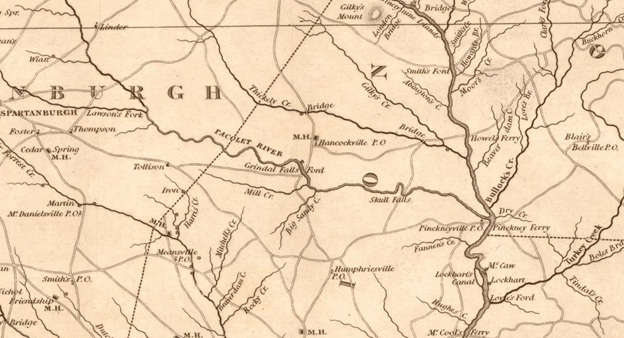
The contents of the letter are not revealed within Chesney’s journal. Nonetheless, it must have contained information about available land that was located in the fertile river bottom on the banks of the Pacolet River near Grindal Shoals. The plot of land was a further one hundred kilometres into the Backcountry and was within the Governor’s Irish Plot. Sarah Cook and her extended family had migrated from Pennsylvania in 1772 after the death of her husband John Cook. The Cooks were granted three hundred and fifty acres on the north side of the Pacolet River and Huge Cook was granted land a short distance away on Thicketty Creek. Chesney made his way to the area where he remarked that the family was “remarkably civil” and noted that a great many of the settlers in the area held the Cooks in high regard. In the conflict to come, John and Huge Cook, along with their brother-in-law Charles Brandon, would become leading Loyalists in the Grindal Shoals community.
With the assistance of the Cook’s, Alexander Chesney surveyed three hundred and fifty acres of land on the lush north bank of the Pacolet River at Grindal Shoals. [26] The land was bounded by the properties owned by John Grindal, Jacob Mitchell, John Elliott, and John Williams. The Chesney family’s land was granted on the 4th of May 1775. Alexander was granted one hundred acres adjoining his father’s land, which was on the 31st of May 1775. Once the surveying and documentation had been completed, Alexander and Sarah Cook’s sons assisted the remainder of the Chesney family in moving to their new homestead on the Pacolet. The Chesney’s also boarded with the Cooks until the families’ cabin was built. From 1773 on, the journal briefly recounts the daily goings on of clearing land, planting crops, and building the family’s cabins. Chesney dryly states that, apart from the birth of two more siblings, life went on “without any particular occurrence…until 1775” when William Tennent arrived to present the Whig association to the inhabitants of the region at the Thicketty Creek meetinghouse.[27]
From these brief journal entries, one can clearly observe how important these ties of kinship were to immigrants and these relationships would form the foundation of familial allegiances. As the political disagreement over the nature of the Rights of Englishmen and the structure of British Imperial Federalism escalated into open violence, Chesney states that he provided services as a guide and sheltered fleeing King’s friends from Whig militia under the command of Col. Richardson during the Snow Campaign of 1775. He even went so far as to go to Col. Richardson’s main encampment in the Congaree region to guide defectors like Capt. James Phillips and his militia company to the relative safety of Loyalist held areas in North Carolina. It was during this period of Whig domination that the Loyalists of the Pacolet River area formed an association to gather support for the King’s government, as well as for mutual protection.[28] Shortly thereafter, it seems both Robert and Alexander’s activities were discovered and his family’s property “ransacked”. Whig forces caught both men, in the act of sheltering Loyalists and were immediately imprisoned at the Whig camp on the Reedy River. Col. Richardson paroled Chesney but the “Congress party” held him in contempt.[29]
Alexander was given the option to return to his cell or affirm his loyalty to the South Carolina Provincial Congress and join the “Rebel Army.” Lacking another recourse, Chesney plainly states that he chose to serve in the Whig militia to “save my father’s family from threatened ruin [.] He had been made prisoner already harbouring some Loyalists.”[30] Seeing the reality of the situation, Alexander forsook his professed loyalty to the King in exchange for the safety of his kith and kin. Chesney’s kinsman John Cook would take a stand on principle and not swear an oath to the Whigs. As a result, Cook was brutally whipped in public and imprisoned until liberated by the British after the capture of Charlestown in 1781.[31] Chesney’s actions at this point suggest that he was not yet motivated by an overt adherence to abstract principles, but rather, as many in the Backcountry, by survival, which meant they would support whatever side held the upper hand at any given moment.
With his loyalty now declared for the Whigs, Chesney served as a private in the militia at the first the Battle of Charlestown (June 4th-28th, 1776), where he and a few friends attempted to defect to the British lines but were unable to secure a boat, so abandoned the effort. From Chesney’s actions, one might conclude, as Ralph Waldo Emerson did when he wrote, “[a]ll promise outruns the performance. We live in a system of approximations. Every end is prospective of some other end, which is also temporary; a round true, not domesticated.”[32] Emerson’s point highlights the endless possibilities that might explain human action. Was Chesney an opportunist seeking a way to further his own ambitions? It might also be true that he seems to have been suffering from the rashness of youth. Or perhaps he truly was a principled friend of the King. Regardless of the underlying motivation, one has to wonder if he thought through this decision to defect to the British. Did Chesney consider what would happen to his father’s family if Major General Charles Lee’s forces discovered that he had defected? When not in the tempering presence of his father, Alexander does not seem to have been aware of how the consequence of his actions would affect those associated with him. This rash disregard for others is a theme that is recurrent throughout Alexander’s journal.
After this episode and the failure of the British to capture Charlestown, Chesney was sent on a campaign against the Cherokees and Creeks in the Lower towns then shifting north to burn the Valley Towns. Remarkably, Chesney, rather matter-of-factly, states that his unit had little opposition in fighting the aboriginals despite a near-miss at a “serve battle with Indians near the middle settlements.”[33] During the engagement, five or six Cherokee levelled their muskets at Chesney. One marksman amongst the group nearly hit his mark but for a small tree branch that slowed the ball to the point that it lost all momentum before striking his chest. Despite a near-death experience, Alexander dryly attests that during the summer of 1776 he assisted in devastating thirty-two aboriginal villages under the command of General Williamson and Col. Sumter.[34] Ostensibly indifferent to the carnage he had just engaged in, Alexander’s journal picks up in the spring of 1777. One observes Chesney on what might be considered a grand colonial tour, with him participating in target practice upon Alligators and enthusiastically skirmishing with the Creeks in the swamps around Fort Barrington on the Altamaha River in Southern Georgia. Indeed, it seems that Chesney, like many Ulster Scots, had a particular disdain of aboriginals, he plainly states “we had several scrimishes [sic] with the Creek Indians, in which I was always a volunteer.”[35] This admission about his eagerness to assail native peoples is a curious one because he had only lived in the colony for about four years and had not experienced the pitiless fighting during the Seven Years War. Moreover, it also seems strange that Chesney would be so active in the suppression of the King’s allies.
From this account we can only conclude two possible reasons that account for Chesney’s behaviour. Firstly, Chesney’s explanation supports the idea that he was an impressionable twenty-two-year-old at that time, who was out on his first campaign and was merely emulating his superiors to curry favour as young men are often inclined. The second reason may be informed by the experiences of the Cook family who lived on the Pennsylvania frontier during the latter part of the Seven Years War. Given the bonds of kinship, Chesney would have been told the Cook family accounts of the terror and havoc wrought by the tribes during the war. With lineage from a people with long memories, perhaps the occasion presented an opportunity to settle old feuds. If the second reason provided the impetus for Chesney’s actions, then it is another example of how familial relations and heritage can shape an individual’s mentalities. As opposed to the rational notion that stipulates if Chesney were a true friend of the King, it would be counterintuitive to attack your potential allies so vigorously.

Regardless of Alexander’s underlining motivations, he had served across the Backcountry of Georgia and the Carolinas in the service of the Whigs. After spending an uneventful winter at his farm along the Pacolet, the spring of 1778 found him under the command of his neighbour Captain Zachariah Bullock and was promoted to lieutenant by his “loyal friends” within his militia company.[36] Chesney remained under the command of Capt. Bullock and Capt. McWhorter in Georgia. During the summer of 1779, his militia company was skirmishing with the Creek before being ordered to march up from Augusta to reinforce General Lincoln’s forces at Charlestown. Stationed in the fortifications along the Stono, Chesney states that just before Lincoln’s attack on the British lines at the Stono River, he “returned home on business.”[37] It seems that Capt. Bullock found the young Lt. Chesney dependable enough to send him back to Grindal Sholas to recruit. This brief entry is another curious statement given that the Battle of Stono Ferry (June 20th, 1779) was the last major engagement before the siege of Charlestown began the following year. The timing of Chesney’s departure from Bullock’s militia company is curious, he seems to have been content with rampaging against aboriginals but through some stroke of luck or contrivance, he avoids the Battle of Stono Ferry, which would place him in direct opposition with British forces. Regardless of the circumstances, he returns to his homestead on the Pacolet River and is engaged to marry the daughter of a local Whig family, The Hodges. To further muddy the matrimonial waters, Elizabeth Cook, cousin of Alexander, married The Hodge family’s patriarch, William II. Accompanying Margret Hodge in the marriage is her dowry of two hundred acres of prime bottomland. Reflecting upon this marriage, one finds it to be peculiar that a Whig family would allow their daughter to marry a “former” Loyalist. Interestingly, marriages between families on opposing sides seem to have been a fairly common occurrence. Indeed, Alexander Chesney’s sister Jane married Daniel McJunkin, the brother of a prominent Whig named Joseph McJunkin.
After Chesney’s marriage to Margret Hodge, he does not return to the militia and states that it was “firmly believed in the beginning of the year that Charles-town would be reduced by the British.”[38] In due course, Charlestown fell to the British on the 12th of May 1780. In short order, Gen. Clinton issued three decrees to facilitate “tranquility and order to the country.” On the 22nd of May, Clinton pronounced that anyone found in arms or persuading “faithful and peaceable subject” to rebel against the King would suffer imprisonment and the confiscation of their estates. The next decree was issued on the 1st of June, which offered amnesty to all those who swear an oath of allegiance to King George III. Not two days later, Clinton issued an amendment to his proclamation requiring all paroled militia to swear an oath of allegiance within seventeen days and were henceforth required to take up arms in defence of the His Majesty’s government in South Carolina. Whigs considered these proclamations as deceitfulness on part of the British because it meant that they could no longer continue their lives as neutrals in accordance with the terms of their parole. These former rebels would be obliged to serve in Loyalist militia units against their former comrades, who opted not to accept Clinton’s terms. The consequence of Clinton’s decrees was that, in the span of a few weeks, the temperament of many within the South went from mild acceptance of the British occupation to active military opposition, as Loyalist militias began to seek retribution against their Whig neighbours for the injuries incurred during the Snow Campaign. Unable and, in many cases, unwilling to prevent Loyalist depravations, the British Army stood by while the Backcountry began to be set alight with the renewed flames of inter-communal strife.[39]
Upon hearing the first pronouncement, Chesney did not wait for Gen. Clinton’s June decrees to seek amnesty. On the 25th of May, Chesney submitted himself to Capt. Isaac Grey of the South Carolina Royalists, and retained his commission of lieutenant in the militia. From that point on, Chesney fought for the Crown and, in time, would become a prominent Tory militia commander. With the deceptive cloak removed, with zeal Chesney began seeking out and contending against his former comrades in arms. Within the span of a few months, Chesney had demonstrated his commitment to the British cause by accepting dangerous missions for which he would take no reward. When his loyalist neighbour, Col. Zachariah Gibbs, offered Chesney a handsome reward for accepting a mission from Maj. Patrick Ferguson to reconnoitre a Whig encampment in North Carolina, Chesney states “I told Col. Gibbs that what services I could do were not with any lucrative view and that I would undertake this difficult task for the good of H M Service.”[40] After sending that report by messenger to Maj. Ferguson, Chesney was captured at his home by his Whig neighbours, which included another brother-in-law, Joseph McJunkin, and repeated turncoat, John Heron. Demonstrating a talent for the daring getaway, Chesney would make the first of his bold escapes and return to Ferguson’s encampment to discover that his information led to the Second Battle of Cedar Springs (August 8th, 1780) which resulted in a tactical draw. Both sides claimed victory, but the Loyalist’s forces suffered the majority of the casualties. Regardless of the battle’s outcome, Maj. Ferguson was impressed by Chesney’s actions and prompted him to the rank of captain and made him the adjutant general of the Loyalist militia battalions under his command.[41]
Chesney would spend the summer and early fall fighting in a continual set of running skirmishes with Whig forces. Such was the regularity and ferocity of the fighting that Alexander admits that he could not recall the details of all the engagements, “numerous other skirmishes having escaped my memory, scarcely a day passes without some fighting.”[42] With the arrival of October, Chesney recounts that he was accompanying Maj. Ferguson in North Carolina clashing with small detachments of Whig militia in the foothills of the Blue Ridge. It was during that expedition that Maj. Ferguson issued his infamous proclamation intended to strike fear into the paltry Whig partisan bands and to rally Loyalist support. Perhaps imprudently, Ferguson boldly proclaimed in a message to Col. Shelby “If they did not desist from their oppositions to the British arms, he would march his army over the mountains, hang their leaders, and lay their country waste with fire and sword.” Ironically, Ferguson was echoing similar rhetoric and threatening violence of action that subdued his native Scotland not thirty-five years prior. Incensed by this threat, frontiersmen from all over the Appalachia began to gather in large numbers and struck out to catch Ferguson before he had the opportunity to link up with the main body of the British Army under the command of Gen. Cornwallis near Charlotte.[43]

Upon hearing of such a large Whig force moving swiftly to intercept him, Ferguson sensibly decided to withdraw to higher ground. Ferguson chose a bald hill called King’s Mountain to make his stand against the approaching Whig rabble. Rising nearly one thousand meters above the rolling piedmont, the hill has a long escarpment running the length of the summit, which is wider at the northeast end of the hill. The slopes of the hill are covered in a dense temperate forest, making the terrain an ideal for militia’s “Indian” tactics, which made effective use of the rifle and available cover behind trees. Ferguson, believing the height advantage prohibited the Whigs from being able to fight their way up the steep wooded slopes if under fire, merely thought that if they got too close to his lines the bayonet-trained troops would simply push them back down the hill. Unbeknownst to Ferguson, militiamen had long observed effects of ball trajectories in relation to firing up or downhill. When firing uphill, it was observed that the ball flies on an almost straight flight path before arching as the ball loses momentum. Conversely, when firing downhill it is the natural tendency of the shooter to overshoot the target. To correct this issue the shooter needed to aim lower on the target in order to gain a hit. Nurturing the Whig militia’s marksmanship was the fact that Ferguson’s Provincials adorned in their green uniforms would have been silhouetted against the blue sky standing atop the hill while charging down at the Whig militiamen, which would make fine targets for the rifle-armed over-mountain men.[44]
From the onset of the battle, Ferguson made many tactical blunders that would cost him his life and the lives of two hundred and ninety of his men. Ferguson planned to use the bayonets of his American Volunteers to drive away concentrations of Whig militia below the hilltop, which was the standard tactic at that time in dealing with rifle-armed troops. Such tactics work well when driving a force in one direction during a mobile engagement but served little purpose during a static defence. Indeed, such needless running about only served to wear out his men and continually expose them to accurate rifle fire. Physical exhaustion when combined with persistent exposure to fire has significant negative consequences for soldiers. Moreover, Ferguson did not use the terrain to his advantage. Though thickly forested, Ferguson did not order his men to cut down trees to construct an abatis to provide defilade for his troops. In its place, he ordered that the wagons and baggage be formed as a barrier along the northeast crest of the hill where he established headquarters. He then deployed his men along both sides of the hilltop to await the attack of the over-the-mountain men.
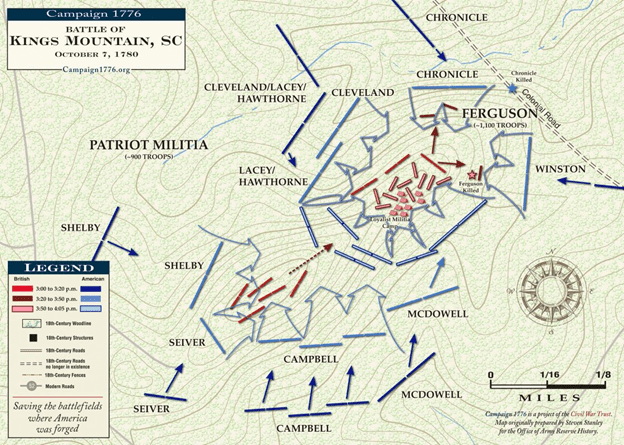
The attack came as Chesney was demounting his horse to report to Maj. Ferguson “that all was quiet and the pickets on the alert.” The report of rifles was heard on the northern slope of the hill, Chesney rallied his militiamen and was wounded above the knee during the first exchange of fire but remained to perform his duties. Darting from behind trees and firing, Whig militiamen inflicted heavy casualties on Ferguson’s men. Chesney sorely described the “irregular destructive fire” that cut down his men. When groups of Whigs would get close to overrunning the Loyalist militia, Ferguson’s American Volunteers would perform a bayonet charge downhill to dislodge the Whigs. This tactic had a limited effect because once the provincial troops moved back up the hill the rifle-armed Whigs would follow and pick off Ferguson’s men as they climbed back up the slope. In one last valiant attempt to rally his men for a breakout, Ferguson was shot from his horse. His foot being caught in the stirrup was dragged a distance and his red-checkered shirt made him a perfect target for numerous Whig marksmen, each wanting to exact their personal revenge on the man who had threatened to burn their homes. “Upon examining the body of their great chief,” wrote James Collins, “it appeared that almost fifty rifles must have been levelled at him at the same time; seven rifle balls had passed through his body; both his arms were broken, and his hat and clothing were literally shot to pieces.”[45]
Throughout the battle, Chesney states that he scarcely felt the pain from his injury because he was so preoccupied. The night after the battle he tells us was a night filled with the stench of the dead and the air filled with the cries of the wounded. What is notable is the fact that Chesney does not mention the depraved acts that Tarleton attributes to the Whigs. Tarleton’s account states that the Whig militia stripped Ferguson naked and urinated on his corpse.[46] The journal of Dr. Uzal Johnson, Ferguson’s surgeon, also does not mention this heinous event.[47] It seems that only Tarleton mentions this disturbing episode of barbarism. Regardless, Chesney was taken prisoner along with some six hundred other Loyalists. On their long march back into North Carolina, each prisoner was made to carry two muskets and had his shoes removed. On the night of the 14th, Alexander watched as the Whigs hung ten prisoners; Dr Johnson mentions only nine.[48] The approach of Tarleton’s British Legion put an end to these dark festivities and the prisoners were force-marched toward the Yadkin River. Along the way, Chesney tells of how some of the Whig forces were “cutting and striking us by the road in savage manner.”[49] Eventually, the infamous and ruthless Whig commander, Col. Cleveland, confronted Chesney. Cleveland offered Chesney his life in exchange for insights into how Ferguson employed his command whistle and a demonstration of the troop movements. When he refused, Cleveland ordered him to be put to death once they reached the Moravian towns. Fortuitously, Chesney saw his opportunity to escape while on the northeast branch of the Yadkin River, around modern-day Winston-Salem.
Trekking back in the woods and accepting assistance from kindly loyalists, Chesney made the two-hundred-and-forty-kilometre journey back to the north branch of the Broad River. Once across the river, he made his way to his brother-in-law’s, John Heron, who it seems was also at King’s Mountain but fled the battle at the first opportunity by placing a scrap of white paper in his hat, which identified him as a Whig combatant. Chesney would spend the night there before making the fourteen-day journey back to his farm on the Pacolet. Once home he found that the Whigs had ransacked the house, which left his wife and infant children in a state of desperate need. Yet, Chesney seemed more concerned about re-joining British forces than caring for his young family. While potting to re-join the British, he and fellow Tories, Hugh Cook and Charles Brandon hid in a shallow cave on a branch of the Pacolet. Cook’s wife brought the men meals and news of troop movements in the area. Interestingly, he also states that he hid at his fathers-in-law, William Hodge II, who was a noted Whig. Upon hearing that Col. Tarleton had been defeated at the Battle of Blackstock’s Farm (November 20th, 1780), he attempted to raise a company “with great difficulty” and joined the assembling Loyalist militia at the home of turncoat Col. Andrew William’s on Little River. Chesney was then ordered to rendezvous with other units on the Enoree, but upon arrival at the appointed place, he was taken prisoner by Maj. Benjamin Roebuck. After a brief skirmish to free Chesney at a fortified house not far off, Maj. Roebuck paroled him to Fort Ninety-Six in exchange for Capt. Clarke, son of prominent Whig Col. Elijah Clarke.[50]
That December, Chesney was placed in command of the militia guard at the jail of Ninety-Six. With the arrival of Tarleton’s British Legion in January of 1781, Chesney was ordered to be a scout and guide during Tarleton’s race to catch Gen. Morgan. Upon entering the Grindal Shoals area, he observes the old camps of Gen. Morgan’s army. He then proceeded to his father’s house, where he was told that Morgan had gone to the “old fields about an hour before.”[51] Chesney then rushed to intercept Tarleton and found him to the north at the head of Thicketty Creek, which was Morgan’s last campsite. Upon making contact with Gen. Morgan’s mixed force consisting of militia with a small contingent of regulars at a place known as the Cowpens, Chesney sardonically comments that “we suffered a total defeat by some dreadful bad management.”[52]

Chesney asserts that a key element of the defeat was due to the observation that Tarleton’s British Legion was mostly comprised of American Continentals captured at the Battle of Camden (August 16th, 1778), and seeing their old regiment they refused to attack it. In of itself, that point offers profound insights into the complicated nature of the divided loyalties that emerged during the war. At the end of the brief account of the Battle of Cowpens, Chesney plainly states, “I was with Tarleton in the charge who behaved bravely but imprudently. The consequence was his force dispersed in all directions [and] the guns and many prisoners fell into the hands of the Americans.”[53] For Chesney, the reason for the failure of the British attack clearly fell at the feet of Col. Tarleton. Moreover, Chesney understood the implications of the British defeat at Cowpens because he rode hard to his family’s modest farm. Upon arriving, he gathered his family and what little was left of their possessions, the homestead was plundered this time by Gen. Morgan’s army a mere two days before the battle and was stripped of anything that could aid Tarleton’s men. A brief aside to examine these complex familial bonds is prudent at this juncture, males of the McJunkin and Hodge families would fight on the opposing side against Chesney. The night prior to the engagement, Gen. Morgan ordered his army to take supplies from loyalists as to not further impose upon the patriot families. It is not improbable infer that either McJunkin or Hodge had a hand in stripping Chesney’s house clean of anything of value in retaliation for his possible hand in their imprisonment in the winter of 1780.[54]
With his family in tow, they rode to Rob McWhorte’s at the headwaters of the Edisto, where Chesney left his family. He then proceeded to Charlestown to find accommodation and reparations for his services.[55] In the meantime, the Whigs had been precipitously regaining control of the areas outside British outpost and urban strongholds. By December 1782, the British found themselves largely confined to Charlestown and its immediate vicinity. During this period, Chesney was appointed to be the superintendent of cutting of wood and found some comfort in alleviating the impoverished condition of a number of refugee loyalists by employing them in this work, which prevented them from starvation. Chesney had lost his wife and infant daughter at the end of November 1781 and was obliged by ill-health to relinquish the administration of the woodcutters early in the following January. As his illness got progressively worse, he sent his son to his mother’s, who still resided at Grindal Shoals.[56]
In the late spring of 1782, Alexander would embark upon the Orestes, a British sloop of war, bound for Ireland. The name of the ship that would transport Alexander was fitting for it would carry him away from the brutal madness of civil war that had taken hold within the Carolina Backcountry. Across the tempestuous Atlantic Ocean, Chesney abandoned his kith and kin in hopes of achieving the relative stability that he perceived the Empire provided. At this point, Alexander sought compensation from Parliament for his losses at the hands of the Whigs. On May 19th, he landed at Castle Haven, Ireland, and began to seek recompense for his service. In doing so, Chesney abandoned his only surviving child and his father’s family in South Carolina. Alexander never returns to America, instead he remarries and settles down in Northern Ireland. Chesney would continue to serve his King as a minor official in Ireland, and his sons would gain some fame. This final point about Chesney’s departure is fascinating in of itself because in 1784 the South Carolina assembly passed the first Loyalist clemency act that returned about seventy per cent of the confiscated property to their original owners.[57] This clemency accounted for the fact in 1818 Chesney receives a letter from his son William, who he left in South Carolina. In the letter, William stated that he and Robert Chesney, Alexander’s father, were alive. The letter goes on to recount that they were “not in flourishing circumstances in the State of Tennessee.”[58] William’s letter to his father thirty-six years later begs the question, why did Chesney choose to abandon his infant son and extended family with such haste when he could have had most of his lands returned to him within two years? We may never know the true answer to that question. Nevertheless, it is evident from this brief account of Chesney’s involvement in the war that Loyalism was a complicated confluence of influencing factors and Alexander Chesney stands as a prominent outlier when compared to archetypes within the conventional Loyalist narrative. Thus, in order to more clearly observe those possible influencing elements, we need to delve deeper into the historical contexts that permeate Chesney’s pithy journal.
Loyalism Along the Banks of The Pacolet River
Recalling that within Peter Moore’s investigation of the Waxhaws community, he observed that within that one’s allegiance was based on four main local factors: the size of land grants, date of immigration into the region, the political leanings of kith and kin, as well as community tensions. Moreover, the study of the divide between Whigs and Loyalists within the Waxhaw community suggests that there was a high probability of a link between recent immigration and one’s decision to remain loyal to the Crown. Moore’s community-based analyses found that recent émigrés were resistant to joining the Whig resistance movement because of local socio-political dynamics between newcomers and more established settlers. These factors precluded recent immigrants’ assimilation into the community. These newcomers seemed to have all settled in the same general region and that land was usually less fertile than areas settled in the first waves of immigration into the Waxhaw region. From this one can observe the seeds of disharmony within the community over the issue of land. Furthermore, Moore notes that these immigrant areas were not ethnically and religiously diverse, which created community tensions that would serve to stoke the flames of conflict when the community was forced to choose sides upon the arrival of British regulars within the region. [59] The author will attempt to employ Moore’s framework within the Grindal Shoals community located on the Pacolet River in Upstate South Carolina.
In pursuit of that end, the Loyalist region that we shall be exploring is perhaps one of the most complex and challenging areas for historians to fit into the accepted narrative. The region is located west of fertile coastal lands of South Carolina, an area that was on the periphery of colonial society. A land that was thought to have been of little consequence apart from a buffer zone between the wealthy plantations on the coast and the unruly aboriginal tribes that made their home on the western side of Appalachia. Narrowing our focus further, we observe an unassuming community spread out along the numerous streams around the confluence of the Pacolet and Broad Rivers. Located northeast of modern-day Jonesville South Carolina, the Grindal Shoals community was situated on a strategic ford that crossed the Pacolet River and was heavily used by both sides during the Revolution as the various partisans traversed the region leaving desolation in their wake.
Internal migrants predominately populated the community. In the aftermath of the Seven Years War, these settlers followed The Piedmont Road or the Upper Road from the Middle Colonies and Virginia as it separates from the King’s Highway at Fredericksburg, Virginia, and proceed south towards Macon, Georgia. However, there were also recent immigrants from what David Hackett Fischer calls the “borderlands”[60] of Great Britain, as well as a few scattered Germans. These diverse groups would consist of the ethnicities that would become known as Scotch-Irish, though the term does not entirely reflect the diversity of peoples that comprise that broad group. Many of these poor landless peoples were seeking a new life on the frontier where agents of the King were offering large tracks of land to European settlers to sever as a buffer against aboriginal tribe’s attacks and a dependent militia force to suppress slave revolts.[61]
What generates confusion about this term is the lack of historical context, which is a discussion that is most engaging but entirely too protracted for this reflection. Nevertheless, Griffin prudently notes, the term does not adequately describe the Ulster plantation protestants because that culture is not representative of the native Irish nor their cultural kin the Highland Scots.[62] The term is even more mystifying when one considers the depth of interactions that occurred between the Gaelic peoples of Alba, Éireann, and Prydain over the course of their dramatic and, frequently, unhappy history. The earliest use of the term is purported to have occurred in 1545 in reference to Domhnall Dubh MacDomhnaill as king of the ‘Scottyshe Irysshe.’[63] The term can also be seen within the English colonies as early as 1695 to describe that influx of Ulster plantation protestants and gained wide usage in colonial documents by the 1760s.[64]
Despite the prevalence of the term’s use during the colonial period, the so-called Scotch-Irish were loyal Protestants supplanted to the heart of the Gàidhealtachd from the Lowlands of Scotland, Northern England, the marchlands of Wales, and the German principalities. These diverse peoples were attracted to Northern Ireland as part of the Anglo-Norman plantation system that sought to ethnically cleanse the region of the troublesome and savage Irish, who stubbornly refused to be civilised by their benevolent conquerors. The Gaels and Gall-Ghàidheil were culturally distinct from the Ulster Plantation protestants. Indeed, the cultural elements and faith of Gaelic society would have been an anathema to the plantation protestants.[65] This extensive Atlantic history greatly affected how Gaels and Ulster protestants interacted in the densely forested Backcountry of the English colonies.
These groups were diverse in terms of regional languages and cultural identities. Nevertheless, they hailed from regions that were borderlands, where ethnic, religious, and state violence prevailed. The result of those tensions compelled many to flee those regional European conflicts or as a result of a complex economic crisis. What is significant about this point is how the two groups responded to those influences. Primarily, many German-speaking people choose the path of non-violence and peaceful cooperation. Conversely, the Ulster protestants were fundamentally shaped by the violence that encompassed their lives, which profoundly affected them as a people. Such a realisation is strongly suggestive as to a reason why they were more open to slavery, while some Germans choose not to partake in the budding but peculiar institution. Moreover, these consequences of European violence might also explain why Ulster immigrants adapted to frontier conditions more readily whereas the Germans struggled. Moreover, they tended to prefer isolation from other established dissenters and were often described as insular. On the contrary, the German speakers settled amongst those of similar ethnicity or faith. In economic terms, many Germans were semi-literate middling tradesmen, artisans, husbandmen, or yeomen framers that shaped their colonial experience in a slightly more positive light. Ulster immigrants, on the other hand, were mostly illiterate and, often, desperately poor, jack of all trades, tenant farmers. Despite these economic differences, the prospect of financial advancement incentivised both groups to hazard the tempestuous seas in search of economic opportunity.[66]
After 1778, Lord Germain, acting on questionable advice of Loyalist refugees from the Southern Colonies, shifted the war effort toward the South, which brought the loyalties of these diverse and seemly inconsequential peoples to the forefront of the conflict. Indeed, such was the concern over the question of which side these Backcountry settlers would support that the South Carolina legislature formed The Commission of Drayton, Tennent, and Hart to gauge the region’s support for the Whig cause. The commission’s findings and the subsequent reaction of the Whigs would have a lasting effect on which side the frontiersmen would support once large numbers of British regulars arrived in the colony during the spring of 1780. Such was the enthusiasm for the British cause in the up-country that it does give credence to the oft discounted notion that there was little support for the Crown in the Southern Colonies. With that said, the reasons why a person chose to be a Loyalist is a most complicated question and is not conducive to definitive answers. Nevertheless, when describing the situation in the up-country, Loyalist Col. Robert Grey observed, “The whole province resembled a piece of patchwork, the inhabitants of every settlement when united in sentiment being in arms for the side they liked best and making continual inroads into another’s settlements.”[67] As we journey along Alexander Chesney’s path towards armed Loyalism, we will find that Col. Grey’s description is the most prudent observation of what was occurring within communities across the Carolina Backcountry.
As we shall discover, where factors can even be identified, the individual choice of which side to support in the conflict is a convoluted one. Familial bonds were significant to some, while inconsequential to others. The threat of land confiscation and the lure of plunder guided the decisions of others. Regional leading men swayed some individuals by the force of their personality and reputation. For others, local animosities and personal grudges guided the dark hearts of others. There were also other more general factors such as recent external immigrants tended to become Loyalists, while native-born internal migrants were more inclined to be Whigs. There were also tensions between Christian dissenting denominations also played a role for some individuals in making their decision. The commonly accepted narrative about the almost universality of Scotch-Irish Presbyterian support for the Whig cause is not sustained when one observes outliers such as the Chesney family. Their rejection of Radical Whig ideals has its roots within the First Great Awakening and the alternations that occurred within Presbyterianism by evangelical ministers such as George Whitefield. Their Old Light Covenanting Presbyterian beliefs brought with them from Ulster rejected the New Light passions of their more established neighbours.
Of Anglo-Norman ancestry, the Chesney’s emigrated to Ulster during the English plantation period at some point in the mid-16th century.[68] During that destructive age, thousands of Gaels were forcibly displaced or transported to the English New World Colonies. The Ulster plantations were predominantly designed to destroy the Gaelic culture connections with the Gaelic Highlands of Scotland.[69] Setting aside the troubled past of Northern Ireland, this reflection will explore the intricacies of local structures: social connections between families, religion, the extent of integration, and when the Chesney family immigrated into the region. Additionally, it is prudent for one to consider how Alexander Chesney might have perceived land ownership and his rights as a subject of the King. Once these various elements are thoroughly investigated, one must hen combine these assorted threads to observe how they factored into his individual decision to choose to support one side in the conflict over the other. As those threads are woven together, we will observe a slightly hazy portrait of the underlying influences that informed Chesney’s decision to support the King. Indeed, we will find that his choice was a consequence of the combination of the factors mentioned above. Not from some rational mental assessment of the cost-benefit analyses or from abstract Enlightenment principles concerning human freedom, which were prevalent during the period. At its core, this inquiry will attempt to explain Alexander Chesney’s story and discern what lessons about the intricate influences can be gleaned about loyalism in the Carolina Backcountry from his experiences. Ultimately, Chesney’s life experiences demonstrate that his life is both representative of the ordinary Loyalist’s experience and a significant deviation from that narrative.
“Contending For the Ascendancy:” Grindal Shoals Demographics
After the fall of Charlestown in 1780, throngs of militia and banditti posing as militia roamed the countryside intimidating adherent on both sides.[70] A Whig militiaman recounted that it was “almost Fire & Faggot Between Whig & Tory, who were contending for the ascendancy.”[71] This unpretentious observation subtly conveys the scale of savagery that was unlashed in the up countries of Georgia and the Carolinas, where neighbours turned upon one another in a perpetual cycle of violence. Yet, those tumultuous events lay in the future for the Chesney Family. By the time that the family arrived in South Carolina during the autumn of 1772, the Grindal Shoals region was home to about forty-nine individuals and extended families scattered along both banks of the Pacolet River beginning at the west bank of the Broad River stretching west towards Lawson’s Fork Creek. The demographics of the region are difficult to sort out given the lack of accurate records of the period.[72] Nevertheless, by utilising genealogical accounts and existing land grant records, one can begin to observe the dispersion of the community. For this inquiry, however, it is prudent to only focus on the families that were powerful influencers within a day’s ride from the Chesney homestead. Moreover, it is also wise to employ the Pacolet as a dividing line between the families. Even with these distinctions, the intermarrying before the war has muddied the waters of the region significantly. Indeed, as this paper develops, one will observe that the familial bonds for women seem to be an inconsequential factor, and their allegiance is contingent upon their husband’s political dispositions. Thus, though extensive marriage links existed between Whig and Loyalist families, that does not seem to be a factor in individual decisions to choose to support the Whig or Loyalist causes. With that said, once the families are plotted upon a map one does observe similar familial and religious bonds that Moore found in his study of the Waxhaw’s community, though the families are not so neatly divided into two distinct areas. Instead, extended familial clusters can be observed, with male members dictating allegiances despite intermarriage with families on opposing sides.[73] Another interesting note is that it seems that within the younger males of the leading families, there seems to be no observable source for their constantly shifting allegiances, which ebbed and flowed as both sides contented for the ascendancy.
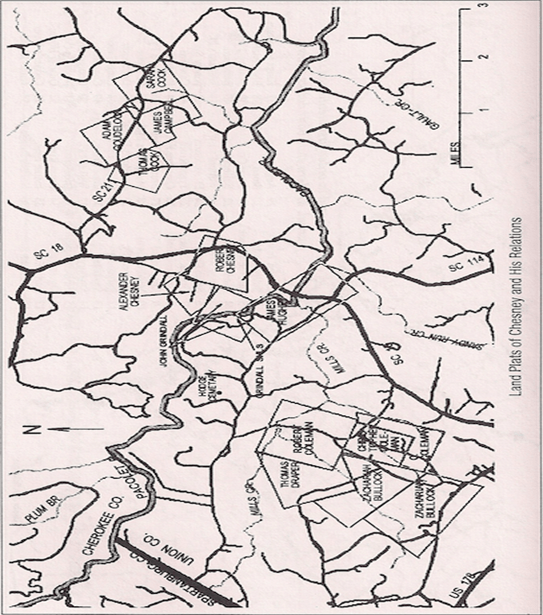
On the north side of the Pacolet River, intermingled among the numerous snaking streams that flow into Gault Creek, the Cook family choose to cut out of the wilderness a three-hundred-acre farmstead. The matriarch of the extensive Cook clan was Sarah Fulton Chesney, the sister of Robert Chesney, Alexander’s father. The Covenanting Presbyterian Cook family emigrated from Northern Ireland to Pennsylvania in the years following the Seven Years War. After the death of John Cook, the widow Sarah choose to move on to larger land grants on South Carolina’s frontier.[74] Accompanying the family was a young Charles Brandon and his wife Sarah Cook. Charles and Alexander Chesney would be boon companions throughout the turbulent period until Alexander chose exile after his wife, Margaret Hodge, succumbed to smallpox during the winter of 1781 in Charleston. [75]
Once in Grindal Sholas, the Cook family wasted little time and quickly married into prominent families already residing in the area. David Cook married into the staunchly loyal Gibbs family, whose large estates were located south of the Pacolet River near Christie’s Tavern, which was run by another leading loyalist family, the Colemans. Switching sides, Elisabeth Cook married into the leading a family that would be fervent Whigs, the Hodges. Perhaps this was a shrewd political move on the Cooks part to shore up their position in the region, which was the common practice in the Old Country. The remaining Cook children, apart from David who married Mary Gibbs (Zacharias Gibbs’s Sister) were already married and brought their spouses with them when migrating from Pennsylvania. Despite the marriage ties to a future leading Whig family, the Hodges, the Cooks would be fiercely loyal to the Crown during the coming war. All but the youngest son David and Charles Brandon choose to stay after signing an agreement that stated they would no longer bear arms against the Whigs.[76]
Straying from the Cook family’s resolute loyalism, the Chesney’s fractured throughout the war for reasons not entirely clear, and Alexander makes only passing mention of his siblings within his journal. Only the patriarch, Robert, and his eldest son, Alexander, displayed any real zeal for the Loyalist cause. Like their cousins, the Cooks, the Chesney’s were Covenanting Presbyterians, who missed the levelling consequences of the Great Awakening that occurred within the Backcountry. Alexander would follow the Cook’s lead and marry into the Presbyterian Hodge family in 1780,[77] during the short parole period before General Clinton’s order mandating all former Whigs, who been paroled, to serve in loyalist militias. The creation of this bond might have been an attempt by the Chesney family to emulate the Cooks in order to create familial bonds between the prominent families of the region. Such notions of creating political and social ties between families was an ancient European custom.[78] Nevertheless, the second oldest son, Robert Jr., would remain relatively neutral throughout the war. Conversely, the youngest son, William, just a young lad at the time of the war, would actively serve as a dispatch rider for the Whig militia. Though difficult to accurately determine, records indicate that William served with the Second Spartan Regiment under the command of Col. Brandon and Maj. Joseph McJunkin. Their sister Jane would marry into the McJunkin family, who were energetic Whigs, and her husband Daniel would serve alongside his brother Maj Joseph McJunkin in the Second Spartan Regiment.
Along with the Cook and Chesney families, on the northside of the Pacolet, were the Presbyterian Lowland Scots Goudelock family, who immigrated from Northern Ireland to Amelia County Virginia, and later to Grindal Shoals. Their property was near to the mustering grounds and the meeting house. The Officially neutral, old Adam Goudelock seemed to have harboured loyalist tendencies or at least walked a fine line between the two sides. A veteran of the Seven Years War, old Adam Goudelock would remain aloof from fighting in the years ahead. Though at crucial moments in the conflict Goudelock would support both Whig and Troy. For instance, after the Battle of Blackstock’s Farm, a doctor attended the wounds of General Thomas Sumter in Goudelock’s cabin.
Later in the war, on the eve of the Battle of Cowpens, the legendary Backcountry woodsman and notorious brawler, General Daniel Morgan, was drawing the impetuous Banister Tarleton deeper into Whig territory in order to fight on ground of his choosing. In hot pursuit, Tarleton’s British Legion swept through Skull Shoal just north of Goudelock’s cabin where Morgan’s flying column had broken camp the night before. After Morgan’s brilliant and crushing victory, Tarleton left his men and fled back whence, he came. Upon arriving at Skull Shoal, Tarleton ‘impressed’ the aged Goudelock as a guide and took him to Hamilton’s Ford after his defeat at the Battle of Cowpens. When Colonel William Washington arrived at the farmstead, Hannah Goudelock, standing on her porch that overlooked the trade road south, proceeded to mislead Washington’s pursuit by telling him that the British headed for the Green River Road. Years later when asked why she intentionally hoodwinked Washington, Hannah simply stated that she “for the safety of her husband, saved…Tarleton and the remnant of his legion from captivity.”[79] Such was the shifting tactical situation in the Backcountry that Goudelock’s daughter Sallie admits that she “had known many notable characters of the times, both Whig, British, and Tory, for her father was a lame man, a non-combatant; so it followed, his house was frequented by all parties.” It is apparent from this brief account of the Goudelock Family that another factor of Backcountry allegiance is observed: often principled loyalties are less important when your family’s survival hangs in the balance. Following this logic, it stands to reasons that loyalties shifted as the tide of battle ebbed and followed from one Whig to British throughout the course of the war.
About two kilometres north of the Goudelock’s, resided the prominent Whig family, the Jefferies. Along with the Hodge and Goudelock’s, the Jefferies were the first families to settle the region in the 1760s. Emigrating from Virginia the hardboiled veteran of the Monongahela and subsequent Backcountry campaigns against the Cherokee, Nathaniel Jefferies, and his wife Sarah Steen, sister of Col. James Steen, built a brick plantation house that was burnt by Tories during the conflict. Of English Episcopalian stock, Nathaniel and his three sons were ardent Whigs. Throughout the war, the family seems to have been in very nearly every significant engagement within their theatre of war, fighting with “splendid courage and resourcefulness.”[80] The Jefferies would serve the duration of the war within the Second Spartan Regiment under Lt. Col. Steen, and Col. Thomas Brandon, as well as in the New Acquisition District Regiment under Col. Bratton.[81]
Shifting to the Southern bank of the Pacolet River, also of English Episcopalian stock resided The Bullocks. The patriarch, Zachariah, had moved to the Pacolet area from Dinwiddie County Virginia in the 1760s. Prior to the war, Zachariah was the leading man within the Backcountry and well propertied. He held over three thousand acres of virgin bottomland along creeks all across the upcountry of South Carolina by 1771. Bullock also held regular Episcopalian prayer services in the tobacco smokehouse on his Pacolet estate, which is an indication of the lingering levelling effects of the Great Awakening. At various times he served as justice of the peace, surveyor, and as a member of the Colonial Assembly. Accompanying Bullock was his sister Agatha and her husband, John Nuckolls. The Nuckolls bought four hundred acres on both sides of Thicketty Creek about twelve kilometres north of Bullock’s home on the Pacolet. Nuckolls would name his plantation Whig Hill to show his encompassing Tory neighbours how fervently he supported the Whig cause.[82]
As war loomed on the horizon, the Bullock’s retreated to and helped shore up the fortifications at Baylis or John Earle’s Fort, which was a refuge for families during the troubles with the Cherokee or Shawnee tribes. During the War for American Independence, the fort severed as a stronghold for Whig families seeking to escape roving Tory militias and their relentless raids upon Whig homesteads. The fort was located on the southside of the Pacolet River about seventy-three kilometres north of Grindal Shoals. Near present-day Landrum, South Carolina. With his family safely behind thick walls of rough-hewn timbers, Zachariah brought the war home to the Tory stronghold near Fair Forest, to the northwest, and Thickitty Creek, to the northeast of the crossroads at Grindal Shoals. For the duration of the war, he would serve as a Major in Roebuck’s Battalion of the Spartan Regiment under Col. Brandon.[83] Zachariah would continue his former duties after the war, but brother-in-law, John Nuckolls, was so not fortunate. Nuckolls served alongside Zachariah as a Captain of Pacolet Whig militia units until the winter of 1780 when he and his son John Jr. were callously murdered by their neighbours while taking their harvest to McKown’s mill on the Broad River. Their revenge was swift, Bullock’s men rounded up an unknown number of Nuckolls’s neighbours and put them to an equally grizzly demise. The Whig partisans even ask John’s widow, Agatha, for shovels to “settle” in some of her neighbours, and men assured her that those men would remain “quiet.”[84]
Bullock’s eastern neighbour was the extended family of William Hodge II. They were brought to the region from Lancaster County, Pennsylvania by another strong matriarch, Margaret Cook. William Hodge Sr, born in Ireland around 1700 and died in Pennsylvania in 1767.[85] Their son, William II, had married Elizabeth Cook at some point before departing Pennsylvania, which cemented familial bonds by extension with the Chesney family. The Hodge’s were a profoundly religious family, after the war, the family moved to Macon Georgia, where Reverend Groves Harrison Cartledge, a Presbyterian circuit rider, wrote, “Beside the William Hodge, who has already been named as one of the elders of New Hope [Church] and who afterwards emigrated to Tennessee, there was another William Hodge from North Carolina who later came into the congregation. This latter William Hodge, Esq., married a Saye (Ann) and was a brother-in-law to James Thompson, Sr… I have already stated that among the first settlers of Madison there were two men with the name of Hodge.”[86] Williams’s mother, Margaret Cook, is buried in Fairforest Presbyterian Kirkyard, Union County, South Carolina. From this evidence, it is clear that the Hodges were Irish Presbyterians.
Before the war, Hodge’s neighbours described him as “a peaceable citizen.” Yet, lurking beneath that humble exterior an ardent family of Whig partisans sprang forth with a vengeance. William, along with his sons, William III, John, Samuel, and young Henry, would serve in the Spartan Regiment under Col. Brandon. Despite this devotion to the Whig cause and during the height of the communal conflict, Hodge senior allowed Alexander Chesney to wed his sister Margaret. In so doing, Hodge had made a decision that would long haunt his family and drive them to flee their home along the Pacolet for lands with not many bitter memories on Georgia’s frontier. What is even more intriguing about this marriage is the fact that William Hodge I, who died in 1767, somehow enters into a joint debt with Alexander to the sum of £235.15s, on the 25th of December 1780. Reading between the lines, one might infer that Margaret Cook married off her eldest daughter to her cousin Alexander with a sizable marriage dowry to shift the Hodge inherence into her family’s coffers. The plot thickens when one observes the witness is the notable Tory James Vernon, to whom all assets are bequeathed upon failure of payment or death.[87] Such an underhanded manoeuvre would account for both parties’ actions during the war. Shortly, thereafter General Clinton issues his infamous proclamations in the summer of 1780, in which he ordered all the Colony’s “subjects” to report for militia duty, which violated the parole of Whigs forces after the fall of Charleston. Faced with the prospect of being forced to fight against the Whig cause many paroled Patriots began to re-organise their resistance. The Hodges quickly joined the burgeoning Whig partisan militias. Both Hodge and Chesney’s decisions would have grave implications for their families.
Reeling from the crushing Loyalist defeat at King’s Mountain in the autumn of 1780, General Charles Lord Cornwallis ordered Col. Banastre Tarleton to disengage with his impudent pursuit of Francis Marion in the tidewater swamps in order to reinforce the outnumbered British garrison at Ninety-Six. This isolated outpost was threatened by Col. Sumter’s militia force. Amidst these turbulent events, the conflict between the two families erupted. Recently escaped from a prisoner of war camp in North Carolina, former adjutant of the defeated force under the command of Major Patrick Ferguson, Alexander Chesney was observed to have been hiding in a cave near his family’s homestead with Charles Brandon and Huge Cook. Upon hearing Sumter was thrashed at the Battle of Blackstock’s farm, the men rode forth to join British forces in the area, but Col. Roebuck men intercepted them. In the ensuing firefight, Major Frost of the Loyalist Fairforest Regiment was killed. Identified by an unknown member of Roebuck’s force, possibly by Major Bullock, Chesney was paroled to Ninety-Six in exchange for Captain Clark, son of Col. Clark.
What is curiously missing from Chesney’s journal is the account of how Col. Tarleton’s force, who were in the Grindal Shoals area searching for Whig partisans in the aftermath of the Battle of Blackstock’s Farm. At some point in November, Tarleton was led directly to the homestead of William Hodge.According to the journal left by Major Joseph McJunkin and oral tradition recorded by J.D. Bailey, shortly after sunrise Tarleton’s British Legion came to the house of Mr. Hodge, and “made him their prisoner.” The British Legion soldiers confiscated the family’s “provisions and provender…his stock shot down, and his house and fences burned to the ground.” After making the Hodge family destitute, Tarleton led William away in chains telling his wife as they started off that her husband “should be hung on the first crooked tree on the road.” William was transported to Camden and placed within a prisoner of war camp.[88] Hodge was subject to horrendous living conditions and nearly starved to death before escaping by cutting the metal bars out of his window.
It is interesting to note this event occurred during the period when Chesney was hiding in the cave under a poplar tree that stood on the bank of a creek that fed the Pacolet River. Chesney admits to locating and joining up with the Tarleton’s force operating in the region during November. Taking into account what type of commander Tarleton demonstrated himself to be,[89] it is not beyond the realm of possibility to consider that he would have asked Chesney to point out locals who were Whig insurgents. Furthermore, given the proximity of the cave location and the fact that Hugh Cook’s wife was feeding them regularly,[90] the news of Tarleton’s movements would have been generally known to the sulking party hiding in the shallow cave. While making unsubstantiated assertions as to the possible identity of the informant is a moot point, this occurrence sets into motion a chain of retaliation which ends with Gen. Morgan’s men stripping the Chesney homesteads of all their possessions on the eve of the Battle of Cowpens, which forced Alexander Chesney to flee to the environs of Charleston. From the interactions between the Hodge and Chesney families, one can observe how personal animosities, coupled with financial/familial intrigue, reinforced personal decisions to support one side over the other. Indeed, there seems to have been a point of no return, where one is prepared to commit any number of ill deeds against one’s own kith and kin in order to support their chosen side. Such is the callous and vicious nature of intercommunal warfare. [91]
Returning to the other families on the south side of Grindal Shoals, we observe a block of interconnected families surrounding Christie’s Tavern. The proprietor of the tavern was Robert Coleman, son of second-generation English settlers. The Coleman’s and their extended family emigrated from Amelia County in the 1760s. Based on the Coleman family’s county of origin in Virginia it is possible to extrapolate that they were quite possibly of the Presbyterian faith. As early as 1608 the congregation of Amelia County had petitioned the Presbytery of Laggan, in the North of Ireland, for a minister. The first Presbyterian minister to that region was Mr Makemie, ordained by the Presbytery of Laggan and a graduate of the University of Glasgow.[92]
Accompanying the family south was Thomas and Charles Draper. Thomas Draper was married to Lucy Coleman and settled a stone’s throw away from the site of Christie’s Tavern. With the assistance of Surveyor Bullock and neighbour Randolph Hames, the Colman’s settled into their new home along Mill Creek, a tributary of the Pacolet River.[93] In short order, Frances Coleman married into the extensively landed Gibbs family. Frances’s husband, Zacharias Gibbs, a second-generation Englishman of possible Episcopalian faith from Middlesex County,[94] Virginia. Gibbs would become a notoriously vicious Loyalist during the war. The Coleman daughter also married into the Eison, McWhorter, Meek, Hames, and White families. The Meeks and White lands bordered Gibb’s estate to the north near the tavern. The Eison, Hames, and McWhorter lands were spread out just south of the snaking Pacolet River intermingled amongst Whig homesteads. These families, along with the Cook Coleman, Gibbs, and Chesney families, make up the core Loyalist households within the Grindal Shoals region. The Colemans have marriage connections with the Cook/Chesney clan through the Drapers. While Alexander Chesney’s journal makes little mention of these crucial familial connections, they are sure to have had an influencing effect upon his decisions given that all the prominent families of the Grindal Shoals area, apart from the Bullocks, were firm friends of the King. Using the tavern as a centre of operations, these core Loyalist families, along with their Fairforest allies, created much mischief for their Whig neighbours.[95]
Prominent historian Bernard Bailyn remarked that, “[i]n the first flush of victory the American patriots saw loyalists as the worst of all enemies-betrayers of their homeland, unnatural sons, traitors.”[96] Accordingly, once the Whigs gained the upper hand militarily, the majority of the loyalist families within the Grindal Shoals region, except for Thomas Draper and Robert Coleman, son of Christopher Colman, would have their lands confiscated at the end of the war. Charles Draper and Randolph Hames were hung in the Spring of 1779. For his active support of British forces, Robert Chesney lost his land and moved over the mountains to Tennessee with Alexander’s son, William. Hugh, John, and Thomas Cook choose exile in Britain. James Cook and Charles Brandon changed their allegiance to save their land after the fall of Ninety-Six. Robert Colman Sr. died of smallpox during the siege of Ninety-Six. The remaining sons of Robert Coleman chose exile, but their children choose to stay. In a final twist of fate, Zacharias Gibbs and William Meek died at sea upon their return trip to Ireland after selling their compensation land grants in Nova Scotia. [97]
A culmination of socio-political elements converged to influence individual choices, which resulted in all those lost lives, uprooted families, and devastation. The war could have just as easily reversed its fortunes, but the choices on the opposing sides would have led to similar outcomes. The speed at which the war in the south escalated into a true civil war is telling. The various allied families supporting one side over the other fought an almost unrestrained conflict to cleanse their localities of each other. Unmistakably, one can conclude from this brief examination of the principal families within the microcosm of the Grindal Shoals community demonstrates the observation that strong familial bonds united with leading men that exhibit charismatic natures such as Zacharias Gibbs or the steadfast determination of William Hodge II had an impact upon those within their social circles. Moreover, the resulting personal grievances concerning happenstances before the war and during the conflict erupted into an unrelenting cycle of vengeance and retaliation that spiralled out of control. Where once cordial neighbours struggled amicably with the toils of the frontier living, with a shift that made their world uncertain they turned on each other in order to punish their neighbours for their political beliefs as the tide of battle ebbed and flowed. At some point unknown point, perhaps, both sides understood that there was no going back, and they committed themselves wholeheartedly to their chosen side. Once their metaphorical River Po had been crossed any manner of evils could be justified as long as their side won the day. At the close of the war, the brutal and merciless conflict had torn the community asunder. Most residents, stricken with regret and laminating the torments neighbour wrought upon neighbour, sold their lands in order to seek a new life over the mountains. By the 1880s, little remained of this once vibrant community situated upon an unremarkable ford on the Pacolet River.
Raise The Flag & See Who Salutes: The Drayton, Tennent, and Hart Commission
“…[R]esolutions were presented for signature at the Meeting-house by the congress party and I opposed them.”[98] ~ Alexander Chesney
With that unassuming declaration above, a young nineteen-year-old Alexander Chesney affirmed before a gathering of his neighbours that he was a friend of the King and that he intended to oppose those advocating for the separation from the mother country. Perhaps standing alongside his son stood Robert Chesney, also avowed his allegiance to the Crown. The Chesney family stood firm with other local prominent Loyalists such as Maj. Joseph Robinson, Capt. Robert Coleman, and Capt. Zacharias Gibbs.[99] One can almost picture the scene at Mr Alexander’s meetinghouse on Thicketty Creek, a crude log building overflowing with hardy frontiersmen. Around the building men, women, and children milled about outside in the dense humidity, waiting to hear the outcome of impassioned deliberations brought about by the arrival of a Low-county Presbyterian preacher. William Tennent travelled to Thicketty Creek in order to represent the rebellious Whig coalition that had recently usurped the Royal government in Charlestown. The consequence of those public displays of allegiance would serve to form the dividing line between neighbours and set in motion a series of events that would lead to some of the most vicious fighting witnessed during the struggle to free the Colonies from the arbitrary rule of the Metropolis.
As the summer of 1775 progressed, the newly formed South Carolina Provincial Congress captured power, which forced the Royal Governor, William Campbell, into a hasty flight for safety aboard H.M.S Tamar anchored in the Charlestown roads. In the months shortly before the meeting at Mr Alexander’s meetinghouse, ardent King’s Friend and Colonel of the Upper Ninety-Six district militia, Thomas Fletchall, had been fomenting Loyalist descent in the backcountry. Col. Fletchall and Maj. Robinson had been attempting to get the rank and file of militia to side with the Crown against the Whig usurpers. The growing turmoil among the predominantly Ulster-Scots population of that region was the principal cause for the Whig controlled legislature to formulate a commission to counter Col. Flechall’s royalist agitation and to convince these unruly settlers that it was in their best interest to support the Whig cause.[100] The legislature appointed five men to head the commission. Each man was chosen for his perceived amiability towards the suspicious and resentful up-country settlers. William Henry Drayton was chosen as the leader of the mission. The Drayton family were securely planted within the aristocracy of the colony, as demonstrated by the magnificent Drayton Hall that graced the banks of the Ashley River outside of Charleston. William was an ambitious Oxford educated lawyer, entrepreneur, and politician on the make. As part of the Drayton family’s assets, he owed an important iron mine and smelting operation on the North Branch of the Broad River, near modern-day Gaffney, South Carolina.[101] Historian Bobby Moss argues that Drayton was chosen because his ironworks were a vital part of the up-country economy and employed a significant number of labours, farmers, waggoneers, and tradesmen in the region. Given the period’s social deference to great men, Drayton’s appointment, on the surface, seemed prudent. Furthermore, Moss argues that he was selected because he could explain how the new British trade restrictions threatened the future of the operation to the common man working in the fledgling Backcountry industries.[102] Nevertheless, Drayton was also the head of the Secret Committee and the central orchestrator of the Whig propaganda campaign against the Royal administration throughout the non-importation effort in South Carolina.[103] Naturally, it may be inferred that he might have exploited his influence to appoint himself as the head of the commission. Regardless, the central objective of the commission was to have the Backcountry immigrants sign an oath of allegiance to the Whig cause and to determine which communities would become potential problems should the British Army arrive in the colony.[104]
Accompanying Drayton on the mission were the Reverends William Tennent and Oliver Hart. Given the three main Protestant sects in the region were Presbyterian, Quaker, and Baptist, the legislature felt that the influence of educated ministers would be essential to advancing the Whig cause. Rev. Hart was a well-respected and distinguished Charlestown Baptist preacher and was chosen due to the substantial Baptist congregations in the up-country.[105] The Grindal Shoals community, where Chesney resided, had the Goucher Baptist Church located near Goucher Creek, and the structure is considered one of the oldest Baptist Churches in the backcountry. Conversely, Rev. William Tennent was chosen because of the large numbers of Ulster-Scots Presbyterians. Tennent was a native of Northern Ireland, a graduate of the College of New Jersey (Princeton), and the pastor at Charlestown’s Independent (Congregational) Church. The choice of these educated preachers stems from a prevailing notion at that time, which alleged that Backcountry congregations placed a premium on educated ministers.
Both pastors fit that description and should have been able to command special attention among the recessive frontiersmen if the underlining assumption was correct.[106] A brief examination of surviving church records from the years prior to the war illustrates that many of these congregations had long running disputes with their pastors over minimal or lack of payment for their services.[107] Undeniably, such a notion was highly problematic given the long history of the frontiersmen spurning learned clergymen.[108] Perhaps, this point helps, in part, to explain why the commission ultimately failed to garner widespread support. The Rice King dominated legislature did not comprehend the prevailing socio-economic situation in the region and bought into common stereotypes that portray Backcountry settlers as uncouth ruffians, who would be easily overawed. To add further insult to injury, when the mission split to cover more territory, the Baptist Rev. Hart travelled northwest along the Saluda and Enoree Rivers, which was predominately Presbyterian or Quaker. The commission’s lack of understanding about the region’s faith composition effectively meant that the Whig pastors trudged into areas that had diametrically opposed Christian faiths. Such a lack of planning and consideration naturally created localised tensions within the communities they were meant to sway to support the Whig government.

For the proposes of this exploration, we shall set aside the accounts of Drayton and Hart, in order to focus on the journal of William Tennent because he was the commissioner that was sent to convince the settlers in the Grindal Shoals community to take up the Whig cause. We pick up Tennent’s path on the 21st of August 1775, near the headwaters of Bullock Creek speaking at the Beersheba meetinghouse to an assembled crowd. Tennent preached and spoke about public affairs for nearly five hours. His lengthy oratory had the desired outcome, “the people seemed entirely satisfied & signed the association almost universally.”[109] He goes on to say that with such a large portion of settlers siding with the Whigs that it might bring over most of the rank and file of Col Fletchall’s regiment. Yet, Tennent’s optimism is about to become dashed by the realisation that just across the Broad River the situation was more convoluted, and he would begin to face resolute opposition to his Whig agenda.
Monday the 22nd of August finds Tennent fording the Broad River at Smith’s Ford and proceeding to another meetinghouse on Thicketty Creek. Ahead of Tennent, went Rev. Joseph Alexander the pastor of the Beersheba congregation. It seems that after establishing the Beersheba church, Rev. Alexander also created one on the west side of the Broad River called Thicketty Creek, which later became known as Salem. [110] Rev. Alexander’s Thicketty Creek congregation was not as enamoured with him as much as those at Beersheba. It seems the community along the banks of the creek only heeded their Whiggish shepherd in spiritual matters. Regardless, it seems that word had spread that the commissioners were attempting to convince people to sign the Whig association. This prompted leading Loyalists to appear at these meetings in order to counter the Whigs message and to lend a voice to those who remained loyal to the King.
Tennent observes this fact when he almost in a surprised and derogatory manner notes the presence of prominent Loyalist Maj. Joseph Robinson. Tennent writes, “There were present many of the most hated of Maj. Robinson’s friends, his wife & others: Two Captains Steen and Colman.”[111] Indeed, Tennent’s surprise at their attendance is worth mentioning because Maj. Robinson’s home was at Fishdam Ford on the Broad River some eighty kilometres to the south. Despite the presence of notable King’s Friends, Tennet tells us that the meeting seemed to go rather well. He claims that many signed the association and that they “retired seeming contented.” The one glaring frustration with Tennent’s journal is that it does not state how many signed the association or the portion of those present that refused. If those records were kept, perhaps we might find that the Chesney’s were in attendance and that followed the example set by men like Maj. Robinson, which validates the notion that local leading men held substantial influence within these communities.
Nevertheless, the two other persons Tennent mentions by name also provide a window into the social dynamics at play within this soon to be divided community. Let us briefly examine Capt. James Steen. While Tennent notes that Steen is a friend of Robinson, Steen invites him to his home where Tennent states, “he [Steen] is entirely taken off from a most horrid scheme carrying on there…Capt. Steen seems fully convinced & ready to sign the association.”[112] The “horrid scheme” Tennent is referring to is Col. Fletchall’s Loyalist association that Maj. Robinson drafted earlier that spring. Steen’s conversion to the Whig side is revealing because it displays the rifts that emerged within up-country communities, which resulted from the Imperial Crises. Capt. Steen, a native of Bogard in County Antrim, would go on to serve in the Whig militia from 1777 to 1781, and eventually become a Lieutenant Colonel. However, Steen would also be consumed by the brutal interpersonal violence unleashed by the conflict. In the summer of 1781, Steen was stabbed to death while attempting to apprehend a leading Loyalist in North Carolina.[113]
After staying with Capt. Steen, Tennent writes that he rode five kilometres to Adam Goudelock’s where he meets with leading local Whig John Nuckolls and a man named Adderson.[114] The following day, the 24th of August, he met up with Drayton at the Enoree Muster Grounds near John’s Ford where one thousand militiamen from Upper Ninety-Six Militia Regiment were supposed to assemble for the commissioner to address. Upon arriving the Whig representatives only found two hundred and seventy men assembled on the grounds, all heavily armed. Even more troubling was the observation that Col. Fletchall and other leading Loyalists turned out in large numbers at the muster grounds, which may have been their plan from the start. Chesney does not mention the muster, but the news of the debate and its outcome would have spread like wildfire across the backcountry. Tennent notes, “[t]he gang of leaders [Col. Fletchall etc.] were there, all double armed with pistols.” During the subsequent exchange, Tennent and Drayton attempted to convince the militiamen of the worthiness of their cause but tempers quickly flared. Tennent recounted that Drayton “began to harangue them & was answered in a most scurrilous manner by Kirkland when Mr. Drayton interrupted him a terrible riot seemed on the point of happening.”[115] After the fiery exchanges, emotions cooled and other members of the militia averted the threat of impending violence. Writing the following day, Tennent described the diatribes of Moses Kirkland[116] and Thomas Brown:[117]
“Imagine every indecency of language, every misrepresentation, every ungenerous, and unjust charge against American politics, that could alarm the people, and give then an evil impression of our designs against their liberties and the rights of Great Britain. Imagine all you can on these points, and you will not exceed what we heard as well from Kirkland, as Brown. Our indignation was painful for we were obliged to conceal it, and our situation was as disagreeable as you can well conceive. Brown loudly declared that when the King’s troops arrived, he would join them against us, and he hoped every other person in these parts would do the same.”[118]
What Tennent and Drayton were failing to convey in their accounts of this animated exchanges, was the observation that these leading Loyalists had publicly accused the Whigs of secretly plotting separation from the mother country and, therefore, the commissioners were fomenting sedition against the Crown, an act of High Treason. Indeed, Drayton admits a year later, in 1776, that the accusations carried elements of truth because he was openly advocating for such a course of action.[119] It can be also inferred that Rev. Tennent was also less than honest because he held a position on the Secret Committee, which was headed by Drayton. The Secret Committee had a mandate to “procure and distribute such articles, as the present insecure state of the interior parts of this colony renders necessary, for the better defence and security of the good people of those parts, and other necessary purposes.”[120] Utilising these broad powers Drayton seized Royal powder magazines at Hobcaw and Cochrans, as well as raiding the Charlestown armoury.[121] Such brazen actions were undoubtedly public knowledge and served to cast doubt on the more reserved language used in the Whig association. The consequence of this disingenuous behaviour was that it may have reinforced the Backcountry settler’s pre-existing perceptions of low-country legislators and drove many to distrust their motives, which led them to support the perceived stability offered by Crown.
Accordingly, it became clear to the commissioners that the region north of the Saluda River was firmly under the influence of the King’s Friends. Furthermore, one can glean from these exchanges the idea that leading local men were held in higher esteem and had significant power to influence local decisions as opposed to the Low-county commissioners. In response to such a fervent backlash to the Whig mission, Drayton convinced the Council of Safety that firm action was called for, and the Low-country militia was called out to suppress their fellow neighbours to the north.[122] In short order, Whigs forces dispersed the naïve and divided Loyalists. By December of 1775, a militia force of nearly five thousand under the command of Col. Richardson swept through the up-country crushing Loyalist opposition and captured or killed some of the leaders. During the chaos, Loyalist families like the Chesney’s guided leading Tories to safety over the mountains to the Cherokee territories and hid them in their homes.[123] Chesney and his cousin-in-law, Charles Brandon, guided to safety his neighbour and relative through marriage, John Phillips, into North Carolina. For the next four years, Loyalists would quietly bide their time and plotting their revenge should the opportunity present itself.
This radical change of socio-political circumstances in the Backcountry had its wellspring in the antagonisms brought about the by Drayton-Tennent-Hart Commission. The principal outcome of the ill-fated mission was that, in a period of about forty days, these public affirmations of loyalty or renunciations of the Whig association had effectively formed lines of allegiance throughout the scattered communities of the up-country. Almost overnight, insignificant local and individual antagonisms within these communities would become focal points for the ruthless violence waiting to be unleashed by the arrival of General Clinton in the spring of 1780. In time, the violence would create more fractures would tear open families, disrupt patterns of kinship, and set the stage for the most brutal kind of warfare. If such events had occurred in our own time, it would be considered to be ethnic cleansing. Such violence, whether politically or personally motivated, could now be draped in the flowing garb of patriotism. As Americans, we often forget that both sides thought of themselves as ardent patriots fighting a just war against those that threatened the public order offered by their respective governments. Thus, those on the “other side” were loathsome traitors. Such notions dehumanised their neighbours and served to justify all manner of depraved behaviour.
Analysing Plausible Influences Upon Alexander Chesney’s Loyalism
A Common Colonial Experience: Social Integration
Another essential component in Alexander Chesney’s decision to remain loyal was his family’s ability to socially integrate into the Grindal Shoals community. For the purpose of this journey into the depths of Loyalism, social integration is qualified by three factors: date of immigration, service within the militia prior to the 1770s, and religion. Given the importance of religious beliefs, that component shall be examined within the next section. Naturally, there are other factors. However, these are the influencing elements we shall concentrate upon for the time being.
The Chesney family’s date of immigration to the providence of South Carolina occurred in 1772. Arriving at the latter end of the Ulster Scot wave of immigration clearly hampered Alexander’s social integration into the mainstream of colonial thought. It seems the only social integration that did occur was a solidification of bonds with their kinsmen The Cook family. Writing in 1785, historian David Ramsay noticed that length of residency in America had a palpable effect on patterns of allegiance in the backcountry. Recently arrived Ulster Scot émigrés, who received Royal land grants after 1763, were more likely to remain a friend of the King. Conversely, internal migrants from Pennsylvania and Virginia, who immigrated in the 1750s and 1760s, would generally support the Whig cause.[124] It is important to note that there were exceptions to this general pattern. As the discussion on the demographics of the Grindal Shoals community demonstrates, the Brandon, Coleman, Cook, Gibbs, McWhorter, and Meek families were internal migrants who remained loyal to the Crown. Conversely, the Bullock, Haile, Hams, Henderson, Hodge, Jefferies, Moseley, Nuckolls, and Sims families chose to side with the Whigs.[125] As a consequence, this notion is a general trend and not an absolute rule.
Nonetheless, Peter Moore’s comprehensive study of the divided Waxhaw community provided backing to Ramsay’s observation that there was a high probability of a link between recent immigration and Loyalism. Moore’s community-based analysis found that recent émigrés were resistant to join the Whig movement because of local social dynamics between those that had arrived after the 1760s and the more established settlers. This lack of time to absorb or adapt to a new environment precluded their integration into the community. Moreover, Moore observed that these newcomers all settled in the same general area, which created an atmosphere where they could insulate themselves from the prevailing socio-political trends that held sway within the larger colonial society. Moore also notes that these external immigrant areas were not ethnically and religiously diverse. An added element was the discontentment over the land, which was usually less fertile than areas settled in the first waves of immigration into the Waxhaw region. The culmination of these factors created increased community tensions that would serve to stoke the flames of conflict when the community was forced to choose sides during the 1770s.[126]
The Chesney family fit into this general trend of recent immigrants remaining loyal to the Crown. What makes the Grindal Shoals community stand apart was the fact that it was more diverse than the Waxhaw region that Moore examined. A second distinction is the observation that, apart from the Chesney family, there were few external immigrant families within the immediate community. Most of the families had migrated into the region from Pennsylvania and Virginia. That point notwithstanding, the Chesney’s were very recent immigrants, the family had only lived on their land in Grindal Shoals for about two years before the Snow Campaign in November of 1775. The consequence of this recent immigration was that the Chesney family only had time to socially integrate with their relatives, The Cook family, and their extended social network, which fell within the sphere of established kinship patterns. It should be no surprise then that Alexander Chesney was a Loyalist because he did not have time to be exposed to and absorb the ideas that informed the decisions of more established settlers like The Hodge family. When William Tennent confronted The Chesney family with the radical Whig ideas at the Thicketty Creek meetinghouse, Alexander made his decision of allegiance based on the only thing that was familiar to him in that new environment. When faced with systematic uncertainty, the human propensity for tribe trumps reasoned argumentation over the abstract nature of liberty.
The central institution that facilitated social integration for males within the Colonial Period was the militia. The roots of the English concept of militia have been effectively demonstrated that its origins are firmly cemented within the Saxon Fyrd and has its statutory lineage within the Middle Ages,[127] as well as a consequence of the political struggles that resulted in the Glorious Revolution.[128] By forthrightly examining the militia system within colonial Virginia, one observes that the militia served an important social role within colonial society apart from a purely defensive function. Indeed, the majority of militia statutes held that the common militia had to perform other civic duties within their communities, such as Christian charity or working on communal construction projects. Even elite volunteer militias, such as the snowshoe men of the United Colonies of New England, were not exempt from the building of local bridges as the proposed 1757 Massachusetts legislation for the creation of the Picket Guards demonstrates.[129] This tradition of community service continued into the nineteenth century with the formation of state-sanctioned volunteer militias. Briton Busch details this linkage by recounting that militias “helped their communities celebrate festivals, holidays, and funerals with marches, balls, and banquets, helping out in emergencies and often building an esprit de corps which established a basis for effective wartime service and even elite reputations.”[130] Busch and other’s research has touched upon the importance of examining the socio-political elements that are inherent to the militia as an institution, which is an oft-neglected topic of study.
Intricately linked with these communal obligations, was the central political role that the militia performed. Principally, the militia served as a check on the power of government at the local level. While this political function was partially an unintended consequence of the tempestuous conditions within the New World, a succession of Royal governors would be taught the lesson that a general diffusion of arms meant that they only ruled by the consent of the governed. In 1635, Governor John Harvey was compelled to learn the hard way when his unpopular rule was put to an end by the Virginia militia, who wished the arrogant government appointee to “know wee have armes.”[131] This was the political situation on the eve of The Seven Years War. Indeed, The Old Dominion’s governor during that period, Robert Dinwiddie, eventually decided to create a select militia that would become the Virginia Provincial Regiment as a direct result of those political realities and as a consequence of the social pressures inherent within a society where those that were enfranchised maintained a considerable ability to demonstrate their dissatisfaction with the government because they were well-armed. This reality in turn prompted the great men within the House of Burgesses to be more discretionary with their policies in order to maintain the largess that their political office afforded.[132] It seems the spectre of Nathaniel Bacon’s anarchic rebellion still stalked the dark corners of the minds of Virginia’s gentry. Thus, the militia was an essential check on abuse of government,[133] which highlights its integral social aspects, as well as its political importance at the local level.
The final social aspect of the militia that has also received little attention is the role of patronage. The militia as a communal institution served an important socio-political function that fostered a sense of duty, charity, and interdependence within local communities, as well as providing a conduit for social mobility for marginalised males. Social ascension into the middling sort could be achieved through the ranks of the militia. The colonies, to a greater or lesser extent, were hierarchical society, where hard work and ingenuity often failed to bring about tangible results without the vital component of “useful friendships.” These subordinated friendships were founded upon mutual dependency. Through these relationships, an enterprising man could pull himself, step by step, up the social pyramid. Alexander Chesney seemed to have a natural talent at securing ties to great men and slowly began his climb, as his promotion within the Whig militia, the nomination to be the adjutant to Maj. Ferguson’s American Volunteers, and his later appointment to the Royal Irish Revenue Office demonstrates. From that observation, one can denote that the militia was an important social conduit that enabled men like Chesney to establish bonds by providing a common purpose and offered a measure of independence where middling men could prove their worth. All these social elements were further reinforced through regular training requirements. These monthly and annual training obligations served as a meeting place where communities exchange ideas, goods, news, and conducted or formed business associations. All of which culminated to strengthen social connections within the larger community, as well as links of patronage.[134] The portion of the militia equation that was missing in Chesney’s case was time. Bonds of patronage take time to formulate as men build bonds of trust over the course of years and after numerous socio-political interactions.
Consequently, the late hour of the Chesney Family’s immigration from Norther Ireland diminished Alexander’s exposure to the socialising effects experienced through long-term interaction within the militia. Interestingly, the life of William Chesney, Alexander’s younger brother, underscores the social forces at play within the militia. William seems to have been drafted into the militia about the time that Alexander and Robert Chesney were made to swear allegiance to the Whig cause after they had been caught aiding Tories escapes to North Carolina in 1776. Though a young lad, no older than his early teens, William served throughout the war as a dispatch rider for Colonel Thomas Brandon’s Second Spartan Regiment. In 1785, William seems to have defected to the Hodge Family and Robert Chesney attempted to have the courts return him. The courts ruled the young William could remain with the Hodges.[135] After the Chesney Family’s lands were confiscated, it seems that William was allowed to retain ownership of segments of the family’s lands near Grindal Shoals. In 1805, William bought the land that was confiscated from his sister Ann from Thomas Thomas upon which stood her former house. [136] From these land records, we can infer that William chose to stay in South Carolina, while the remainder or portions of the family moved to what would become the state of Tennessee. Furthermore, one can observe the different paths taken by the two brothers.
Religion: Old Light and New Light Presbyterians
When exploring the influences upon a person who chose to remain loyal to the Crown, one must examine their religious affiliations because they were indeed a deciding factor in determining loyalties in the social structure of the eighteenth century. As occurred within many other Christian denominations, the Presbyterians were divided by the Revolution. While one can generally argue that the New Side congregations were supporters of the independence movement, one cannot expand that generalisation to say that the Old Side was generally against separation from the Metropolis. Indeed, there are many significant outliers within both Old and New Sides that muddy any attempt to create a neat historical narrative. Accordingly, the only way one can make sense of the discrepancies is to view religious affiliation as a social cue to indicate those within one’s social circles who are of decent pedigree. Meaning that person is considered worthy of patronage, is a person who is trustworthy in business, and a potential person that is eligible for creating matrimonial familial bonds. With all theories, this too has its outliers as we shall observe. Nevertheless, the patronage and familial bond aspect seem to hold true, even when families marry into other Christian denominations. With that said, the assertions made by distinguished Loyalist historian, Robert Calhoun, are also correct when he perceived that there was not one single explanation that accounts for the individual choice to remain a King’s Friend, and that there was a diminutive agreement between individual motives. Despite that fact, there is an indication based on individual actions of a series of linking interests that serves to bind Loyalists to one another, which is worth our attention. Again, there is no general theory that can explain all human action, though Ludwig von Mises’s theory proposed within his magnum opus, Human Action: A Treatise on Economics, concerning the application of human reason that enables individuals to choose the most suitable means to satisfy their desired ends, seems to be applicable; as least in the case of Alexander Chesney.[137]
Before we began the discussion on the social implication, one must call to the forefront the notion that both Old and New Side Presbyterians were steeped in the liberalising trends brought on by the Enlightenment and The Great Wakening. Nevertheless, one also must remember that the Presbyterian church, of that period, was an institution still struggling to define itself in the particular circumstances of the American colonial experience when the Great Awakening burst forth creating further divisions. During the early years, most of the Presbyterian ministers were Scottish or Irish immigrants, born into extreme poverty, and witnessed English oppression. They were educated in the pietistic universities of Scotland. Once in the colonies, they ministered principally to communities of recent immigrants on the fringes of colonial society in a humble or pietistic manner as necessitated by their congregation.[138]
The Great Awakening, however, necessitated the need for an alteration of the liturgical style, which was a response to the revivalist’s spiritual awakenings that were sweeping the colonies. From the 1720s onward, the two factions emerged and sparred over the true theological nature of Presbyterianism. A new generation of native-born ministers who held concerns for piety but also exhibited fervour and desire to have ministers educated within the Colonies. These new trends within Presbyterianism formed the foundation of New Side in 1745.[139] According to historian Mark Noll, the New Side contingent of the Awakening preferred “pietism or evangelicalism was a movement away from formal, outward, and established religion to personal, inward, and heartfelt religion.”[140] Some historians like Alan Heimert over generalise, contending that there were two sides “evangelical and rational.” Meaning the liberalism of New Lights “was profoundly conservative, politically as well as socially, and…its leaders, insofar as they did embrace the Revolution were the most reluctant of rebels.”[141] Other historians contend that the Old Side embraced liberal elements of the Scottish Enlightenment and practised the faith as in its country of origin, Scotland or Ireland, and continued to staff their churches with ministers educated in those countries.[142] Contrary to the assertions of eminent Presbyterian Leonard Trinterud, throughout the Great Awakening, the Old Side allowed the New Side to form their own presbytery. These seemingly unexplainable actions are only thus if one concedes to the notion of a uniquely Irish version of Presbyterianism, which had increased in influence with the successive waves of Ulster immigrants streaming into colonies. The Presbyterian Church in Northern Ireland was not an exact copy of the Church of Scotland. While the Lowland Scottish Presbyterian Church generally prospered under the Union of the Crowns, the Irish Church languished under the rash conditions of the Ulster Plantation system, where the Anglican Church penalised other Christian faiths. Though not prosecuted on the scale of Catholics, Irish Presbyterians, who followed the faith choose to do so despite the legal and social disadvantages. Accordingly, it was this hardened and increased sensitivity to arbitrary government version of Presbyterianism that gradually advised the stance of the Old Side. In time these transformations would link the two sides within a similar realm of political thought, though arrived at by different experiences.[143]
With increased immigration, the Scottish conservatives within the Old Side quickly found themselves outstripped by the Irish and a fresh cohort of American ministers trained by Irish headmasters. Even with the increasing theological differences between the two sides, by 1758, both parties had arrived at a satisfactory agreement on the crucial principles of the church in order for reunification to occur. On the point of contention concerning the revivals, the parties agreed to disagree. Despite the accord, both sides preferred to continue to maintain their distances. As time progressed the New side with the majority members residing within the urban centres attempted to bend the mostly rural Old Side into conformity. Unable to attract new ministers, rural Old side communities began to wither.[144]
As the war loomed upon the horizon, such theological debates fell to the wayside. Increasingly, both sides employed the language of liberty and limited government. That observation demonstrates that, despite theological issues, there was a commonality of thought within Presbyterianism. Ideas of rationalism and Lockean criticisms of the British Imperial system can be observed from Old and New Side commentators. Indeed, many on both sides agreed with the notion of a covenant between those that govern and those who are governed, as well as the core principle of the natural law, self-defence. It was these common temporal beliefs that enabled Presbyterians to justify armed resistance against the tyranny of the Parliament, as the Old Side Ulster immigrant Rev. Francis Alison is an exemplar.[145] The Witherspoon address at the 1775 Synod of New York and Philadelphia, urged loyalty to a misguided King, whose reign was brought about by the principles of 1689.[146] The rift in Presbyterian solidarity opens when, following the lead of Thomas Paine’s arguments within the rational broadside Common Sense, many of the New Side leaders begin to call for Independence. This rift produced a temporal quandary for Presbyterians of the persuasion of William Smith Jr., who employed the Whig language of liberty and stylised himself as one of “King Wm’s Whiggs, for Liberty and the Constitution.”[147] Yet, Smith could not choose which side to ultimately support until the war forced him to abandon his neutrality and become a vocal loyalist.
Patronage: The Hierarchical & Familial Bonds that Join Individuals
Given the unity of thought within both Old and New Side Presbyterians, how did religion factor into Alexander Chesney’s decision? Perhaps one of the keys to understanding the decision to remain loyal or to rebel against the King was the 18th century system of patronage. A common practice in Europe, linkages of patronage bound individuals and groups of families together through religious, social, political, and economic enterprises. Through a system of inequality, to one degree or another, patrons and their dependents trusted one another to represent their combined interests accurately. Historians Lewis Namier and Harold Perkins maintain that system of patronage was altered within the English Empire. Unlike the Bourbon controlled continent, the English system was more democratic where men were not united by allegiance to a class but by common interests. This system of patronage incorporated a common political stance, the correct religious affiliation, familial bonds facilitated through marriage, and interconnected business interests served to bind individuals together in a series of interconnected links. This alternate patronage system was a social order built upon personal contacts, where links were made between those judged to have the proper pedigree, which indicated that a person could be trusted with economic and familial bonds.[148] Once one comprehends the nature of this system, even if it was breaking under the strain of the American experience, then the picture becomes more transparent as to why a person would choose one side over the other.
As we have already briefly touched upon in regard to the social aspects of the militia, dense links of interest can be shown to have existed across the Colonies. Those who chose to remain loyal to the Crown would have taken into consideration their links of patronage and moved within social circles that were of like mind. These decisions were founded upon a combination of familial bonds and economic partnerships established before the onset of hostilities, which were influenced by the culmination of all the links taken in their totality. This fact holds true for religious and ideological considerations, as the discussion about the New and Old sides of Presbyterians demonstrates. While both employed the language of liberalism, some Old Side proponents like William Smith Jr. still thought of themselves as loyal subjects to the dynasty established by the Calvinist Glorious Revolution of 1689. Though they recognised the tyranny of the Parliament, they would not go so far as to what they perceived would undermine the rule of law by declaring independence. It is that distinction in regard to the limitations some were willing to place on liberty that is central to comprehending many individual decisions to remain loyal. It is these diverse sets of influences and patronage links that quite possibly confound historians. Indeed, untangling this intricate web of personal interests is complicated given the lack of documentary evidence and personal accounts. Nevertheless, in many cases, through the use of historical inference supported by existing documentary evidence, one can employ human reason to identify these links logically.
With that point in mind, let us attempt to apply these observations to Alexander Chesney. Being a recent immigrant to South Carolina, one would naturally call upon relations to assist in the move and settling near them for mutual assistance. Humans being tribal in nature desire to be around those who are of likeminded and culturally comparable. Indeed, the Cook family invited their cousins to join them on the “Irish” reserves along the north bank of the Pacolet River. Once Alexander arrived at his Aunt Cook’s cabin, he and Charles Brandon located three hundred a fifty acres of vacant land which they surveyed.[149] Alexander remarks that “[the Cook] family were remarkably civil to me, and the greater part of the settlers near them [the extended Coleman clan and the Hodges] being their relation gave them weigh.”[150] Here, we observe Alexander directly telling us that the decision to settle in that region was due to familial bonds. Moreover, one can infer that the common Presbyterian faith of the Cook, Hodge, and Coleman families would also have had some influence on the decision to settle along the north bank of the Pacolet River. The outlier in that formula is the Episcopalian Gibbs family. The commonality of faith, cultural familiarity, and ethnicity then combine with inclusive familial links that were congenial to enable a patronage relationship with the Cooks until Gen. Henry Clinton’s summer proclamations of 1780.
Before the summer of 1780, the world Alexander Chesney inhabited was one where a traditional agrarian social norm held sway. In that world kinship was an essential part of life and familial bonds guided individual decisions, more so than what we experience today. Bonds of kinship ordered immigration and settlement patterns, as we can clearly observe from Chesney’s journal. The plot of land the Chesney family surveyed was less than six kilometres away from their kinsmen, the Cook family. Kinship served as the foundation of the local trade-based economy and provided the underpinning for social cooperation in dealing with the conditions of frontier life. Kinship reinforced sectarian identity, marriage, associations for mutual defence, and the sharing of labour, yet at its core, these bonds meant that settlers were not going it alone in the wilderness. Such was the case between the Cook and Chesney families. The Chesney’s owed their livelihoods to the Cooks’ for informing them of the rich bottomland in the Grindal Shoals area.
Furthermore, the Cook family would greatly assist the Chesney’s in settling into their new home, thus creating an atmosphere of patronage. In an era of manual labour, the Cook’s lent the Chesney’s their time and labour; a mighty gift in when one considers they had their own homesteads to tend. They assisted the Chesney family in moving their household ninety-seven kilometres to their new land at Grindal Shoals. Then the Cook’s helped in clearing the land and building a cabin, all the while offering them accommodation in their own homes until the Chesney’s large cabin was constructed. In addition to the assistance, the local community held the Cooks in high regard, which meant that they exerted a measure of social currency, and Chesney noted that fact in his journal.[151]
Working in conjunction with the Cook, Coleman clan, and Gibbs families they formed the substantial block of Loyalist support from the Grindal Shoals area that confronted Rev. William Tennent at the Thicketty Creek meeting house along with brethren from the immediate vicinity of the meeting house on the night of the August 24th, 1775. Perhaps sensing a community consensus or following the example of his extended family, one can infer that this was the source of young Alexander’s opposition to the Whig association. It is often the case that young men look to peer groups, authority figures, and kinship ties when attempting to deliberate upon significant issues. Add into the mix the peculiar financial transaction between the deceased William Hodge Sr. and Alexander, which indebted them to the sum of £235.15s, and one finds all the essential elements for the patronage theory to spring to life.
Where the theory withers and dies can be indicated at some undetermined point during the height of the intrastate conflict when those links of patronage break down as a result of the conflict, when local bonds are disrupted or shattered as the Whig forces gain the ascendancy, leaving many loyalist dependants searching for new patrons. Shifting from the micro, the Cooks and Colman families, to the macro, the British Imperial System, Alexander Chesney’s actions suggest that he believed that his interests and his ability to prosper economically were intrinsically tied to land ownership and the British Empire. Consequently, Chesney, as well as many of his compatriots, viewed the British Imperial Government as the best guarantor of his property rights and the best means to advance himself. Thus, Alexander allied himself with those that had similar personal interests to his own. When defeat seemed inevitable, he forsook the wrecked patronage bonds of kith and kin, sent his infant son to his mother still residing in the ruins of the Grindal Shoals community, and boarded the sloop of war Oreste in order to seek out new avenues of patronage within the expanding British Empire. A task to which Alexander’s British descendants did accomplish as the life of Charles Cornwallis Chesney demonstrates, but that is a story for another time.
Personal Interest: Principle & The Security of Future Prospects
The final significant factor that influenced Chesney’s decision to support the Crown was how he thought about his rights as a subject within the British Empire. For many Loyalist immigrants, abstract notions concerning the rights of Englishmen were ideas that were foreign or, at least, were seen as impractical. Ordinary Backcountry Loyalists seemed to have considered the continued security of their land titles as more important, and the fear of its loss informed their choice of which side to give their allegiance. Hence, many of these immigrant Loyalists chose to side with the Crown because they felt that the British imperial administration could ensure their landholdings that the King had granted them. William Henry Drayton records in his journal that it was the heavily German area surrounding the Saxe-Gotha township that expressed these very fears concerning what might happen to their land titles should they support the Whigs against the Crown. After a week of deliberations where Drayton “harangued” the community multiple times, he had to report to the Council of Safety the “the Dutch are not we us.”[152]
David Ramsay’s account of the Southern Campaign also notes the fear of the loss of land title as a motivating factor behind some immigrants’ support of the King. For Ramsay, the great strength of Loyalism in South Carolina had its wellspring in a rampant sense of trepidation or regime uncertainty.[153] Loyalists’ were apprehensive about several uncertainties: British naval power, concerned over the large numbers of enslaved, land titles, and the aboriginal threat on the frontier.[154] Nonetheless, even after the fall of Charlestown in 1781, Ramsay noted that the Loyalists were a minority in the colony and the Whigs were “great in number, and in weight and influence greater still.”[155] With that said, Ramsay does admit that the highest concentration of loyalists was in the central portion of the colony that comprised mainly of external and internal immigrant populations. These communities formed a band that stretched from Charlestown to North of the Saluda River deep within the district of Ninety-Six.[156] Ramsay, perhaps partially correct, attributes their Loyalism to the Regulator and, more importantly, to fears concerning the loss of land titles should they support the Whigs.[157] Ironically, some of these people would indeed lose their properties because they supported the British, against their fellow countrymen.
The other element that comprises the land equation is centred on how British immigrants viewed the concept of land ownership. British historians Matthew Dziennik, Michael Newton, and Colin Calloway[158] have all noted the abstract relationship between liberty and property within immigrant populations from the British Isles. Many of these immigrants from the glens of British borderlands were persons who had been disposed of their lands and social structures either by conquest or shifts in land usage brought about by industrialization. In the case of early Highland Scots immigrants, they were exiles or prisoners resulting from the failure of the Jacobite Rebellion of 1745. Subsequent Gaelic migrants would cross the Atlantic due to fundamental changes with highland society and within the economy of the British Isles. The economic shifts encouraged the landed aristocracy, who had long since abandoned their roles as the head of the clans, that it was more profitable to remove tenant farmers and replace them with herds of sheep. The wool from these herds would feed the growing number of water-powered mills springing up along the rivers in the Lowlands and the North of England. Not long after the Highland Scots were displaced, these same forces began to affect Ulster and other parts of Britain. Many of these immigrants were poor with little to their name but they all came to America with an intense desire to free themselves from the shackles of arbitrary and dictatorial landlordism. Many of these peoples did not care about abstract principles concerning individual rights. They were more concerned with tangible liberties like access to land grants and the right to own that land outright. Recently arrived immigrants depended upon land grants to further their economic expansion. Accordingly, these exiles increasingly viewed land ownership and economic success as independence.
Once arrived upon the shores of the New World, these persons integrated themselves into the economic worldview of empire, whereas other established internal migrates usually had clung to an inward provincial outlook. They placed greater emphasis upon asserting one’s right through political representation within the British Empire and the ability to purchase land to further their own economic goals. It was the combination of these factors and their integration into imperial trade networks that was a major factor in determining where they would place their allegiances. Many recent immigrants considered the King’s imperial government as the paramount guarantor of their material and economic interests. Consequently, these immigrants rejected many of the abstract ideas underpinning the Revolution not because they misunderstood those ideas. Rather, they thought that their interests were better served by the British Empire.
Alexander Chesney’s life stands as a decent illustration of these concepts at play within the historical record. Throughout the first half of the conflict, he continually expanded his land holdings through marriage and by purchasing land.[159] In the winter of 1778, Chesney invests in a wagon and begins to trade with Charlestown directly. He recounts that the profits from this trip were, “being with care 300 per cent.”[160] Chesney’s trading came to an abrupt end when the Whig forces impressed his team and wagon for the assault on the British lines at Stono Ferry. Chesney states that he sustained a significant loss due to the impressment, the team and wagon were “valued at 2,000 currency.”[161] From Chesney’s economic behaviours, we can comprehend his attitude towards land was comparable to other British immigrants at the time. It stands to reason then that Chesney felt that the strongest entity that could preserve land titles was the Imperial government, which is perhaps why Chesney submitted himself so quickly after Gen. Clinton’s decree.
Where Chesney’s story deviates from the overwhelming majority of Loyalists can be observed in his actions after the Battle of Cowpens. At some point, his commitment to the British cause reached a point where he felt that he could or would not be able to continue living in South Carolina. After the battle, Chesney must have begun to consider that the British were not going to prevail in this contest of arms. As Chesney’s world crumbled around him, he seems to have decided to mercilessly cut his losses and seek a new life somewhere else within the British Empire. Many historians neglect to consider that this decision to choose exile was a departure from what the great majority of Loyalists experiences after the war. Of the estimated five hundred and fifty-three thousand Tories, only twenty thousand to eighty thousand elected to pursue the same course of action that Chesney took. Even when using the high number, that leaves around four hundred and fifty-three thousand Loyalists who chose to stay with the boundaries of the burgeoning United States. Around twenty thousand Loyalists, mixed in with their slaves, left from the Port of Charlestown. Of that number a significant portion was not from South Carolina because the town was a major port.[162] This fact brings forth the realisation that the average Backcountry Loyalist, who survived the war, stayed within the state and some seventy per cent would receive some form of clemency.[163] Accordingly, this observation makes Chesney and the eighty thousand other exiles the ones who differed from the ordinary Loyalists. Indeed, that high number of exiles drops a bit further when one considers many of those Loyalists returned in the years after the war. The exact number and demographics of the returned Tories remain a subject that requires further investigation. Regardless, one has to now ask the question why was Chesney different and why did he choose to abandon his infant son and his father’s family?
To answer these questions, one must enter the realm of speculation that makes the historian uneasy and duly cautious. Ultimately, we may never know why Chesney chose to leave. He never states any intention to retrieve or even to inquire about his family once he leaves. Perhaps, Chesney was merely an opportunist who cared little for his family because they were a means to further his economic ends. Eugene Fingerhut’s research has highlighted the fact The Loyalist Claims Commission is filled with examples of bloated claims and is rampant with fraudulent claims. There were outright false ones from destitute Loyalists, as well as from less than savoury individuals seeking a means to enrich themselves at the expense of the King’s purse. [164] Indeed, as the war drew to a close, Loyalists jockeyed for official appointments and competed with each other for land grants for service and monetary compensation. Central documentary evidence that was supposed to support these claims are curiously missing, purposefully omitted, or were destroyed, whether real or imagined, during the eight-year conflict. Thus, Fingerhut urges other historians to employ caution when attempting to navigate or extrapolate conclusions from the accounts within the claims. [165] Neil MacKinnon articulately framed the phenomena, when he wrote a “scramble over the spoils of defeat’ developed as everyone attempted to secure their own corner within the Empire.”[166] Nevertheless, Fingerhut’s article is prudent given the fact that Chesney submitted a rather large and dubious appeal to the Claims Commission for personal property that seems to have been tactically acquired during his operations with the Loyalist militia. Chesney’s claim does include some curious property estimates that he never mentions in his journal. Chesney claims to have owned the trad schooner Dolphin, which was seized by the Rebels and valued at one hundred- and ten-pounds sterling. He also mentions a one-hundred-acre tract of land along the Bush River that cannot be substantiated with documentation.[167]
While these claims are peculiar it does not necessarily imply that Chesney submitted false estimates of his property to increase his monetary compensation. The most likely explanation for Chesney’s actions can be found in the simple observation that the war had caused him much grief and cost his immediate family dearly. More importantly, he had desired to seek an opportunity of advancement by reviving the bonds of patronage by seeking to curry favour with some great man. Indeed, Chesney spent a significant portion of both July and August of 1782 shadowing his former commanders around London. After a seven-month whirlwind tour of nearly every British general who held command during the War, Chesney was recommended to General Burgoyne, then Commander in Chief and Privy Councillor in Ireland,[168] by Lord Rawdon and General Cornwallis for a position within the Revenue Office in Ireland. Armed with letters of introduction from these great men, Chesney approached Counsellor Doyle seeking an audience with Earl Temple, The Lord Lieutenant of Ireland. After reviewing the letters, Earl Temple granted him a post in Belfast. Shortly thereafter, Chesney received £1,998.10s for his military service and for the property that was lost as a quiescence.[169]
Conclusion
From this inquiry, we observe that the Loyalists in the Backcountry were influenced by four overarching determinants: extent of social integration, religious affiliation, bonds of patronage and familial ties, and personal interest. Inherently linked are the subcategories that all factored into their mental equations when making their individual decisions to remain loyal to the King. Contrary to some arguments, the individual decision to remain loyal does not have its wellspring within irrational human impulses, nor where those choices inexplicable. The totality of explanations offered to account for the phenomena of Loyalism by themselves is insufficient to explain human action. However, when one infuses those elements with rational human reason in conjunction with the above-mentioned socio-political aspects, then one has, as best one can, immersed themselves within the other world of the eighteenth century and viewed their world through their eyes. The contexts that encompass these various links of one’s life intermingled within familial bonds, marriage ties, educational endeavours, and economic ventures because they could rely on each other to maintain their combined interests. Put simply, they trusted each other on a level that today would be incomprehensible. They, for the most part, acted in concert with one another. Not in some trivial pursuit of wealth but within all the vital aspects of life; politics, region, principle, business, and family. Nevertheless, those bonds only lasted as long as the society that supported those relationships held together. Once the overarching social structures crumbled under the weight of the social forces unleashed by the War of American Independence, individuals who watched as their local loyalist ties shatter had to look elsewhere for patronage. Indeed, many would seek those new bonds with the British Empire, though many would find that they had linked their person to a merciless and cold ship, a great many other forged new links and prospered within the expanding environs of the Empire. Alexander Chesney and his descendants were just a few amongst many, who choose to pursue a life of order in service to King and Country, as opposed to following their former countrymen out onto the tempestuous seas of liberty.
The impetus for this account of Alexander Chesney’s life and the examinations of his motivations for remaining loyal stem from a series of unanswered questions about who Loyalists were and why they chose to remain loyal to Britain during the War of American Independence. In addition, the author has pointed out the flaws within the prevailing Loyalist narrative that permeates the public sphere but also within academia. The evidence from this exploration dispels the common archetypical image of a Loyalist as a member of the colonial elite with strong ties to the Metropolis, which only describes one small portion of this diverse group of people. Indeed, Alexander Chesney stands as a clear example that Loyalism had support from all ranks within colonial society. Chesney was the son of a meagre Ulster Scot tenant farmer with no significant connections to the Imperial government, yet he chose to side with the British. He then return to Northern Ireland once he perceived the war to be lost in order to further his personal interests and advance himself within the Empire. Furthermore, the review of the current historiography demonstrates that Loyalism is a convoluted subject and one that historians are still endeavouring to unravel. Nonetheless, historians Robert Calhoon, Peter Moore, Robert Lambert, and others have provided us the framework that will allow future historians to continue to reveal the multifaceted elements that drove individuals to side with the Crown. This behavioural context methodology centres on the notion that it is only by taking into account local circumstances and placing them into the broader context of the period, may we be able to discover the underlying currents that influenced Loyalist thought. By employing a local approach, we find that Loyalism was an individual choice that was influenced by various personal factors. By breaking those categories down, the author has endeavoured to illustrate how each component influenced Chesney’s decision-making process.
The Chesney family were recent immigrants to South Carolina. They arrived in colony in October of 1772 and had only finished establishing their homestead in 1774. With this in mind, the Chesney’s had little time to socially integrate with more established settlers, who tended to be Whiggish in temperament. Moreover, their recent arrival meant that they did not have a prolonged exposure to the ideas that were underpinning the Whig arguments against the Metropolis that were transmitted through colonial institutions like the militia. If the Chesney Family were exposed to any prevailing ideas, it would have been a result of their strong familial bonds with the Cook family, who were staunch Loyalists. This point reveals another influencing element. In addition to the pre-existing ties of kinship, the Cook’s created a strong social bond with the Chesney family by assisting them in settling within the Grindal Shoals community. Moreover, Alexander Chesney was within the same age group as his cousins John and Huge Cook, as well as Charles Brandon, who was a relative by marriage. All three men were firm Loyalists and would have influenced Alexander Chesney’s thought process through peer association. By considering the combination of these factors, it is clear that familial bonds provided a substantial indicator of the social influences that drove Alexander Chesney toward the Loyalist cause. With that said, the case of William Franklin, the son of prominent Whig leader Ben Franklin, stands as an example that discounts the familial bond element. Though the circumstances of William Franklin’s loyalism might merely be an outlier.[170] Accordingly, one must concede that more research into the numbers of Loyalists who broke with their families in order to support the Crown need to be conducted.
The other significant influencing factor is tied to how Alexander Chesney may have viewed his rights as a subject of King George III in relation to the ownership of property and how the Empire was the best guarantor of those rights. Historians of British immigration to the colonies have noted that many of these persons viewed liberty as a notion that was inherently connected to land ownership. Socio-economic shifts in the British Isles caused the mass dispossession of land occupied by poor tenant farmers. These landless people then immigrated to the colonies with an intense desire to free themselves from the shackles of arbitrary and dictatorial landlordism. Accordingly, these people did not care for the abstract principles that lay at the heart of the English concept of rights, as well as debate over British Imperial federalism. They were more concerned with tangible liberties like access to land grants and the right to own that land in order to advance themselves economically. In that thread, Alexander Chesney’s actions suggests that he also believed that that his freedom and his ability to prosper financially was intrinsically tied to land ownership, which is why he pursued avenues that allowed him to acquire more land. It should be no surprise then that Chesney viewed the British Imperial government as the best guarantor of his property rights and by supporting the Whigs he would have threatened his perceived interests within the Empire.
These four factors taken together form the basic elements that Alexander Chesney use to arrive at his decision to support the Loyalist cause. These aspects served as the impetus for the decision he made on the day of the 24th of August 1775 when Rev. William Tennent spoke at the meeting house on Thickitty Creek. Thus, the catalyst for all these factors to coalesce into a cognitive decision was the Drayton-Tennent-Hart Commission. One can imagine Alexander Chesney standing in the meetinghouse surrounded by his neighbours and in the company of his kith and kin listening to Rev. Tennent explain the Whig case against Parliament. When Tennent concludes he asks the congregation to make their mark as a sign of allegiance to the Whig controlled Provincial Congress. In that moment, Alexander Chesney, possibly following the lead of his kin, elected to side with the faction that he thought would best support his interests. The wellspring of that decision had its origins within the ideas and influences that were prevalent within his social group. While there is no evidence that he was there, apart from his unassuming statement within his journal, one has to consider that the presence of prominent Loyalist leaders at the meeting demonstrates the importance of the event. This observation serves as a possible stimulus for one to infer that Chesney was present alongside his extended family; especially considering the meetinghouse was only sixteen kilometres to the north of his family’s humble cabin. Regardless, Chesney’s decision to support the King was a consequence of the combination of the above-mentioned factors, and not from some objective mental assessment of the facts or principled ideas that were prevalent during the period.
With all that said, historians cannot comprehend the inworking of the mind and soul of the historical actors we are examining. Ultimately, the assertions put forth in this paper are merely probable assumptions based upon the author’s employment of facts, logic, and reason after a diligent study of the source material. By utilising specific historical understanding or verstehen, a historian can attempt to comprehend the individuality of an action, but not what it has in common with other actions. Meaning that in order to explain an event one cannot make an appeal to generalisations. By using verstehen, a historian can make judgments about the goals and beliefs of particular persons, based on our own knowledge and experiences. Furthermore, specific historical understanding makes judgments of relevance about particular events in causing other events.[171] In order to explain Chesney’s actions the author has attempted to discern what his goals possibly were given the fact that he never states them outright. By taking into account Chesney’s goals, coupled with the multifaceted elements that may have influenced him, plus his beliefs and desires, then we can partially explain his actions. Nonetheless, there are real limitations to our knowledge because we remain in a state of near ignorance of a great many factors due to the lack of documentary or oral evidence, which often casts Chesney as a one-dimensional historical figure.
The final point the author would like to convey, concerns the argument about how Loyalist exiles represent a significant deviation from the behaviour of the ordinary colonists who chose to declare themselves as a friend of the King. Questions concerning the reasons why individual Loyalists felt compelled or forced into exile are inherently complex. Even more perplexing are the questions pertaining to why the vast majority of Loyalists chose to stay within the former British colonies. In South Carolina, where the hostilities reached the depths of inter-communal warfare, it is intrinsically fascinating to ponder the motivations behind individual decisions to remain within those same communities where such ruthless violence and brutality had recently raged. The main obstacle to answering all these questions is a lack of scholarship pertaining to the vast majority of Loyalists who remained. While the exiles like Alexander Chesney garner significant attention from historians, the multitude of the main body of Loyalists remain only a faintly observable shadow on the periphery of our collective consciousness.
With that in mind, it is evident that further research is required. Prominent historians like Lambert, Davis, Moss, and Calhoon have only prepared the groundwork for further scholarly excursions into the dense labyrinthian morass that is Loyalism. Indeed, the task seems monumental with an estimated four hundred and thirty-three thousand individual loyalists serving as potential candidates for further research. The main hindrance to this worthy endeavour is a lack of records and primary documents, as well as a tendency towards broad narratives that paint with a broad brush when attempting to explain individual actions. Nevertheless, if historians adhere to the Calhoon-Moore approach for analysing Loyalism based up evidence uncovered at the local level, then we may have enough accumulated information to assemble a fairly accurate portrait of the various motivational categories found within Loyalism.
Appropriately, the next stage of research for the author is to uncover the story of what happened to Alexander Chesney’s kith and kin. Questions concerning what happened to the remainder of Cook family and what were the circumstances that led to the Chesney family to leave the Grindal Shoals community remain unanswered. From Chesney’s journal, one observes that his father’s family moved to the new state of Tennessee. In 1818, Chesney received a letter from his son William that he abandoned when he chose to go into exile. It seems that many Backcountry Loyalists followed their Whig counterparts and attempted to start a new life over the mountains. While others remained within their communities and went on to become leading members within the state. It is evident then, that more research is requires in order to fully comprehend Loyalism. With each new study we come closer to understanding the multifaceted nature of Loyalism, and we gain a clearer picture of the origins of the people who influenced the development of our diverse polity.
Bibliography
Abbot, W. W. “The Loyalists in Revolutionary America, 1760-1781. By Robert McCluer Calhoon. New York: Harcourt Brace Jovanovich, 1973.” The Journal of American History 63, no. 4 (March 01, 1977): 1001. doi:10.2307/1893644.
Adolphus, John. History of England from the Accession of George III to the Conclusion of Peace in 1783. Vol. II. London, 1810.
Alison, Francis, John Dickinson, and George Bryan. The Centinel: Warnings of a Revolution. Edited by Elizabeth I. Edited by Elizabeth I. Nybakken. Newark, DE: University of Delaware Press, 1980.
Anderson, Fred. A People’s Army: Massachusetts Soldiers and Society in the Seven Years War. Chapel Hill, NC: University of North Carolina Press, 1996.
Babits, Lawrence Edward, and Joshua B. Howard. Long, Obstinate, and Bloody: The Battle of Guilford Courthouse. Chapel Hill: University of North Carolina Press, 2013.
Bailey, J.D. History of Grindal Shoals and Some Early Adjacent Families. Gaffney, SC: The Ledger Print, 1927.
Bailyn, Bernard. The Ideological Origins of the American Revolution. Cambridge: Belknap Press, 1967.
_____________. “Appendix. The Losers: Notes on the Historiography of Loyalism.” In The Ordeal of Thomas Hutchinson, 383-408. Cambridge, Mass: Belknap Press of Harvard University Press, 1976.
Bannister, Jerry, and Liam Riordan. The Loyal Atlantic: Remaking the British Atlantic in the Revolutionary Era. Toronto: University of Toronto Press, 2012.
Bardon, Jonathan. The Plantation of Ulster: The British Colonization of the North of Ireland in the 17th Century. Dublin, IRL: Gill & MacMillan, 1815.
Barnwell, Joseph W. “The Evacuation of Charleston by the British in 1782.” The South Carolina Historical and Genealogical Magazine 11, no. 1 (January 1910): 1-26. http://www.jstor.org/stable/27575255.
Bass, Robert D. The Green Dragoon: The Lives of Banastre Tarleton and Mary Robinson. New York, NY: Henry Holt and Company, 1957.
Beiler, Rosalind J. “German-Speaking Immigrants in the British Atlantic World, 1680–1730.” OAH Magazine of History 18, no. 3 (April 01, 2004): 19-22. https://doi.org/10.1093/maghis/18.3.19.
Blackstone, William. Commentaries on the Common Law of England. Vol. 1. 4 vols. Chicago, IL: University of Chicago, 1979.
Brannon, Rebecca. From Revolution to Reunion: The Reintegration of the South Carolina Loyalists. Columbia, SC: The University of South Carolina Press, 2016.
Brauer, Jerald C., ed. Reinterpretation in American Church History. Chicago, IL: University of Chicago Press, 1968.
Bridenbaugh, Carl. Myths and Realities: Societies of the Colonial South. Baton Rouge, LA: Louisiana State University Press, 1952.
Brown, Richard D. Major Problems in the Era of the American Revolution, 1760-1791: Documents and Essays. Major Problems in American History Series. Boston, MA: Houghton Mifflin College, 1999.
Brown, Wallace. The King’s Friends: The Composition and Motives of the American Loyalist Claimants. Providence, RI: Brown University Press, 1965.
Buchanan, John. The Road to Guilford Courthouse: The American Revolution in the Carolinas. Hoboken, NJ: Wiley Publishing, 1999.
Busch, Briton Cooper. Bunker Hill to Bastogne: Elite Forces and American Society. Washington, DC: Potomac Books, 2006.
Chappel, Alonzo. Kings Mountain, Death Of Ferguson. 1863. Centre for Digital Scholarship, Brown University, Providence, RI. https://library.brown.edu/cds/catalog/catalog.php?verb=render&id=1198274837437500.
Calhoon, Robert M., Timothy M. Barnes, and George A. Rawlyk. Loyalists and Community in North America. Wesport: Greenwood Press, 1994.
_______________., Timothy M. Barnes, and Robert Scott. Davis. Tory Insurgents: The Loyalist Perception and Other Essays. Columbia: University of South Carolina Press, 2012.
Calloway, Colin G. White People, Indians, and Highlanders: Tribal Peoples and Colonial Encounters in Scotland and America. Oxford: Oxford University Press, 2010.
Canny, Nicholas P. “The Ideology of English Colonization: From Ireland to America.” The William and Mary Quarterly 30, no. 4 (1973): 575-98. doi:10.2307/1918596.
Cartledge, G. H., Jessie Julia Mize, and Virginia Louise Newton. Historical Sketches of Presbyterian Churches and Early Settlers of Northeast Georgia. Athens, GA: University of Georgia, 1960.
“Catalog Record: Records of the Presbyterian Church in the United States of America: Embracing the Minutes of the General Presbytery and General Synod 1706-1788, Together with an Index and the Minutes of the General Convention for Religious Liberty, 1766-1775.” Records of the Presbyterian Church in the… | Hathi Trust Digital Library, 1904. https://catalog.hathitrust.org/Record/100871374/Home.
Chesney, Alexander. Journal of Capt. Alexander Chesney: Adjutant to Major. Patrick Ferguson. Edited by Bobby Gilmer. Moss and E. Alfred Jones. Blacksburg, SC: Scotia-Hibernia Press, 2002.
Collingwood, R. G., and W. J. Van Der. Dussen. The Idea of History. Oxford: Oxford University Press, 1994.
Cress, Lawrence Delbert. Citizens in Arms: The Army and Militia in American Society to the War of 1812. Chapel Hill, NC: University of North Carolina Press, 1982.
Cunliffe, Marcus. Soldiers and Civilians: Martial Spirit in America, 1775-1865. New York, NY: Little, Brown and Company, 1968.
Dabney, William M., and Marion Dargan. William Henry Drayton and the American Revolution. Albuquerque, NM: University of New Mexico Press, 1962.
Dederer, John Morgan. War in America to 1775: Before Yankee Doodle. New York, NY: New York University Press, 1990.
Draper, Lyman. King’s Mountain and It’s Heroes: History of the Battle of King’s Mountain October 7th, 1780, And The Events Which Led To It. 8th ed. Baltimore, MD: Genealogical Publishing, 1997.
Dziennik, Matthew P. “Through an Imperial Prism: Land, Liberty, and Highland Loyalism in the War of American Independence.” The Journal of British Studies 50, no. 02 (April 2011): 332-58. doi:10.1086/658185.
Ellis, Steven G. “The Collapse of the Gaelic World, 1450–1650.” Irish Historical Studies 31, no. 124 (1999): 449-69. doi:10.1017/s0021121400014358.
Ferling, John E. The Loyalist Mind: Joseph Galloway and the American Revolution. University Park: Pennsylvania State University Press, 1977.
Fingerhut, Eugene R. “Uses and Abuses of the American Loyalists’ Claims: A Critique of Quantitative Analyses.” The William and Mary Quarterly 25, no. 2 (April 1968): 245-58. doi:10.2307/1919094.
Foxley, Rachel. The Levellers: Radical Political Thought in the English Revolution. Manchester, UK: Manchester University Press, 2014.
Friedman, Leon. “Conscription and the Constitution: The Original Understanding.” Michigan Law Review 67, no. 8 (1969): 1493-552. doi:10.2307/1287481.
Galvin, John R. The Minute Men: The First Fight: Myths and Realities of the American Revolution. Washington, D.C.: Pergamon-Brassey’s International Defence Publishers, 1989.
Gibbes, Robert W. Documentary History of the American Revolution: Consisting of Letters and Papers Relating to the Contest for Liberty, Chiefly in South Carolina, from Originals in the Possession of the Editor, and Other Sources. New York, NY: Appleton, 1853.
Gies, Frances, and Joseph Gies. Marriage and the Family in the Middle Ages. New York, NY: Harper Perennial, 1987.
Gilchrist, M. M. Patrick Ferguson: ‘A Man of Some Genius.’ Edinburgh, EH1: NMS Publishing, 2013.
Grey, Charles. Captain Alexander Chesney. 1841. Ulster Museum. In Art UK. https://artuk.org/discover/artworks/captain-alexander-chesney-17551843-122059.
Griffin, Patrick. “The People with No Name: Ulster’s Migrants and Identity Formation in Eighteenth-Century Pennsylvania.” The William and Mary Quarterly 58, no. 3 (July 2001): 587-614. https://doi.org/10.2307/2674296.
Harrell, Isaac Samuel. Loyalism in Virginia. New York: AMS Press, 1965.
Hartz, Louis. The Liberal Tradition in America. New York, NY: Harcourt, Brace and Company, 1955.
Hardy, Robert. Longbow: A Social and Military History. London, UK: Lyons Press, 1993.
Heimert, Alan. Religion and the American Mind: From the Great Awakening to the Revolution. Cambridge, MA: Harvard University Press, 1966.
Higgs, Robert. “Regime Uncertainty: Some Clarifications.” Mises Institute. November 12, 2012. Accessed May 05, 2021. https://mises.org/library/regime-uncertainty-some-clarifications.
Hodge, Charles. The Constitutional History of the Presbyterian Church in the United States of America. Philadelphia, PA: William S. Martien, 1839.
Holcomb, Brent. Union County, South Carolina, Deed Abstracts. Baltimore: Genealogical Publishing Co., Inc., 2009.
Howson, Gerald. Burgoyne of Saratoga: A Biography. New York, NY: Times Books, 1979.
Jameson, John Franklin. American Revolution Considered as a Social Movement. Princeton: Princeton University Press, 1926.
Jasanoff, Maya. Liberty’s Exiles: American Loyalists in the Revolutionary World. New York, NY: Vintage Books, 2011.
Johnson, Thos Cary. Search Results Web Results Virginia Presbyterianism and Religious Liberty in Colonial and Revolutionary Times. Richmond, VA: Presbyterian Committee of Publication, 1907.
Johnson, Uzal. Captured at Kings Mountain: The Journal of Uzal Johnson a Loyalist Surgeon. Edited by Wade S. Kolb, Robert M. Weir, and Ann H. Weir. Columbia, SC: University of South Carolina Press, 2011.
Jones, Maldwyn A. “The Scotch-Irish in British America.” Edited by Bernard Bailyn and Philip D. Morgan. In Stranger within the Realm: Cultural Margins of the First British Empire, 267-97. Chapel Hill, NC: University of North Carolina Press, 1991.
Lambert, Robert Stansbury. South Carolina loyalists in the American Revolution. Columbia, SC: University of South Carolina Press, 1987.
Lecky, W.E.H. History of England in the Eighteenth Century. Vol. 2. London, UK: Longmans, Green, 1892.
Lee, Wayne. Crowds and Soldier in Revolutionary North Carolina: The Culture of Violence in Riot and War. Gainesville, FL: University Press of Florida, 2001.
Mackesy, Piers. The War for American 1775-1783. 1st ed. London, UK: Longmans, Green and Co. LTD., 1964.
Mackinnon, Neil. This Unfriendly Soil: The Loyalist Experience in Nova Scotia, 1783-1791 Montréal; Kingston, ON: McGill-Queen’s University Press, 1986.
Mahon, John K. History of the Militia and the National Guard. New York, NY: Macmillan, 1983.
Middlekauff, Robert. The Glorious Cause: The American Revolution, 1763-1789. New York, NY: Oxford University Press, 1982.
Miles, Emma Bell. The Spirit of the Mountains. Knoxville, TN: University of Tennessee Press, 1975.
Mises, Ludwig Von. Theory and History: An Interpretation of Social and Economic Evolution. New Haven: Yale University Press, 1957.
____________. Human Action: A Treatise on Economics. Edited by Bettina B. Greaves. Indianapolis, IN: Liberty Fund, 2014.
Moore, Peter N. World of Toil and Strife: Community Transformation in Backcountry South Carolina, 1750-1805. Columbia, SC: University of South Carolina Press, 2007.
Moss, Bobby Gilmer. Roster of the Loyalists in the Battle of Kings Mountain. Blacksburg, SC: Scotia-Hibernia, 1998.
______. Roster of The Loyalists In The Battle of Kings Mountain. Blacksburg, SC: Scotia-Hibernia, 1998.
______. Roster of South Carolina Patriots in the American Revolution. Baltimore, MD: Genealogical Publishing Co., Inc., 2006.
Nash, Gary B. The Unknown American Revolution: The Unruly Birth of Democracy and the Struggle to Create America. London, UK: Viking Press, 2005.
Namier, Lewis. The Structure of Politics at the Accession of George III. Basingstoke, UK: Macmillan Press, 1957.
Newton, Michael. We’re Indians Sure Enough: The Legacy of the Scottish Highlanders in the United States. Auburn, NH: Saorsa Media, 2001.
Noll, Mark A. America’s God: From Jonathan Edwards to Abraham Lincoln. New York, NY: Oxford University Press, 2005.
__________. Old Religion in a New World: The History of North American Christianity. Grand Rapids, MI: Eerdmans, 2002.
Palmer, R. R. The Age of the Democratic Revolution: A Political History of Europe and America, 1760-1800 A Political History of Europe and America, 1760-1800. Princeton, NJ: Princeton University Press, 2014.
Perkin, Harold. The Origins of Modern English Society. Abingdon, UK: Routledge, 2015.
Piecuch, Jim. Three Peoples: One King: Loyalists, Indians, and Slaves in the Revolutionary South, 1775-1782. Columbia: University of South Carolina Press, 2013.
Ramsay, David. The History Of The Revolution Of South-Carolina: From A British Province To An Independent State. Vol. I. Trenton: Collins, 1785.
Raphael, Ray. A People’s History of the American Revolution: How Common People Shaped the Fight for Independence. New Press People’s History. New York, NY: New Press, 2001.
Ray, Celeste R. Highland Heritage: Scottish Americans in the American South. Chapel Hill, NC: University of North Carolina Press, 2001.
Sabine, Lorenzo. American Loyalists, or Biographical Sketches of Adherents to the British Crown in The War of the Revolution. Boston, MA: Charles C. Little and James Brown, 1847.
Schlesinger, Arthur Meier. Colonial Merchants and the American Revolution. New York, NY: Columbia University, 1918.
Shea, William L. The Virginia Militia in the Seventeenth Century. Baton Rouge, LA: Louisiana State University Press, 1983.
Skemp, Sheila L. Benjamin and William Franklin: Father and Son, Patriot and Loyalist. New York, NY: St. Martin’s Press, 1994.
Smith, Paul H. “The American Loyalists: Notes on Their Organization and Numerical Strength.” The William and Mary Quarterly 25, no. 2 (April 1968): 259-77. Accessed February 19, 2017. doi:10.2307/1919095.
Smith, William. Historical Memoirs of William Smith, Historian of the Province of New York, Member of the Governor’s Council, and Late Chief Justice of That Province under the Crown, Chief Justice of Quebec. Edited by William Henry Waldo Sabine. Vol. 2. New York, NY: New York Times and Arnos, 1969.
Snowden, Yates, and Harry Gardner Cutler. History of South Carolina. Vol. 4. Charleston, SC: South Carolina Historical Society, 1920.
Sparshott, Christopher. “Personal Visions of the British Empire: Re-examining the Loyalist Experience at the end of the American Revolution” Unpublished paper delivered to the Newberry Seminar on Early American History and Culture, Chicago, 17 November 2005.
Stark, James H. The Loyalists of Massachusetts and The Other Side of The American Revolution. Boston, MA: W.B. Clarke Co., 1910.
Taylor, Alan. American Colonies: The Settling of North America. London, UK: Viking, 2001.
Titus, James. The Old Dominion at War: Society, Politics and Warfare in Late Colonial Virginia. Columbia, SC: University of South Carolina Press, 1991.
Trevelyan, G. O. American Revolution. Vol. II. London, UK: Longmans, 1899-1907.
Trinterud, Leonard J. The Forming of an American Tradition: A Re-examination of Colonial Presbyterianism. Louisville, KY: Westminster Press, 1949.
Wilson, John, and Henry Schenck Tanner. “A Map of South Carolina (1822).” Map. Library of Congress Geography and Map Division. https://hdl.loc.gov/loc.gmd/g3910.ct009823.
Wood, Gordon S. Creation of the American Republic Chapel Hill NC: University of North Carolina Press, 1969.
Woodmason, Charles. The Carolina Backcountry on the Eve of the Revolution: The Journal and Other Writings of Charles Woodmason, Anglican Itinerant. Chapel Hill, NC: University of North Carolina Press, 1953.
Wright, Ella F. Genealogical Sketch of the Tiffany Family. Waterbury, CT: Mattituck Press, 1904.
Wright, Esther Clark. The Loyalists of New Brunswick. Beaver Bank, N.S., Canada: Justin B. Wentzell, 2008.
Yassky, David. “The Second Amendment: Structure, History, and Constitutional Change.” Michigan Law Review 99, no. 3 (2000): 588-668. doi:10.2307/1290496.
Appendix A
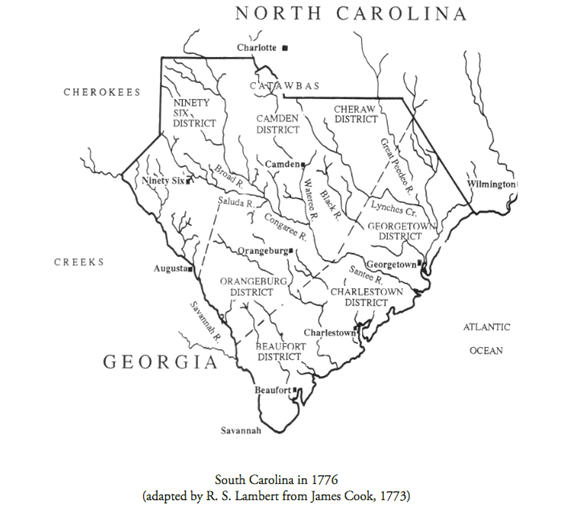
Appendix B
A CIRCULAR LETTER
TO THE COMMITTEES IN THE SEVERAL DISTRICTS
AND PARISHES OF SOUTH CAROLINA
CHARLES TOWN, June 30, 1775
FELLOW-CITIZENS: — This year will be a grand epoch in the history of mankind. In this conspicuous and ever memorable year, America has been abused and Britain has disgraced herself in an unexampled manner. All the guilt of all the English Ministers of State, from the reign of the First William to the conclusion of the late war [Seven Years War] does not equal the guilt that British Ministers have incurred since the latter period. The measure of their iniquity appears now full. They seem fixed in the pursuit of their plan to enslave America in order that they might enslave Great Britain ¾ to elevate the Monarch that has been placed on a Throne only to govern under the law into a Throne above all law. But Divine Providence has inspired the Americans with such virtue, courage, and conduct as has already attracted the attention of the universe and will make them famous to the latest posterity. The Americans promise to arrest the hand of tyranny and save even Britannia from shackles.
In a former letter, we declared to you that there was “but little probability of deciding the present unhappy public disputes by the pacific measures we have hitherto pursued.” Our ideas were just, and with the deepest grief yet firmest resolution we now announce to you that the sword of civil war is not only actually drawn, but stained with blood! The King’s troops have at length commenced hostilities against this continent, and not confining their ungenerous attacks against men in arms defending their properties, they have slaughtered the unarmed — the sick — the helpless — having long indiscriminately oppressed, they have now massacred our fellow-subjects in Massachusetts Bay. Mark the event. . . . [The Battle of Lexington and
Concord is recounted in detail.]
As a first step for our defense, it was thought expedient to unite the inhabitants of the colony “as a band in her defense against every foe,” and to this purpose, on the fourth day of June, immediately after the celebration of Divine service in Congress, an association was signed by all the Members present, solemnly engaging their lives and fortunes. In the space of four days, the association was voluntarily subscribed by almost every inhabitant in Charles Town, and transmitted into the country.[172]
Appendix C
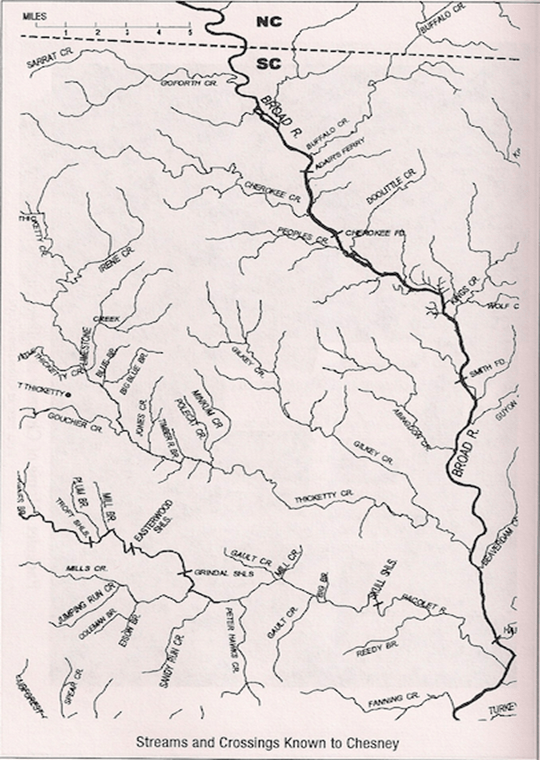
Appendix D
RESOLUTION OF THE LOYALISTS ON PACOLET RIVER,
SOUTH CAROLINA.
We the principle inhabitants of the neighbourhood [sic] of Pacolet River, beholding with the utmost abhorrence and detestation, the dareing [sic] pro-ceedings of those infatuated people, who call themselves committee men, or Liberty boys, feloniously breaking open the houses of his Majesties subject, and thence carrying away Arms, Ammunition, and other warlike stores; as well as putting their persons in confinement, which proceedings must terminate in the ruin and misery, of the poor deluded people themselves.
In order therefore to shew our attachment to our King and country, we promise government and each other, that we will embody ourselves at the shortest notice, to support the rights of the crown, as soon as called by any Legal Authority from hence-[173]
Foot Notes
[1] Piers Mackesy, The War for American 1775-1783. (1st ed. London, UK: Longmans, Green and Co. LTD., 1964), 253.
[2] W. W. Abbot, “The Loyalists in Revolutionary America, 1760-1781. By Robert McCluer Calhoon. New York: Harcourt Brace Jovanovich, 1973.” The Journal of American History 63, no. 4 (March 01, 1977): 1001. doi:10.2307/1893644.
[3] See; Paul David Nelson. William Tryon and the Course of Empire: A Life in British Imperial Service. (Chapel Hill, NC: University of North Carolina Press, 1990).
[4] See; Bernard Bailyn, The Ideological Origins of the American Revolution. (Cambridge: Belknap Press, 1967), 313. Rebecca Brannon, From Revolution to Reunion: The Reintegration of the South Carolina Loyalists. (Columbia, SC: The University of South Carolina Press, 2016), 5-6. Richard D. Brown, Major Problems in the Era of the American Revolution, 1760-1791: Documents and Essays. Major Problems in American History Series. (Boston, MA: Houghton Mifflin College Div, 1999), 229-230, 233-238, 247-254. Robert Calhoon, Timothy Barnes, and George Rawlyk. Loyalists and Community in North America. (Wesport: Greenwodd Press, 1994), 55. Ray Raphael, A People’s History of the American Revolution: How Common People Shaped the Fight for Independence. (New Press People’s History. New York, NY: New Press, 2001), 183-234.
[5] Maya Jasanoff, Liberty’s Exiles: American Loyalists in the Revolutionary World. (New York, NY: Vintage Books, 2011) 23-24. Robert Calhoon, Loyalists and Community in North America, 56-62, 91-102. Rebecca Brannon, From Revolution to Reunion, 15-22.
[6] Jasanoff, Liberty’s Exiles, 24.
[7] Jasanoff, Liberty’s Exiles, 24.
[8] Robert M. Calhoon, Loyalists and Community in North America, 58.
[9] Robert Calhoon, Timothy M. Barnes, and Robert Scott. Davis. Tory Insurgents, 205.
[10] See., Esther Clark Wright, The Loyalists of New Brunswick. (Beaver Bank, N.S., Canada: Justin B. Wentzell, 2008), and Jasanoff, Liberty’s Exiles.
[11] The actual numbers of exiled Loyalists are a hotly debated topic among colonial historians on both sides of the Atlantic. The high number comes from Maya Jasanoff’s 2011 book and the more conservative number is from Rebecca Brannon’s 2016 book. It seems that some of the higher figures fail to account for inconsistences within the Loyalist Claims Commission and other document often records certain individuals’ multiple times. Regardless, the debate continues.
[12] See., Lorenzo Sabine, American Loyalists, or Biographical Sketches of Adherents to the British Crown in The War of the Revolution. (Boston, MA: Charles C. Little and James Brown, 1847).
[13] Paul H. Smith, “The American Loyalists: Notes on Their Organization and Numerical Strength.” The William and Mary Quarterly 25, no. 2 (1968): 259-77.
[14] Robert Stansbury Lambert. South Carolina loyalists in the American Revolution. (Columbia, SC: University of South Carolina Press, 1987), 320.
[15] Robert M. Calhoon, Timothy M. Barnes, and Robert Scott. Davis. Tory Insurgents, 205
[16] For an inkling about the diffusion of Enlightenment ideas amongst the “middling sort” and “common herd.” See; Louis Hartz, The Liberal Tradition in America. (New York, NY: Harcourt, Brace and Company, 1955); Gary B. Nash, The Unknown American Revolution: The Unruly Birth of Democracy and the Struggle to Create America. (Viking Press, New York: NY, 2005).
[17] George Howe, History of the Presbyterian Church in South Carolina. (Columbia: Duffie & Chapman, 1870), 465.
[18] William Pierce to St. George Tucker, August 26, 1781, in Pierce, “Southern Campaign of Greene,” 436.
[19] Robert Stansbury Lambert. South Carolina loyalists in the American Revolution. (Columbia, SC: University of South Carolina Press, 1987), 27.
[20] Banastre Tarleton, A History of the Campaigns of 1780 and 1781, In the Southern Provinces of North America. (London: T. Cadell, 1787), 217.
[21] Richard Hayward, In Praise of Ulster. Edited by James Humbert Craig. (London: A. Barker, 1946), 70-72.
[22] Alexander Chesney, Journal of Capt. Alexander Chesney: Adjutant to Major Patrick Ferguson. Edited by Bobby Gilmer Moss. (Blacksburg, SC: Scotia-Hibernia Press, 2002), 1.
[23] Chesney, Journal of Capt. Alexander Chesney, 3-5.
[24] Peter N. Moore, World of Toil and Strife: Community Transformation in Backcountry South Carolina, 1750-1805. (Columbia, SC: University of South Carolina Press, 2007), 2-4.
[25] Chesney, 6-7.
[26] See; Appendix A and C for a maps of the region’s waterways and the Chesney land holdings.
[27] Chesney, 8-10.
[28] See., Appendix D for the text of the Pacolet Loyalist Association.
[29] Chesney, 12.
[30] Chesney, 12-13.
[31] Chesney, 50.
[32] Ralph Waldo Emerson, The Works of Ralph Waldo Emerson. Edited by George Sampson. Vol. 1. (London, ENG: G. Bell, 1914), 360.
[33] Chesney, 13.
[34] Chesney, 13.
[35] Chesney, 15.
[36] Chesney, 15.
[37] Chesney, 17.
[38] Chesney, 17.
[39] Buchanan, The Road to Guilford Courthouse: The American Revolution in the Carolinas. (Hoboken, NJ: John Wiley, 1999), 72.
[40] Chesney, 20.
[41] Chesney, 21.
[42] Chesney, 21.
[43] Buchanan, The Road to Guilford Courthouse, 212-224.
[44] Babits, A Devil of a Whipping, 14-15.
[45] James Potter Collins and John M. Roberts, A Revolutionary Soldier. (New York: Ayer, 1979), 26.
[46] Tarleton, A History of the Campaigns of 1780 and 1781, 165.
[47] Uzal Johnson. Captured at Kings Mountain: The Journal of Uzal Johnson a Loyalist Surgeon. Edited by Wade S. Kolb, Robert M. Weir, and Ann H. Weir. (Columbia, SC: University of South Carolina Press, 2011), 29-31.
[48] Johnson. Captured at Kings Mountain, 32.
[49] Chesney, 34.
[50] Chesney, 35-38.
[51] Chesney, 39.
[52] Chesney, 39.
[53] Chesney, 39.
[54] Chesney, 39; and Bobby Gilmer Moss. Roster of South Carolina Patriots in the American Revolution. (Baltimore, MD: Genealogical Publishing, 2006), 451, 630.
[55] Chesney, 39-41.
[56] Chesney, 40-47.
[57] Chesney, 47; and Rebecca Brannon, From Revolution to Reunion: The Reintegration of the South Carolina Loyalists. (Columbia, SC: The University of South Carolina Press, 2016), 65.
[58] Chesney, 80.
[59] Moore, World of Toil and Strife.
[60] David Hackett Fischer. Albion’s Seed: Four British Folkways in America. (New York, NY: Oxford University Press, 1989), 605, 697, 717, 723, 765.
[61] William Dollarhide, Map Guide to American Migration Routes, 1735-1815. (Bountiful, UT: Heritage Quest, 2001), 6, 7, 33, 36.
[62] Patrick Griffin. “The People with No Name: Ulster’s Migrants and Identity Formation in Eighteenth-Century Pennsylvania.” The William and Mary Quarterly 58, no. 3 (July 2001): 587-614.
[63] Steven G. Ellis, “The Collapse of the Gaelic World, 1450–1650.” Irish Historical Studies 31, no. 124 (1999), 453.
[64] Celeste R. Ray. Highland Heritage: Scottish Americans in the American South. (Chapel Hill, NC: University of North Carolina Press, 2001), 46-51.
[65] For a more detailed discussion on this topic, see; Nicholas P. Canny, “The Ideology of English Colonization: From Ireland to America.” The William and Mary Quarterly 30, no. 4 (1973): 575-98. doi:10.2307/1918596; David Hackett Fischer. Albion’s Seed, 618-621; and Maldwyn A. Jones. “The Scotch-Irish in British America.” Edited by Bernard Bailyn and Philip D. Morgan. In Stranger within the Realm: Cultural Margins of the First British Empire, 267-97. (Chapel Hill, NC: University of North Carolina Press, 1991).
[66] Rosalind J. Beiler. “German-Speaking Immigrants in the British Atlantic World, 1680–1730.” OAH Magazine of History 18, no. 3 (April 01, 2004): 19-22; Patrick Griffin. “The People with No Name: Ulster’s Migrants and Identity Formation in Eighteenth-Century Pennsylvania.” The William and Mary Quarterly 58, no. 3 (July 2001): 587-614, Alan Taylor. American Colonies: The Settling of North America. (London, UK: Viking, 2001), 289-269; David Hackett Fischer. Albion’s Seed, 608-642.
[67] “Colonel Robert Gray’s Observations on the War in Carolina,” South Carolina Historical and Genealogical Magazine 11, No. 3 (July 1910), 153.
[68] Chesney, 1-2.
[69] See., Jonathan Bardon. The Plantation of Ulster: The British Colonization of the North of Ireland in the 17th Century. (Dublin, IRL: Gill & MacMillan Publishing, 1815).
[70] Robert Middlekauff. The Glorious Cause: The American Revolution, 1763-1789. (New York, NY: Oxford University Press, 1982) 539.
[71] Lawrence Babits, A Devil of a Whipping: The Battle of Cowpens. (Chapel Hill: University of North Carolina Press, 2001), 7.
[72] For a more detailed breakdown of the families within the Grindal Shoals region; see Chesney, Journal of Capt. Alexander Chesney; Moss, Roster of South Carolina Patriots in the American Revolution; Moss, Bobby G. Roster of The Loyalists in The Battle of Kings Mountain. (Blacksburg, SC: Scotia-Hibernia, 1998); and Holcomb. Union County, South Carolina, Deed Abstracts.
[73] Peter N. Moore. “The Local Origins of Allegiance in Revolutionary South Carolina: The Waxhaw as a Case Study.” The South Carolina Historical Magazine, January 2006, 26–41. https://www.jstor.org/stable/27570787.
[74] Chesney, 150.
[75] Chesney, 47.
[76] Chesney. 150.
[77] Chesney. 17.
[78] See Frances & Joseph Gies. Marriage and the Family in the Middle Ages. (New York, NY: HarperCollins, 1987).
[79] John B.O’Neall, and John A. Chapman. The Annals of Newberry South Carolina. (Greenville, SC: Southern Historical Press, 2018), 39. Pursuit details can be found in William Hodge, pension, 20 Apr. 1832, M804, Roll 1295.
[80] Yates Snowden, and Harry Gardner Cutler. History of South Carolina. Vol. 4. (Charleston, SC: South Carolina Historical Society, 1920), 178.
[81] Moss. Roster of South Carolina Patriots in the American Revolution, 495-496.
[82] Cherokee County Historical and Preservation Society Archives; and Moss. Roster of South Carolina Patriots in the American Revolution, 121.
[83] Moss. Roster of South Carolina Patriots in the American Revolution, 121.
[84] Cherokee County Historical and Preservation Society Archives.
[85] Lancaster, PA probate records, Book B, page 126. Will dated 3 Dec. 1762 and probated 27 Jul 1767.
[86] See; Cartledge, G. H., Jessie Julia Mize, and Virginia Louise Newton. Historical Sketches of Presbyterian Churches and Early Settlers of Northeast Georgia. (Athens, GA: University of Georgia, 1960).
[87] Chesney, 17.
[88] Joseph McJunkin. “Memoirs of Joseph McJunkin.” Ed. J.B. O’Neal, The Magnolia (Charleston, SC: 1842-1843), 53; and J.D. Bailey. History of Grindal Shoals and Some Early Adjacent Families. (Gaffney, SC: The Ledger Print, 1927), 54-55.
[89] For a balanced account of the notorious life of Bloody Ban, see; Robert D. Bass. The Green Dragoon: The Lives of Banastre Tarleton and Mary Robinson. (New York, NY: Henry Holt and Company, 1957).
[90] Chesney, 36-37.
[91] Chesney, 36-37, 147.
[92] Thos Cary Johnson. Virginia Presbyterianism and Religious Liberty in Colonial and Revolutionary Times. (Richmond, VA: Presbyterian Committee of Publication, 1907), 13-14.
[93] Chesney, 157. Unpublished records on Coleman and Draper families by Suzanne W. Watt, & Coleman Family Data in Gilead Baptist Church Clerk’s Records.
[94] John Frederick Dorman, The Virginia Genealogist, Vol. 5, (Washington, DC: J. F. Dorman, 1961), 350.
[95] Chesney. 157. Unpublished records on Coleman and Draper families by Suzanne W. Watt, & Coleman Family Data in Gilead Baptist Church Clerk’s Records.
[96] Bernard Bailyn. “Appendix. The Losers: Notes on the Historiography of Loyalism.” In The Ordeal of Thomas Hutchinson, 383-408. Cambridge, Mass: Belknap Press of Harvard University Press, 1976.
[97] Chesney, 138, 150, 157. Unpublished records on Coleman and Draper families by Suzanne W. Watt, & Coleman Family Data in Gilead Baptist Church Clerk’s Records.
[98] Chesney,10.
[99] William Tennent, Journal of William Tennent: 1740-1777. (University of South Carolina Libraries. May 2007), 8.
[100] Buchanan, 93-95; and Chesney, 88.
[101] See; William M. Dabney and Marion Dargan. William Henry Drayton and the American Revolution. (Albuquerque, NM: University of New Mexico Press, 1962).
[102] Chesney, 89.
[103] William Henry Drayton, Memoirs of the American Revolution: From its Commencement to the Year 1776, Inclusive, as Relating to the State of South-Carolina, and Occasionally Referring to the States of North-Carolina and Georgia. Compiled by John Drayton. (Charleston: A.E. Miller, 1821), 226-228.
[104] See; Appendix B for the full text of the Whig association.
[105] Buchanan, 94.
[106] Buchanan, 94; and Chesney, 89.
[107] See., Leah Townsend, South Carolina Baptists, 1670-1805. (Florence, SC: University of South Carolina, 1935), 4, 6, 17, 43, 46, 89, 90, 92, 120, 178, 186, 187, 201, 214, 242, 249, 294.
[108] Charles Woodmason. The Carolina Backcountry on the Eve of the Revolution: The Journal and Other Writings of Charles Woodmason, Anglican Itinerant. (Chapel Hill, NC: University of North Carolina Press, 1953), 12, 31, 52; Carl Bridenbaugh. Myths and Realities: Societies of the Colonial South. (Baton Rouge, LA: Louisiana State University Press, 1952), 177; and Emma Bell Miles. The Spirit of the Mountains. (Knoxville, TN: University of Tennessee Press, 1975), 137.
[109] Tennent, Journal of William Tennent, 8.
[110] Howe, 602.
[111] Tennent, 8.
[112] Tennent, 8-9.
[113] Moss, 894.
[114] Tennent, 9.
[115] Tennent, 10.
[116] Chesney, 127-128. Moses Kirkland, was a prosperous planter and owned 11,460 acres in the Ninety Six District. Kirkland was also leading member of the Regulator movement (1765-1771) and a member of the Provincial Congress. Kirkland was then appointed to form a regiment of ranger, but after the 24th of August encounter with Drayton, he became an ardent Loyalist. Along with Maj. Robinson, Kirkland managed to get 5,000 signatures from the surrounding region declaring their support for the King. He would go on to serve in multiple roles on the Loyalist side and fight in the majority of the engagements along the Georgia-South Carolina border until the British evacuation of Charlestown in 1782.
[117] Chesney, 151. Thomas Brown was the son of wealthy British merchant named Jonas Brown. Jonas had bought his son 5,600 acres in Georgia/South Carolina backcountry. Arriving in 1774, Brown had brought seventy-five indentured servants and owned a number of slaves. In 1775, a group of men from the Sons of Liberty confronted Brown in order to have him sign an oath of allegiance to the Whigs. During the ensuing argument Brown shot the leader of the Whigs in the foot. After a brief struggle, Brown was tied up and the Whigs burnt the soles of his feet in reparation for his actions and left to die. However, a Whig doctor took petty on Brown and he set him free. Brown then fled Georgia for South Carolina after being tortured and nearly killed by. From 1776 through to 1781, “Burnt Foot Brown,” would lead the King’s Carolina Rangers in a bloody campaign that culminated in seventeen major engagements across the backcountry.
[118] Tennent, 10.
[119] Drayton, Memoirs of the American Revolution, 157, 230.
[120] Drayton, 221.
[121] Drayton, 222.
[122] Buchanan, 97-99; and Chesney, 90-91.
[123] Chesney, 11-12.
[124] David Ramsay. The History Of The Revolution Of South Carolina: From A British Province To An Independent State. Vol. I. (Trenton: Collins, 1785), 260.
[125] See; For a more detailed examination of the complex webs of inter-marriage by the families residing within the Grindal Shoals community, see; see Chesney, Journal of Capt. Alexander Chesney; Moss, Roster of South Carolina Patriots in the American Revolution; Moss, of The Loyalists in The Battle of Kings Mountain; and Holcomb. Union County, South Carolina, Deed Abstracts.
[126] Moore, World of Toil and Strife, 7-8.
[127] See; William Blackstone. Commentaries on the Common Law of England. Vol. 1. 4 vols. (Chicago, IL: University of Chicago, 1979), 152, William L. Shea, The Virginia Militia in the Seventeenth Century. (Baton Rouge, LA: Louisiana State University Press, 1983), 1-4, and Robert Hardy. Longbow: A Social and Military History. (London, UK: Lyons Press, 1993), 128-129.
[128] See; Rachel Foxley. The Levellers: Radical Political Thought in the English Revolution. (Manchester, UK: Manchester University Press, 2014), 120, and Marcus Cunliffe. Soldiers and Civilians: Martial Spirit in America, 1775-1865. (New York, NY: Little, Brown and Company, 1968), 32.
[129] John R. Galvin, The Minute Men: The First Fight: Myths and Realities of the American Revolution. (Washington, D.C.: Pergamon-Brassey’s International Defence Publishers, 1989), 30-31.
[130] Briton Cooper Busch, Bunker Hill to Bastogne: Elite Forces and American Society (Washington, DC: Potomac Books, 2006), 53.
[131] Kemp to Commissioners May 17, 1635, Colonial Office Series. 1/8, f. 167. National Archives, London. https://www.nationalarchives.gov.uk/
[132] Titus, James. The Old Dominion at War: Society, Politics and Warfare in Late Colonial Virginia. (Columbia, SC: University of South Carolina Press, 1991), 16, 28-39, and Shea, The Virginia Militia in the Seventeenth Century, 54-56.
[133] Lawrence Delbert Cress’s work, Citizens in Arms, is the seminal study of the impact of English Radical Whig ideas concerning the central role of the militia within a constitutional republic and the hazards inherent to a standing army, also see; Leon Friedman. “Conscription and the Constitution: The Original Understanding.” Michigan Law Review 67, no. 8 (1969), and David Yassky. “The Second Amendment: Structure, History, and Constitutional Change.” Michigan Law Review 99, no. 3 (2000): 588-668.
[134] Shea, 105.
[135] Chesney, 63.
[136] Chesney, 5; Moss, Roster of South Carolina Patriots in the American Revolution, 167; and Holcomb. Union County, South Carolina, Deed Abstracts, 413-414, 262-263, 370.
[137] See., Ludwig Von Mises. Human Action: A Treatise on Economics. Edited by Bettina B. Greaves. (Indianapolis, IN: Liberty Fund, 2014).
[138] Leonard J. Trinterud, The Forming of an American Tradition: A Re-examination of Colonial Presbyterianism (Louisville, KY: Westminster Press, 1949), 10-117.
[139] Trinterud, The Forming of an American Tradition, 118, 122.
[140] Mark A. Noll. Old Religion in a New World: The History of North American Christianity. (Grand Rapids, MI: Eerdmans, 2002), 51.
[141] Alan Heimert. Religion and the American Mind: From the Great Awakening to the Revolution. (Cambridge, MA: Harvard University Press, 1966), ix, viii.
[142] Trinterud,164. Francis Alison, John Dickinson, and George Bryan. The Centinel: Warnings of a Revolution. Edited by Elizabeth I. Nybakken. (Newark, DE: University of Delaware Press, 1980), 20-23.
[143] Jerald C Brauer, ed. Reinterpretation in American Church History. (Chicago, IL: University of Chicago Press, 1968), 153-167.
[144] Charles Hodge. The Constitutional History of the Presbyterian Church in the United States of America. (Philadelphia, PA: William S. Martien, 1839), 250-253.
[145] Heimert, Religion and the American Mind, 278-79, 537-40, Gordon S. Wood, Creation of the American Republic (Chapel Hill NC: University of North Carolina Press, 1969), 118-119; Mark A. Noll, America’s God: From Jonathan Edwards to Abraham Lincoln. (New York, NY: Oxford University Press, 2005), 53-90, 447-451; and Francis Alison, The Centinel, 20-23.
[146] “Catalog Record: Records of the Presbyterian Church in the United States of America: Embracing the Minutes of the General Presbytery and General Synod 1706-1788, Together with an Index and the Minutes of the General Convention for Religious Liberty, 1766-1775.” | Hathi Trust Digital Library, 1904.
[147] William Smith. Historical Memoirs of William Smith, Historian of the Province of New York, Member of the Governor’s Council, and Late Chief Justice of That Province under the Crown, Chief Justice of Quebec. Edited by William Henry Waldo Sabine. Vol. 2. (New York, NY: New York Times and Arnos, 1969), 278.
[148] See; Lewis Namier. The Structure of Politics at the Accession of George III. (Basingstoke, UK: Macmillan Press, 1957); Harold Perkin. The Origins of Modern English Society. (Abingdon, UK: Routledge, 2015); and Middlekauff, The Glorious Cause, 18-19, 23, 39, 51, 132, 140.
[149] Chesney. 8-9.
[150] Chesney. 8-9.
[151] Chesney. 8.
[152] Robert W. Gibbes, Documentary History of the American Revolution: Consisting of Letters and Papers Relating to the Contest for Liberty, Chiefly in South Carolina, from Originals in the Possession of the Editor, and Other Sources. New York, NY: Appleton, 1853), 128-129.
[153] Robert Higgs. “Regime Uncertainty: Some Clarifications.” Mises Institute. November 12, 2012.
[154] Ramsay, 259.
[155] Ramsay, 251.
[156] Ramsay, 253.
[157] Ramsay, 252-253.
[158] See; Colin G Calloway, White People, Indians, and Highlanders: Tribal Peoples and Colonial Encounters in Scotland and America. (Oxford: Oxford University Press, 2010), 5-7.; Matthew P. Dziennik, “Through an Imperial Prism: Land, Liberty, and Highland Loyalism in the War of American Independence.” The Journal of British Studies 50, no. 02 (April 2011): 332-58. Accessed February 27, 2017. doi:10.1086/658185; and Michael Newton, We’re Indians Sure Enough: The Legacy of the Scottish Highlanders in the United States. (Auburn, NH: Saorsa Media, 2001), 27-28.
[159] Chesney, 17.
[160] Chesney, 15.
[161] Chesney, 17.
[162] Joseph W. Barnwell, “The Evacuation of Charleston by the British in 1782.” The South Carolina Historical and Genealogical Magazine 11, no. 1 (January 1910): 1-26.
[163] Brannon, Rebecca. From Revolution to Reunion, 65.
[164] Eugene R. Fingerhut, “Uses and Abuses of the American Loyalists’ Claims: A Critique of Quantitative Analyses.” The William and Mary Quarterly 25, no. 2 (April 1968): 245-58.
[165] Christopher Sparshott, “Personal Visions of the British Empire: Re-examining the Loyalist Experience at the end of the American Revolution.” (Unpublished paper delivered to the Newberry Seminar on Early American History and Culture, Chicago, 17 November 2005), 4.
[166] Neil Mackinnon, This Unfriendly Soil: The Loyalist Experience in Nova Scotia, 1783-1791 (Montréal; Kingston, ON: McGill-Queen’s University Press, 1986), 183.
[167] Chesney, 177-179.
[168] For an account of Burgoyne’s career after his 1777 defeat at the Battle of Saratoga, see;
Gerald Howson. Burgoyne of Saratoga: A Biography. (New York, NY: Times Books, 1979).
[169] Chesney, 49-57.
[170] See; Sheila L. Skemp. Benjamin and William Franklin: Father and Son, Patriot and Loyalist. (New York, NY: St. Martin’s Press, 1994).
[171] Ludwig Von Mises, Theory and History: An Interpretation of Social and Economic Evolution. (New Haven: Yale University Press, 1957), 309-11.
[172] Robert W. Gibbes, Documentary History of the American Revolution, 107–116.
[173] Chesney, 194.
 Tempestuous Seas of Liberty