Samuel de Champlain was able to maintain close relations with many Indian nations while he founded permanent European colonies in the new world. He lived among the Indians and spent much of his time with them, while he also helped to establish three francophone populations and cultures…Québécois, Acadien, and Métis
Fischer, David Hackett. Champlain’s Dream: The European Founding of North America. (New York, NY: Simon & Schuster, 2008), 528 .
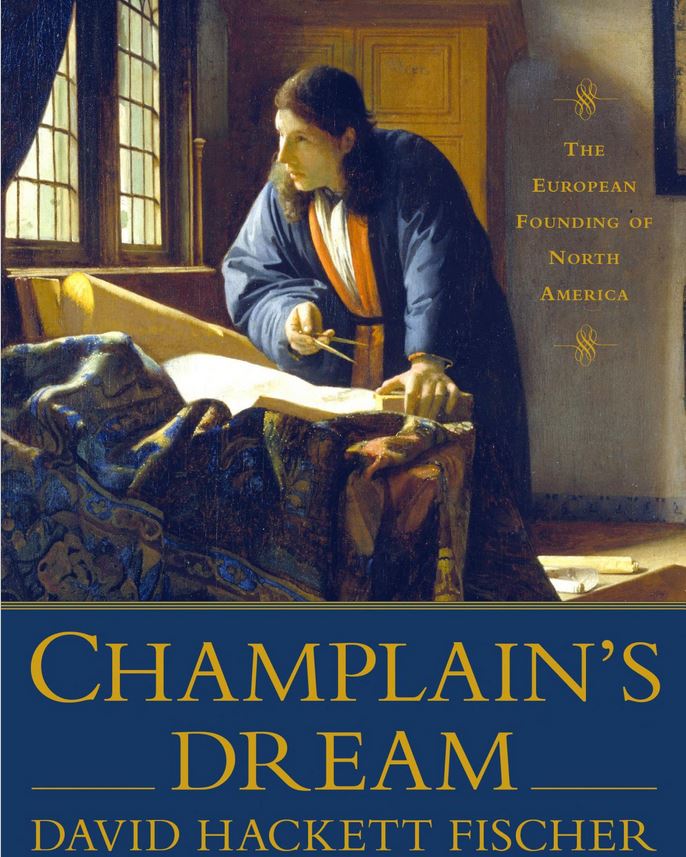
Following in the footsteps of the most venerable Admiral Morison,[1] virtuoso of captivating historical narratives, David Hackett Fischer, adjusts his gaze towards an often-disremembered founder of the French colony that would become the amenable nation of Canada. Within Champlain’s Dream: The European Founding of North America, Fischer recounts a compelling biography written in an engaging style that vividly brings to life the great men narrative in the saga of Samuel de Champlain and his astonishing deeds during the Age of European Discovery. Fischer also blends into the book all of the social complexities and human intrigues that occur when sundry people groups encounter one another for the first time. In narrating the remarkable life of one of the most stimulating figures within the early colonial period, Fischer takes the reader along with Champlain on his epic journeys of discovery in exploring the vastness of the North American continent, as well as his genuine encounters with the diverse aboriginal tribes of the North East. Fischer’s narrative stands as a formidable counter to ceaseless presentist diatribes of recent scholarship and stands as an electrifying example of the path not taken that frequently confronts the ardent student of history. Indeed, the authority of Fischer’s work is centred upon painting a stimulating mental portrait that is tangible and corporeal with a cinematic flair. That narrative is further enhanced by Fischer’s incorporation of vibrant imagery in the form of maps and sketches, as well as a robust compendium of source-material within the considerable appendices. As a whole, the book is a realistic portrayal of Champlain that is neither overtly romanticised nor maligned. Though impartially sketched, Fischer seems to smooth over the rougher portions of Champlain’s nature, which undercuts the objective narrative of the book.
Assertive in his expertise, Fischer pursues a storyline that permits the reader to visualise what Champlain thought and experienced, even though there are scant records; apart from Champlain’s own accounts. Fischer is forthright in admitting that he is telling the story of an elusive silhouette that is only faintly discernible within the historical record. Accordingly, Fischer is compelled to employ historical inference and a touch of praxeology to reconstruct this elusive historical actor. In spite of the limitations, Fischer, exerting a firm control of the sources, describes the echoes of that world with touches of humour and sensory details to lure the reader towards his central argument, that Champlain was, at his core, a humanist. While Champlain’s worldview clearly contained elements of humanism, his thoughts and actions are very much convoluted; a point that Fischer only mentions in passing. Nevertheless, Fischer attempts to strike an equilibrium, by forthrightly acknowledging Champlain’s deficiencies and predispositions while also recognising his achievements and the philosophically consistent portions of his character. Fischer achieves this end by concentrating upon the history of Champlain in three portions. Namely, Champlain’s idealist dream for New France, his forthright attempt at a blending of peoples, and his extraordinary resolve to bring about the potential of New France.[2]
The text hardly conceals Fischer’s admiration of Champlain as a humanist, in his words a cutting-edge figure “who inherited the Renaissance and inspired the Enlightenment.” Fischer’s Champlain infused his worldview with Biblical teachings that fostered “ideas of peace and tolerance” where all persons “possessed an immortal soul.” The coalescing of these forces fostered within Fischer the observation that Champlain believed in a “common humanity,” which “lay at the heart of Champlain’s dream.”[3] Central to Fischer’s argument, he expounds, at great length, upon Champlain’s disposition towards the aboriginal tribes that he pursued “with humanity and respect” with “straight words and equitable dealing.”[4] Richly illustrative, Fischer chronicles the explorer’s interaction with these heterogeneous tribes of the St. Lawrence River valley. From Champlain’s writings, Fischer asserts that Champlain possessed a significant degree of respect and sympathy for the aboriginal peoples that was quite unusual for the age. Nonetheless, Champlain did have frequent moments when he articulates severe criticism of those peoples. Particularly of the native for their enthusiastic mutilation of captives from enemy tribes during ritual torture and their propensity to bend the truth to its breaking point, as well as some of their domestic habits. That notwithstanding, Fischer assures the reader that Champlain is magnanimous towards what he observes because his sympathetic approach is an outgrowth of his humanism. Yet, Fischer candidly tells the reader, without any detail, that Champlain offered these aboriginal peoples more leniency and respect than he ever accorded the common French tradesmen or labourer.
Despite all the book’s excellence, the glaring fly in Fischer’s ointment is Champlain’s contradictions that he acknowledges only in mere passing without regard to its implications for the overarching thesis. It seems that Fischer was too keen to overlook Champlain’s open disdain for Les Misérables: le paysan ignorant, les marchands rusés, le matelot costaud, et le fermier sale, as well as his domineering affinity for ingénierie sociale with complete subservience to the arbitrary rule of Roi Très-chrétien. While the author of this review will not go so far as to take the presentist positions of other historians,[5] these genuine contradictions call into question the foundations of Fischer’s religious humanist narrative. Not to mention, Champlain’s propensity to play one tribe off another in order to maintain the French hegemony in the fur trade and politically within the region. To reveal these inconsistencies, one must ask the question: How can one have a particular affinity towards aboriginal peoples of the New World but scorn the lowly classes upon which the Old World was built?
Perhaps, in this instance, the esteemed historian has allowed his deep admiration for such a unique historical actor cloud his better judgment, which paints an exceedingly compassionate portrait of the Champlain that is not prudently moderated. Indeed, Champlain’s worldview is not consistent with Biblical teachings nor with those of the burgeoning Enlightenment, both of which were imperfectly enshrined as the founding principles of the nation south of the St. Lawrence River valley.[6] By interpreting Champlain as a nearly unsullied humanist that was dreaming of a new world wherein he could create the conditions that would foster a community grounded in those principles,[7] Fischer seems to be injecting his own values, which make it difficult to discern whether one is offered an authentic portrait of Champlain or merely Fischer’s own ideals overlaid upon him. Thus, the dividing lines between Fischer and Champlain become blurred within the narrative, which is challenging for the reader to untangle. Fischer’s admiration of Champlain is clearly palpable in his lecture on the book at his beloved College of the Atlantic.[8] However merited, this lack of adherence to the historian’s mandate of strict objectivity distorts the truth of Champlain’s legacy. A point that Fischer stresses within his book concerning historian’s fallacies.[9]
Challenging a historian of such esteem and gravitas as Fischer in any meaningful way is a significant undertaking that the author of this transitory review does not have the hubris to undertake. Nevertheless, the aforementioned critique are prudent and Fischer’s problematical narrative obscures his genuine attempt to honour Champlain’s achievements. In spite of that negligible reproach, Fischer’s absorbing story contests the progressive trend of revisionist presentist who view the world through an ominously disparaging prism. Fischer has the mature certitude of a seasoned historian with diminutive anxiety towards inconsequential scholarly reviews. His exceptional scholarship on Champlain, working in conjunction with Admiral Morison’s work, will curtail the hordes of petty detractors, leaving them to grapple over the minuscule details.
Fittingly, Fischer’s has penned a stable, erudite, but accessible coup de maître. Throughout Samuel de Champlain’s adventurous life, Fischer has artfully painted a meticulous portrait of a central historical actor in the multidimensional story of the French attempt to colonise the St. Lawrence River valley. More importantly, Fischer judges that Champlain’s life and measured actions reveal noteworthy lessons for our own age of tribulation. Accordingly, one must ask whether Champlain’s dream had any chance of succeeding in our fallen world? Undeniably, that is a question that Fischer asks the reader to contemplate. Yet, as C.S. Lewis reminds us, Christianity’s failure is due to adherents focusing on this temporal existence rather than the next. If they concentrated on aiming “at Heaven” they will “get earth ‘thrown in’.”[10] While one could endlessly dispute the legacy of Champlain’s dream, it is without a doubt that Fischer has breathed life into this elusive figure in a manner that will ensure that he will no longer languish in the darkened corners of Canadian history.
Bibliography
Champlain, Samuel De, and Gayle K. Brunelle. Samuel De Champlain: Founder of New France: A Brief History with Documents. New York, NY: St. Martin’s Press, 2012.
Fasel, George. “Samuel De Champlain: Father of New France.” History 1, no. 1 (June 1972): 2. https://doi.org/10.1080/03612759.1972.9954923
Fischer, David Hackett. Historians’ Fallacies: Toward a Logic of Historical Thought. New York, NY: Harper Perennial, 1970.
Fischer, David Hackett. Champlain’s Dream: The European Founding of North America. New York, NY: Simon & Schuster, 2008.
Fischer, David Hackett. “Champlain’s Dream.” Lecture, College of the Atlantic, July 23, 2007. https://www.youtube.com/watch?v=LEcunFHdmBk.
Hall, Mark David. Did America Have a Christian Founding?: Separating Modern Myth from Historical Truth. Nashville, TN: Thomas Nelson, 2019.
Lewis, C. S. Mere Christianity. New York, NY: Harper-Collins Publishers, 2001.
Morison, Samuel Eliot. Samuel De Champlain: Father of New France. New York, NY: Little, Brown and Company, 1972.
Nash, Gary B. The Unknown American Revolution: The Unruly Birth of Democracy and the Struggle to Create America. New York, NY: Penguin Books, 2006.
Thompson, C. Bradley. America’s Revolutionary Mind: A Moral History of the American Revolution and the Declaration That Defined It. New York, NY: Encounter Books, 2019.
Welch, Richard E., Jr. “Samuel De Champlain: Father of New France by Samuel Eliot Morison.” The New England Quarterly 46, no. 1 (March 1973). https://doi.org/10.2307/364893.
Foot Notes
[1] The predecessor of Fischer’s narrative is Samuel Eliot Morison’s work, see; Samuel Eliot Morison. Samuel De Champlain: Father of New France. (New York, NY: Little, Brown and Company, 1972).
[2] David Hackett Fischer. Champlain’s Dream: The European Founding of North America. (New York, NY: Simon & Schuster, 2008), 5-7, 36-37, 109, 118, 147, 198, 207-208, 342, 362, 390, 494, 521-522, 524, 529-530, 552, 734-735.
[3] Fischer. Champlain’s Dream, 7, 529, 147.
[4] Fischer. Champlain’s Dream, 118.
[5] See; George Fasel. “Samuel De Champlain: Father of New France.” History 1, no. 1 (June 1972): 2. https://doi.org/10.1080/03612759.1972.9954923, Samuel De Champlain, and Gayle K. Brunelle. Samuel De Champlain: Founder of New France: A Brief History with Documents. (New York, NY: St. Martin’s Press, 2012), and Richard E. Welch, Jr. “Samuel De Champlain: Father of New France by Samuel Eliot Morison.” The New England Quarterly 46, no. 1 (March 1973): 1-2. https://doi.org/10.2307/364893.
[6] For an objective account of the role of Christianity in the American founding, see; Mark David Hall. Did America Have a Christian Founding?: Separating Modern Myth from Historical Truth. (Nashville, TN: Thomas Nelson, 2019). The Judaeo-Christian tradition that was infused with Enlightenment principles during the American founding can be observed in C. Bradley Thompson. America’s Revolutionary Mind: A Moral History of the American Revolution and the Declaration That Defined It. (New York, NY: Encounter Books, 2019). Additionally, the extent to which Lockean ideals proliferated the lower rungs of colonial society can inadvertently be found within Gary B. Nash, The Unknown American Revolution: The Unruly Birth of Democracy and the Struggle to Create America. (New York, NY: Penguin Books, 2006).
[7] Fischer. Champlain’s Dream, 7.
[8] David Hackett Fischer. “Champlain’s Dream.” Lecture, College of the Atlantic, July 23, 2007.
[9] David Hackett Fischer. Historians’ Fallacies: Toward a Logic of Historical Thought. (New York, NY: Harper Perennial, 1970), 4-7, 16-17, 24, 28-29, 36.
[10] See; C. S. Lewis. Mere Christianity. (New York, NY: Harper-Collins Publishers, 2001), 134.
 Tempestuous Seas of Liberty