“By 1775 these four cultures were fully established in British America. They spoke distinctive dialects of English, built their houses in diverse ways, and had different methods of doing much of the ordinary business of life. Most important for the political history of the United States, they also had four different conceptions order, power, and freedom which became the cornerstones of a voluntary society in British America.”
Fischer, David Hackett. Albion’s Seed: Four British Folkways in America. (New York, NY: Oxford University Press, 1989), 6.
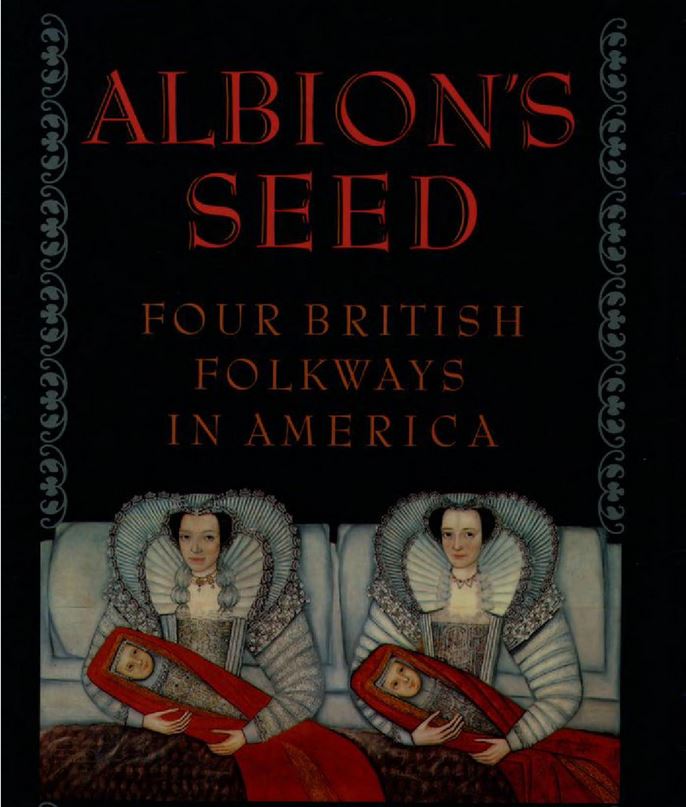
Over thirty years ago, historian David Hackett Fischer endeavoured to assemble a comprehensive, virtually encyclopaedic, atlas of the folk pathways that clearly accentuated the roots of colonial America, which might explain the socio-political culture of the United States as he understood it in 1988. The fundamental argument contained within Albion’s Seed is that, though a small portion of the population today, the culture of those of British antecedent had a significant and lasting effect upon our national temperament. Those cultural legacies were still perceptible in Fischer’s mind, but they were not the outgrowth of some monolithic concept of quintessential Englishness. On the contrary, Fischer observes four predominant folk pathways that reflected the regional uniqueness of the British Isles regarding faith, family, essential principles, and concepts of class that have their origins within the micro societies that comprised the patchwork peoples that inhabited the islands during the seventeenth and eighteenth centuries. For Fischer, the political and cultural foundations of America were solidified during the colonial period by four main swells of immigration from Britain by four distinct groups: The Puritans and Separatists that settled in New England. The Royalist Cavaliers, who populated the Chesapeake Bay and low counties of coastal South. Separating the two was the levelling Quakers in the Middle colonies. The final group inhabited the turbulent backcountry, but they hailed from the violent Borderlands of Britain. According to Fischer, these migrations yielded distinctive regional cultures that held to different folkways that are still faintly palpable in America today. While a significant scholarly achievement in many ways, Fischer’s work lacks depth in many areas and tends to broad brush with his assumptions.
When released in 1989, Albion’s Seed, received a lukewarm reception from academia but was as widely read by ardently curious American bibliophiles. Fischer’s peers generally applauded his boldness in undertaking such a work. At the same time, they also highlighted the narrative’s tendency to generalise and dismiss the contribution of smaller groups of immigrants; not to mention the cultural impact of aboriginals and Africans. These detractors, perhaps correctly, contend that many sections cannot withstand historical muster regarding specific details and conclusions.[1] Indeed, historians tend to bristle at the lack of historical understanding or superficiality that can be observed within some portions of the narrative. Despite the many merits of Fischer’s book, the author of this fleeting review can relate to this accurate and prudent criticism.
Fischer’s chronicle concerning the origins of the peoples found within the chapter entitled “Borderlands to the Backcountry,” was as sensitive and detailed as an English government-approved secondary school textbook. Being significantly intimate with the dense, intricate, and tempestuous history of specific regions within the British Isles, the author greatly chafed while reading Fischer’s narrative. In this section, Fischer paints with offhand brush strokes that lack nuance and are too wide-ranging as he galloped through thousands of years of elaborate history that shaped these peoples in fundamental ways, which he seemingly fails to prudently appreciate. Indeed, Fischer’s nonchalant approach to the formative history of these sundry peoples almost occasioned the author to launch into a detailed clarification of Fischer’s account. Not wanting to overburden the reader, the author has dampened his passions and will suffice to recommend that one must always seek the truth, as well as to approach such sweeping narratives with the appropriate amount of trepidation even if they are the product of an esteemed historian such as Fischer.
While, in the conclusion, Fischer does admit the limitations of his narrative in this regard, he then goes on to claim that such detail is not pertinent to the multifaceted themes within his book. Such an assertion is perplexing considering that one of the central themes of the book is to demonstrate the continuity of socio-political beliefs across time. To address the problematic portions of the text, it might have been more prudent for Fischer to divide these three regions into separate books wherein he could have done his due diligence by providing an appropriate amount of detail to support his overarching conclusions within each section. Though, that approach also neglects to factor in the multifaceted cultural interactions that continually occur when diverse peoples become intermingled. Hence, Fischer’s work in many ways stands as an example of the inherent dangers of crafting such sweeping historical narratives. Even the great six-volume work of the venerable Edward Gibbon does not escape reproach for falling prey to the necessity to generalise certain portions. Thankfully, Fischer’s interests and keen intellect steered him elsewhere, leaving the other two proposed volumes of this series to never be realised.
Fischer’s Albion’s Seed does have its demerits, Fischer has genuinely laboured to bring forth a scholarly narrative that utilised a plethora of sources to support his thesis. Even if many historians are made uncomfortable by portions of the book, his work has become a classic on many levels. Colin Woodard’s book, American Nations,[2] is a primary example of Fischer’s lingering influence within the popular American mind, as pundits attempt to use his thesis to explain modern voting habits or regional temperaments. Though, Fischer might disagree with how the book has been utilised since its publishing. Nevertheless, the work does give us a starting point as we seek to discover the truth about who we are, as Americans. Our national fabric is one that is intricately woven from the threads of many cultures and peoples. Fischer’s work has drawn our attention to a diminished and tattered portion of that national tapestry. Though threadbare, the faded colours of those four immigrations are still weakly discernible within our national character and we are still a nation with conflicting views on liberty. Thus, as Fischer underscores in the book, we are an amalgamation of cultures that are constantly churning as we sometimes violently wrangle over the definition of human freedom.
Bibliography
Fischer, David Hackett. Albion’s Seed: Four British Folkways in America. New York, NY: Oxford University Press, 1989.
Greene, Jack P. “Reviewed Work: Albion’s Seed: Four British Folkways in American History by David Hackett Fischer.” Journal of Social History 24, no. 4 (Summer 1991): 909-11. Accessed February 20, 2021. https://www.jstor.org/stable/3788888.
Joyner, Charles. “Reviewed Work: Albion’s Seed: Four British Folkways in America by David Hackett Fischer.” The Journal of American Folklore 105, no. 416 (Spring 1992): 238-40. Accessed February 20, 2021. https://doi.org/10.2307/541094.
Rutman, Darrett B. “Reviewed Work: Albion’s Seed: Four British Folkways in America by David Hackett Fischer.” The American Historical Review 96, no. 1 (February 1991): 254-55. Accessed February 20, 2021. https://doi.org/10.2307/2164202.
Woodard, Colin. American Nations: A History of the Eleven Rival Regional Cultures of North America. New York, NY: Viking, 2011.
Foot Notes
[1] See; Jack P. Greene, “Reviewed Work: Albion’s Seed: Four British Folkways in American History by David Hackett Fischer.” Journal of Social History 24, no. 4 (Summer 1991): 909-11, Charles Joyner. “Reviewed Work: Albion’s Seed: Four British Folkways in America by David Hackett Fischer.” The Journal of American Folklore 105, no. 416 (Spring 1992): 238-40, and Darrett B. Rutman, “Reviewed Work: Albion’s Seed: Four British Folkways in America by David Hackett Fischer.” The American Historical Review 96, no. 1 (February 1991): 254-55.
[2] See; Colin Woodard. American Nations: A History of the Eleven Rival Regional Cultures of North America. (New York, NY: Viking, 2011).
 Tempestuous Seas of Liberty