I was desirous to have a stroke at Tarleton– my wishes are gratified and have given him a devil of a whipping…
General Daniel Morgan to William Snickers, 26 January 1781

National Portrait Gallery
When considering the sordid history of the American militia, one finds a complex and sundry patchwork of colonial traditions that historians have struggled to untangle from the modern debates surrounding the institution. Despite the charged atmosphere surrounding the militia, it is evident that the organisation served an important socio-political function that fostered a sense of duty, charity, and interdependence within local communities, as well as providing a conduit for social mobility for marginalised males. With that said, John Shy appropriately emphasises in his essay, “A New Look at Colonial Militia,” that militias were complicated institutions, which had important variations between the different colonies.[1] Undeniably, the militias of New England have long been the subject of much attention by historians and the minutemen are deeply rooted in the American Founding mythos. Yet, as Shy points out, there were stark differences such as the fact that Quaker dominated Pennsylvania scarcely had a discernible militia before 1747 when the Associators were formed[2] or Virginia’s often dysfunctional and socially stratified militia.[3] Consequently, one must be cautious when making any generalisations that might be observed as a common militia experience that could be applied to colonial society, as a whole, before the Whig Committees of Correspondence galvanised popular resistance against the arbitrary rule of the Metropolis.
Given the modern connotations surrounding the concept of a militia and professional military historians’ less than objective criticism of the long-deceased institution, one is often left with the perception that the militia was not an integral part of colonial life. Though a bit dated, the bulk of the secondary source information is fairly numerous due to the extensive scholarship of the period, which is due to the fascination with the topic by scholars seeking to prove or debunk the significance of the role of the militia as an institution. Despite the amount of scholarly work on the militia, the majority of the works fall into three vehemently opposed camps. Namely, the derogatory progressive tradition that advances the views primarily held by Washington and the personalities that would eventually form the Federalist Party. These centralising nationalists disparaged the militia in favour of a standing army so that the War for American Independence could be fought in a continental fashion.[4] Sadly, this group of historians fails to consider that such a strategy would have played to the strengths of the British Army and negated the “genius” of the American preference for irregular tactics to which the militia was naturally suited.[5] On the opposite side of the debate, are those historians that charge, full tilt, into the idea that the militia was the core of the American war effort and was engaged in most of the day-to-day fighting. This camp sees that militia as playing a significant role in soundly defeating British regulars, Hessian hirelings, and the King’s Friends with scant assistance of the regulars.[6] The next group of more recent historians merely consider the militia as an extension of America’s peculiar institution.[7] This assertion, of course, fails to consider that the militia was an institution that pre-existed slavery within the colonies. The roots of the English concept of militia have been effectively demonstrated that its origins are firmly cemented within the Saxon Fyrd and has its statutory lineage within the Middle Ages,[8] as well as a consequence of the political struggles that resulted in the Glorious Revolution.[9] Contending for a voice amongst the tumult are a few balanced histories that paint a more accurate portrait of the militia that will be utilised to even out the discrepancies of the other three groups.[10]
Naturally, the truth of the matter always rests somewhere in-between the opposing sides. The key to unravelling the tangled web of history is to remain objective and ardently seek to separate Truth from the myth; as best one can. The historical reality is that the American War of Independence was won in the South by a combination of a modest core of Continental regulars under the leadership of General Nathanael Greene, who was buttressed by a substantial number of continually rotating militia units. Moreover, it was Greene’s ability to learn the lessons as demonstrated by Daniel Morgan concerning the prudent employment of militia that sealed Lord Cornwallis’s fate during the race to the Dan River and at the Battle of Guilford Courthouse (March 15, 1781). All the while, Washington and his glorious Northern Army impotently plotted to retake Manhattan. [11] As aforementioned, if one takes into account all sides of the argument, one often finds that the truth of a historical event lays somewhere in the middle. Thus, an ardent seeker of Truth should endeavour to demonstrate fact and attempt to pierce the partisan haze to reveal as much of the past in its truest form as is possible.
With the contentious nature of the scholarship in mind, by forthrightly examining the militia system within colonial Virginia, one observes that the militia served an important social role within colonial society apart from a purely defensive function. Indeed, the majority of colonial militia statutes held that the common militia had to perform other civic duties within their communities, such as Christian charity or working on communal construction projects. Even elite volunteer militias, such as the snowshoe men of the United Colonies of New England, were not exempt from the building of local bridges as the proposed 1757 Massachusetts legislation for the creation of the Picket Guards demonstrates.[12] This tradition of community service continued into the nineteenth century with the formation of state-sanctioned volunteer militias. Briton Busch details this linkage by recounting that militias “helped their communities celebrate festivals, holidays, and funerals with marches, balls, and banquets, helping out in emergencies and often building an esprit de corps which established a basis for effective wartime service and even elite reputations.”[13] Busch and other’s research has touched upon the importance of examining the socio-political elements that are inherent to the militia as an institution, which is an oft-neglected topic of study.
Intricately linked with these communal obligations, was the central political role that the militia performed. Principally, the militia served as a check on the power of government at the local level. While this political function was partially an unintended consequence of the tempestuous conditions within the New World, a succession of Royal governors would be taught the lesson that a general diffusion of arms meant that they only ruled by the consent of the governed. In 1635, Governor John Harvey was compelled to learn the hard way when his unpopular rule was put to an end by the Virginia militia, who wished the arrogant government appointee to “know wee have armes.”[14] This was the political situation on the eve of The Seven Years War. Indeed, The Old Dominion’s governor during that period, Robert Dinwiddie, eventually decided to create a select militia that would become the Virginia Provincial Regiment as a direct result of those political realities and as a consequence of the social pressures inherent within a society where those that were enfranchised maintained a considerable ability to demonstrate their dissatisfaction with the government because they were well-armed. This reality in turn prompted the great men within the House of Burgesses to be more discretionary with their policies in order to maintain the largess that their political office afforded.[15] It seems the spectre of Nathaniel Bacon’s anarchic rebellion still stalked the dark corners of the minds of Virginia’s gentry. Thus, the militia was an essential check on abuse of government,[16] which highlights its integral social aspects, as well as its political importance at the local level.
The other social aspect of the militia that has received little attention is the role of patronage. While patronage existed in some form across the colonies, the august David Hackett Fischer demonstrates within the problematic but thought-provoking work, Albion’s Seed, that the Old Dominion developed a more aristocratic social order that was distinct from the other colonies.[17] It was within this deferential sociality where patronage flourished to a larger degree than any of the other colonies. A common practice in Europe, linkages of patronage bound individuals and groups of families together through religious, social, political, and economic enterprises. Through a system of inequality, to one degree or another, patrons and their dependents trusted one another to represent their combined interests accurately. Lewis Namier and Harold Perkins maintain that system of patronage was altered within the English American Colonies. Unlike the Bourbon controlled Continent, the English colonial system was more democratic, where men were not united by allegiance to a class but by common interests. This system of patronage incorporated a common political stance, the correct religious affiliation, familial bonds facilitated through marriage, and interconnected business interests that served to bind individuals together in a series of interlocked societal links. This alternate patronage system was a social order built upon personal contacts, where relationships were made between those judged to have the proper pedigree, which indicated that a person could be trusted with economic and familial bonds.[18]
Once one comprehends the nature of this system, even as it was breaking under the strain of the American experience, then the picture becomes more transparent as to why those of “cruder” backgrounds would choose to seek patronage within the ranks of the militia. Accordingly, it is prudent to succinctly examine the socio-political nature of the militia within colonial Virginia regarding the role of patronage that was an outgrowth of the social order that was transported to that colony from Southern England. Moreover, by utilising the vignette of Daniel Morgan, one will observe that the Virginia militia served a vital function that enabled the “common herd” to raise themselves into the middling ranks and beyond. While Dinwiddie’s Virginia Provincial Regiment dominated the military policy during The Seven Years War, the middling militias retained their moral authority, social prestige, and political significance. Consequently, by examining the underlying principles of the Virginia militia, avenues of patronage, and the after-action report (AAR) from the Battle of Cowpens one might shed light upon the possible motivation for why Morgan eventually adopted a nationalist political philosophy, which caused him to diminish the accomplishments of the militia in favour of Continental regulars.

Daniel Morgan, Patronage, & The Militia
In order to narrow our focus on this topic, one must leap forward in time to the final years of the American War of Independence. This time shift is necessary due to the dearth of pre-war writings by Morgan on the militia. Morgan was illiterate for a significant portion of his adult life until the period when he began his social ascension into the middling sort, which enabled him to move into the ranks of the Virginia militia.[19] While the shift brings us ahead in the timeline, the debate in which Morgan was engaged had raged since the earliest days of the colonial settlement and continued well into the period just before the War Between The States when John C. Calhoun adopts the Moderate Whig argument to advance the need for a large standing army.[20] Accordingly, the debate over the militia is quintessentially American in nature, given the rough frontier conditions of the colonies that enabled the institution to flourish, and one that continues into our own rancorous era.
To begin our period jockeying saga, it is prudent to initiate this exploration with Morgan’s account of the Battle of the Cowpens (January 17, 1781) in order to properly frame the historical context. Prominent archaeologist and historian Lawrence Babits points to the battle as that starting point of a series of strategic moves that set the stage for an American victory over the British during the American War of Independence. Yet, what we know of the actual battle originates from the AAR as written by the commanders of each opposing side, as well as scattered accounts that were written years after the battle in the early nineteenth century. [21] While both reports by the opposing commanders are primary sources for the battle, one does note that both officers wrote accounts that served to further their particular historical narrative, which demonstrates each commander’s desire to curry favour with their superiors in order to maintain links of patronage. Moreover, Morgan’s account plays into the protracted trans-Atlantic debate between Moderate and Radical Whigs over the role of the militia versus a standing army.
For instance, the British commander at Cowpens, Lieutenant Colonel Banastre Tarleton, in his official report to General Cornwallis inflated the American troop strength to 1,900 in order to partially explain his overwhelming defeat, as well as to hide his own impetuous conduct from Lord Cornwallis. Not stopping there, Tarleton went further to state that his force had killed 300 Americans in the battle and twice as many wounded.[22] In actuality, however, the Americans only suffered an estimated 148 casualties.[23] When attempting to understand the conflicts within these two accounts, historians Lawrence Babits and Bobby Moss, utilising pension records from 1810, 1818, and 1823, happened upon a discrepancy that casts doubt over both of the official accounts of the engagement.[24] Armed with these insights into the battle sequence, Babits, building on the work of Moss, attempted to reconstruct an accurate portrait of the battle by combining all the available sources into a cohesive narrative that accounts for the variations in the written records.
While Babits’s reconstruction of the battle is nearly beyond repute, his overall thesis about why General Daniel Morgan wrote the AAR report in the way he did is problematic. Babits asserts that Morgan may have been advancing an argument for standing army by purposely neglecting to mention the militia numbers or casualties within his report to Major General Nathanael Greene. Furthermore, Babits posits that Morgan held the militia in contempt akin to other Continental Army officers, like General Washington.[25] Babits concludes that Morgan wrote his account in such a way to enhance the glory of Continental regulars at the expense of the militia, which might compel the Southern States to fund more infantry regiments rather than depending on the militia for their defence.[26] However, Babits’s thesis can be contested by points made in his own work and by considering Morgan’s character throughout his life, evidence from his militia service, how he employed his rifleman, and by considering his nationalistic aspirations that intrinsically hitched his wagon to the Federalist cause.[27] North Callahan, Don Higginbotham, and Albert Zambone[28] have produced authoritative and extensively researched accounts of Morgan’s life that highlight the fascinating contradictions concerning his thoughts on the role of the militia, which stem from his desire to maintain links of patronage within the burgeoning political system of the newly forged United States that would secure his social position.
When attempting to reconcile the varying accounts of a historical event, one cannot assume that one side is dishonest or purposefully altering their account. Instead, one must ask questions about what the varying sources had to lose or gain with their accounts. What interests were at stake? How soon after the event was the source written and who was the intended audience for each account recorded? Next, one must search the source for points of agreement and disagreement between the various contrasting accounts. In order to be of use in understanding a historical event, a source needs to be thoroughly examined and questioned. With that in mind, the concept that Babits’s neglected to consider was the context. Babits should have asked the following questions: Under what conditions was Morgan writing this document? Was Morgan in a hasty retreat? How was Morgan’s health? Did Morgan even know how many men were under his command at any given time? Did he use his operational order issued on the night of January 16th to reconstruct an account of the battle for Nathanael Greene? Most importantly, Would Morgan purposely neglect to mention the militia, or was he currying favour with Nathanael Greene’s superior? If so, what were Morgan’s motivations for doing so? Strangely, Babits did answer all these questions in one way or another. But he failed to comprehend how the answers to these questions impacted his thesis and, indeed, might possibly refute it. Thus, the answers to these questions, working in conjunction with the multifaceted role of the militia as an institution within Virginia society, demonstrate that patronage was a determining factor in Morgan’s worldview despite the collective evidence to the contrary.
From Rough Frontiersman to Bold Continental Army Officer
The evidence to counter Babits’s assertion and uncover the links of patronage can be observed in Morgan’s conduct throughout his life. Morgan’s life demonstrates that he was a man who had risen from the “common herd” into the middling ranks, which enabled his rise to prominence within the Virginia militia. Moreover, Morgan had protracted experiences fighting with the militia during the Seven Years War that intimately acquainted him with the disposition of the militia, which he would employ to great effect throughout the American War of Independence.[29] With that in mind, it seems improbable that Morgan would hold a comparable view of militia like that of General Washington, which forces one to seek another explanation. Namely, that Morgan’s views on the militia were informed by his desire to maintain the continued support of his patron, Washington.
Throughout his life, Morgan was a rough and tumble type of man, who was purposely quiet regarding his humble roots. He was not a Virginian by birth, he could have been born in New Jersey or Pennsylvania. Morgan would later admit that his people immigrated from Wales to the Delaware Valley in the 1720s. At some point in his early teenage years, he left home after a dispute with his father. Morgan made his way down the King’s Road and onto the Great Wagon Road, which landed him in Winchester. That was about as much detail that Morgan was willing to recount about his past prior to his exploits during the Seven Years War. When people would question him about this murky past, he would abruptly end the discussion or change the subject.[30] Clearly, Morgan felt a sense of trepidation and embarrassment regarding his humble origins as he looked back upon his life from such an improved social station.
During the early years at Winchester, Morgan conducted frequent business with the Tidewater gentry.[31] He became a middleman of sorts for these planter elites, who, in turn, extended to him the first vestiges of patronage. As aforementioned, Colonial Virginia was a rigidly hierarchical society, where hard work and ingenuity often failed to bring about tangible results without the vital component of “useful friendships.”[32] These subordinated friendships were founded upon mutual dependency. Through these relationships, an enterprising man could pull himself, step by step, up the social pyramid. Morgan seemed to have a natural talent at securing ties to great men and slowly began his climb.
At the onset of the Seven Years War, he was working as a wagoner at a sawmill in western Virginia.[33] When General Braddock began his campaign towards the Forks of the Ohio, he called for every wagon in the region to help carry the army’s supplies. Along with his cousin Daniel Boone, Morgan dutifully offered his services to the war effort. It is from his service in this conflict that he earned the nickname “Old Wagoner.” In the aftermath of Braddock’s defeat, Morgan was still engaged as a wagoner for the British and was hired to haul supplies from Winchester to Fort Chiswell in West Virginia. At some point during this term of service, Morgan’s naturally coarse personality aggravated a British Lieutenant who struck him with the flat of his sword for his insolence. Morgan, ever keen for a fight, knocked the Lieutenant out with a single punch. In short order, he was court-martialled and sentenced to five hundred lashes, a sentence that often killed the transgressor. However, the strong-willed Morgan endured the lashings with courage and little show of emotion; or so the story goes. This episode would become one of his favourite stories to tell his troops in later years. Indeed, Morgan relished in the fact that the British soldier whipping him miscounted and only gave him 499 lashes. Consequently, the British still owed him “another lash.”[34] On the surface, this story seems to be merely an embellishment or stemming from pure bravado out what John Keegan terms the Bullfrog Effect.[35] Nevertheless, historian James Graham recounts that the incident can be collaborated by three eyewitness accounts.[36] Having no reason to challenge the story’s authenticity, one can only conclude that Morgan was a robust frontiersman.
As the war progressed, Morgan joined the British Army and was given the rank of Ensign, the lowest commission rank. He was stationed at Edward’s Fort, where a party of Delaware aboriginals ambushed him while attempting to take some dispatches to Winchester. The Delaware warriors killed the two soldiers escorting him, and they severely wounded Morgan. A Delaware warrior’s musket ball entered the back of his neck and knocked out several teeth on the left side of his jaw. The ball then exited through his cheek. Lucky for him, his horse galloped back to the fort with Morgan clinging half-unconscious to its neck.[37] He would spend the next six months recovering and would have to bear a horrid scar for the rest of his life to mark his near-death experience. After recovery, Morgan would spend the rest of the war fighting alongside militia units against the natives along the Western frontier, and from that experience, he would learn an appreciation of irregular tactics in which the militia excelled. Morgan served with Colonel Stevens who commanded the Virginia militia at Fort Cumberland.[38]
At the end of the war, Morgan resigned from the British Army and married Abigail Curry. They settled on a small farm in Berkeley County, not far from his favourite public house, Berry’s Tavern.[39] It was during the interlude between the two conflicts that Morgan concentrates on climbing the social pyramid and demonstrates that he was a deeply ambitious man. To begin his quest, Morgan began to acquire land and was soon able to gain the requisite amount that enabled him to gain enfranchisement. More importantly, Morgan began to increase his acumen by learning to read and write. In 1764, he could not sign his name but by 1768 he could write in an intelligible manner, which is demonstrated in his letter to a creditor asking the person for more time in a debt suite. Zambone posits that the fundamental reason why he chose to pursue this interest in learning was to be able to speak publicly. Having the ability to stump with one’s neighbours required literacy, which was an essential skill necessary to seek political office.[40]
With Morgan’s procurement of the requisite £100 of property, he was able to serve on a jury and his first county office was as a road surveyor. These self-wrought developments opened the path for him to become a first lieutenant and then a captain in the Frederick County militia. As a captain in the militia, he commanded a company of men during Dunmore’s War against the Shawnee in the Ohio Valley. All the while, Morgan began to present himself as a man of the middling sort that was upward bound by looking the part. From store records, Zambone recounts that he began to accumulate the adornment of a Virginia gentleman. Clearly, these purchases were not the fineries that we have come to associate with the buckskin-wearing frontiersmen image of Morgan within the popular mind. Morgan was dressed to impress in order to facilitate patronage. Indeed, Zambone contends that Morgan, if not directly linked, was connected in some form to the patronage networks surrounding Lord Thomas Fairfax, which resulted in various opportunities.[41] Such a claim is intriguing when considering that Fairfax was one of the key colonial stakeholders in the Ohio Company, who was partially responsible, along with Dinwiddie, for the outbreak of hostilities with France during the last war. Moreover, this linkage might imply that Morgan was partaking in the great pastime of Virginia gentry, land speculation. Though Zambone asserts there is no hard evidence for such activities.
With the outbreak of the American Revolution, the Continental Congress passed a resolution to fund the formation of ten rifle companies to participate in the Siege of Boston. In response, Virginia recruited two companies of riflemen, and command of one company was given to Morgan by the Committee of Correspondence for Frederick County. These rifle companies were not traditional militia per se. Rather, they were another form of the organisation that developed as a response to government official’s realisation that a recalcitrant well-armed electorate could physically demonstrate their discontentment with policy, were extremely reluctant to suppress their neighbours, and viewed their ability to project force as solely defensive in nature. The only offensive operations that militia consented to were for short-term punitive missions that temporally went beyond the bounds for their communities. Thus, most colonists, considered that warfare was in defence of hearth and home; not as a force with which to create or maintain an empire. With that in mind, in order to resolve the necessities of military recruitment for expeditions to other parts of the British Empire or the frontier, colonial officials adopted a bounty system that was meant to attract full-time soldiers to fulfil those requirements. Yet, low pay, sadistic disciplinary practices, and chronic supply shortages relegated service to the lowest rungs of colonial society; a reality that continues into our own time. Even then most colonies were unable to meet their manpower quotas and resorted to passing impressment laws. Colonial officials also turned towards the acceptance of volunteer companies that were primarily comprised of leading members of the militia from the county in which the unit was formed. The men who enlisted within these companies did so for a variety of reasons, from adventure seekers to patriotism. Though links of patronage were also a primary factor because they bonded men together under the leadership of prominent men within their communities. These volunteer companies would fill gaps in the nation’s military needs and would produce some of America’s most distinguished units until the militia as an institution was dealt its final death blow by the passage of the Dick Act in 1903. [42]
The respect in which Morgan was held in the county was palpable when considering that he was chosen for this command over other more senior militia officers. Three of the committee members, Reverend Charles Bennett Rustin, Major Angus McDonald, and Isaac Zane, were Morgan’s close friends and part of his network of patronage. Interestingly, all but the Quaker Isaac Zane had all risen from the ranks of the militia.[43] From that observation, one can denote that the militia was an important social conduit that enabled men like Morgan to establish bonds by providing a common purpose and offered a measure of independence where middling men could prove their worth. All of these social elements were further reinforced through regular training requirements. These monthly and annual training obligations served as a meeting place where communities exchange ideas, goods, news, and conducted or formed business associations. All of which culminated to strengthen social connections within the larger community, as well as links of patronage.[44]
Such was Morgan’s reputation within the community that in a mere ten days, he recruited ninety-six men by going into taverns and bellowing, “Come boys! Who’s for the camp before Cambridge?” He then held marksmanship competitions to separate the chaff from the sturdy backwoodsmen. Any man that could hit a small wooden roof shingle at one hundred meters made the cut; those who could not make the shot were rejected.[45] His riflemen sorted, on July 14, 1775, the company departed Winchester and arrived at the American lines surrounding Boston on August 6th; a gruelling feat.[46] Morgan’s riflemen were equipped with the long-barrelled Pennsylvania rifles, which had greater range and accuracy than the standard Long Land Pattern muskets used by the British. During the siege, Morgan’s rifles were employed at the Neck of Boston where they shot almost every British soldier that dared to show his head above the entrenchments.[47]
Later that year, Congress sanctioned an invasion of Canada and ordered Brigadier General Richard Montgomery to lead the main force comprised of militia north from Lake Champlain. To support this effort, Colonel Benedict Arnold convinced General Washington, to send another contingent north through the Maine wilderness to aid Montgomery’s rag-tag army. Washington approved Arnold’s plan and gave him three rifle companies to augment his force with Morgan in command.[48] Advancing from Fort Western on September 25, Morgan’s riflemen suffered through his often-harsh discipline, as well as an intense forced march north across the Maine wilderness before finally linking up with Montgomery near Quebec.[49] During the assault on the city, the Americans were repulsed after Montgomery was killed early in the fighting. Undeterred, Morgan’s riflemen made it over the wall by heaping snow up along the city’s walls and then employed improvised ladders to make up the difference.[50] Once over the wall, Morgan realised that none of Montgomery’s men had made it into the city. Trapped on the exposed city’s streets, Morgan’s riflemen were later surrounded by the British garrison. True to his sense of honour, Morgan refused to surrender to the British, and instead, he gave his sword to a Catholic priest.[51] Morgan was held as a prisoner until September 1776, he was initially paroled before being formally exchanged in January 1777. Of the nearly one hundred men that followed him into captivity, only twenty-five survived the depredations of English hospitality.[52]
Re-joining the Continental Army in 1777, Morgan learned that he had been promoted to colonel in recognition of his gallantry and leadership at the siege of Québec. Shortly thereafter, he was ordered to raise the 11th Virginia Regiment, called Morgan’s Sharpshooters.[53] Upon arriving back at the Continental camp at Morristown, Washington was so pleased to see him that he assigned Morgan to organise and lead the Provisional Rifle Corps. Not much is known about the extent of the acquaintanceship between Washington and Morgan, though the Washington clan did own land in close proximity. Accordingly, they must have been, at least, familiar with one another from their dealing within the Shenandoah Valley. Washington, back in 1776, had already singled out Morgan as a promising officer. In Morgan’s new command, he was assigned to lead the first American light infantry battalion consisting of 500 men, but the core of the unit was the 11th Virginia Regiment.[54] After leading attacks against General Cornwallis’ command in New Jersey during the summer, Morgan received orders to take his regiment north to join the Continental Army at Albany.
Arriving on August 30th, Morgan began irregular operations against Major General John Burgoyne’s army, which was advancing south from Canada through the Mohawk Valley. On September 19th, Morgan and the regiment played a key role at the Battle of Saratoga. Taking part in the actions around Freeman’s Farm, Morgan amalgamated his men with Major Henry Dearborn’s light infantry. This amalgamated irregular force inflicted heavy losses on the British before they withdrew to Bemis Heights. Morgan utilised his riflemen to decimate the ranks of British officers and artillerymen. More importantly, his men kept the British inside their lines with nightly skirmishes and ambuscades. On October 7th, Morgan commanded the left-wing of the Continental Army as the British advanced on Bemis Heights. To thwart the British assault, Morgan commanded his men forward in a counterattack that ended in an envelopment[55] of Burgoyne’s left and led the assault to the capture of two crucial British redoubts. Progressively isolated and in dire need of supplies, Burgoyne surrendered on that same day. The victory at Saratoga is considered to be one of the central turning points of the war that lead to the French signing the Treaty of Alliance of 1778. [56] Without the decisive unconventional actions of Morgan’s irregular units, the outcome of the battle might have led to an American defeat and the loss of French support.
The years 1778 and 1779 were dark years for Morgan with the distressing situation back in Virginia and professional frustrations. The most significant blow to Morgan’s sense of honour came when Morgan was passed over for command of a new core of light infantry. The reason for his lack of promotion had its source in the politics of promotion as dictated by Congress, which due to an archaic quota system refused to allow another field grade general officer from Virginia. Naturally, Morgan felt slighted by Congress for not being promoted or paid for his sacrifices. As a result, he resigned and headed home to Virginia. Infuriated at Morgan’s failure to adhere to his duty to serve his nation in a disinterested manner, Washington swore that Morgan would never hold another command. Yet, by the summer of 1780, the necessities of war forced Washington to seek Morgan’s assistance after the fall of Charlestown and the humiliating defeat of Horatio Gates at the Battle of Camden. Before Washington could officially ask the Old Wagoner, he materialised amidst the chaotic Continental Army headquarters at Hillsborough with a small group of neighbours that had volunteered at his request. While the details of this event are sparse, in this instance one can observe intricate links of patronage that bound men together during this period. While only a personality such as Morgan coupled with a sense of duty that patronage implies, could have brought men to serve. This point is especially noteworthy when one considers that many of those volunteers had already provided lengthy service to the new nation.[57] Like the men that followed Morgan south, he had already sacrificed much in the service of his newly forged country and received little in return. Nevertheless, he put his reputation on the line, spurred his neighbours to adhere to their duty, and stood with them in the gap when it mattered the most. The captivating events of the Southern Campaign would be the crowning achievement of Morgan’s military career, but he never neglected to maintain those bonds of patronage, as we shall observe.

Morgan’s Crowning Victory and The Militia
The Battle of Cowpens
Before plunging into Morgan’s AAR, it is prudent to briefly explain the engagement at Cowpens. After the crushing American defeat at Camden (August 16, 1780), General Washington was free to replace the bumbling commander of the Southern Continental Army, Horatio Gates, with a more capable leader, Nathanael Greene. At this same time, Col. Daniel Morgan elected to forgo his retirement in order to, again, offer his services to his country in this desperate hour. To demonstrate their gratitude, Congress finally saw fit to promote Morgan to the rank of Major General.[58] From his headquarters at Charlotte, North Carolina, Greene, had divided his army and spread them out so that he would be able to feed his men more adequately. Green then moved the main army to Hick’s Creek in South Carolina to block the British advance and sent Morgan west to threaten British garrisons in the backcountry.[59]
The core of Morgan’s flying army consisted of about eight hundred Continental Light Infantry, Dragoons, and State Line Troops. These troops were augmented with constantly rotating force militia from the surrounding states and the backcountry.[60] Upon hearing of Cornwallis’s advance toward North Carolina, Green ordered Morgan to the southwest to threaten the British right flank and the garrison at Ninety-Six.[61] Green also ordered partisan militia units under the command of the elusive Swamp Fox, Francis Marion, in the eastern portion of South Carolina to harass British supply lines and undermine Tory support. Green’s effective employment of Whig militia meant that the British only controlled territory within the immediate vicinity of a backcountry garrison or outside Charleston and Savannah. These Patriot militia units played a significant role in thwarting British plans to maintain control of the South through Tory militias. Indeed, such was the violence that veteran James Collins wrote: “almost Fire & Faggot Between Whig & Tory, who were contending for the ascendancy.”[62] The ensuing violence unleashed by the British was in truth a brutish civil war with retaliation killings and a sense that no one was safe from the marauding bands of hostile militia units.
In the West, Morgan moved his army to within striking distance of Ninety-Six and made his camp at Grindal Shoals, which happened to be the plantation of prominent Tory Alexander Chesney. This movement so disturbed Cornwallis’s that he sent a strong force under the command of Tarleton to block Morgan and protect the backwoods garrisons. Tarleton’s brutal tactics in the backcountry coupled with vengeful attacks by Tory militia on paroled or inactive Whigs served as a catalyst to enflame the Patriot sentiments to resist the British throughout Southern Appalachia. As a consequence, Whig militia units began converging on Morgan’s paltry force of Continentals, which would bluster his numbers and encourage him to give battle to Tarleton’s Legion. In a shrewd response to Tarleton’s advance towards him, Morgan pulled his army back north along the Pacolet River, all the while stripping the area of forage. Undeterred, Tarleton relentlessly pressed his force to close the gap with Morgan. In his haste to peruse a quick victory, Tarleton only supplied his men with four days’ worth of rations, which were quickly consumed in the race to catch Morgan’s flying army. Tarleton’s actions played right into Morgan’s strategy, which was to wear down the British by making them, chase his lighter force and lure them into an area stripped of forage.[63]
In order to achieve this tactical outcome, Morgan had taken the time to learn his opponent’s weakness and used that information to entrap Tarleton. To glean that information, Morgan utilised his reputation as a man of worth, his prowess in the employment of men in arms, and his roughly polished frontier demeanour in order to bridge the perceived differences within his motley crew. A feat of cohesion that Morgan’s successors would rarely accomplish. It is during the Southern Campaign that one observes that Morgan began to shift from a subordinated position into one of extending patronage to those beneath him in the hierarchical structure. Moreover, it was the common experiences of the militia that facilitated those linkages. At length, Morgan spoke with local militia commanders who had fought against Tarleton in previous engagements, some of whom were growing increasingly frustrated with him for not taking more decisive action.[64] Despite the impatient atmosphere, from these discussions, Morgan gathered that Tarleton was an overly aggressive commander and that his task now was to use that propensity against him.
On ground of his choosing, Morgan’s rested army waited for Tarleton at Cowpens; an area so termed because it was a locally known cattle pasture that was enclosed by streams and wetlands. On the evening of January 16th Morgan wrote a written operational order in the event that Tarleton’s fast-moving force attacked him during the night. His plan called for a double envelopment,[65] but, with the arrival of multiple militia units, he altered his plan.[66] Morgan’s new plan called for the use of a defence in depth, which consisted of three progressively stronger defensive lines.[67] The first line was comprised of skirmishers armed with rifles, which were deployed behind trees ahead of the militia line.[68] The skirmishers were composed of militia units from North Carolina, South Carolina, and Georgia. Behind that line stood South Carolina militia on the military crest of the low hill,[69] armed with various firearms. The final line was the most robust position, which comprised of Continental Light Infantry and various State Troops, armed with the martial accoutrements that were standard for line troops. Col. William Washington’s Continental Dragoons were in reserve in order to reinforce the infantry and they were positioned behind the infantry line. Washington’s orders were “to be able to charge them [the British] should an occasion offer.”[70]
Once the engagement opened, the British infantry would press the skirmishers. They were then to fall back behind the militia lines. Once safely behind the line, the skirmishers were then to fill in the gaps in the militia position and commence fire at the British regulars.[71] When the British infantry closed on the militia line, they were to fire two volleys then withdraw, and make their way back to the main defensive line in good order. At that point, the ranks would open at the centre, which would allow the militia through the line to reform in the rear. Once reformed the militia would take positions on the flanks of the main line and re-join the fight.[72]
As one can discern, Morgan’s strategy was especially effective in its use of militia forces. While anxieties about the use of militias on the battlefield are grounded in fact, Morgan understood how to employ them against regulars effectively due to his extensive service on the frontier in units comprised of militia in one form or another. Other Continental Army officers attempted to deploy militia units as line infantry, a task to which they were ill-suited. The main reason militia units tended to be less “reliable” in the face of a British infantry assault was due to their inability to withstand a bayonet charge and the fact that the majority of militia members were armed with rifles. Eighteenth-century rifles were slow to reload in the heat of combat, and the barrels did not have the required locking lug to attach a bayonet.[73] Recognizing the militias’ reduced capabilities for sustained European-style combat, Morgan only asked them to fire two volleys and then withdraw behind the main Continental line.
Furthermore, by thoroughly explaining the battle plan, Morgan ensured that the militia would not be exposed to regular fire or bayonets for any real length of time. In addition, Morgan positioned the militia on the reverse military crest of the hill, which was flanked by wetlands. The wetlands on the flanks would serve to keep the British Legion Dragoons from flanking the militia and would channel the British toward their line. By placing the militia on the military crest, Morgan was taking advantage of the British tendency to shoot high and combine that with the natural propensity to shoot over a target from an elevated position.[74] Morgan’s knowledge of topography, marksmanship, and his prudent employment of militia had a devastating effect on the British during the engagement that followed.[75] More importantly, Morgan walked amongst the men and spoke planning to each group of militia, which ensured that they knew what was to be required of them in the battle ahead. As if stumping for a county office, Morgan “walked behind and through the ranks everywhere, all the time cracking jokes and encouraging the men, and said, ‘Boys, squinney well, and don’t touch a trigger until you see the whites of their eyes’[76]… ‘Just hold up your heads, boys three fires…and you are free and then when you return to your homes, how the old folks will bless you, and the girls kiss you, for your gallant conduct.”[77] He appealed to their natural courage and sense of obligation to defend their homes while placing prudent limitations on what he expected of them. Morgan’s reputation merged with the men’s common experience of militia service and its associated socio-political elements that would ensure the defeat of Tarleton, as well as offering a template for Greene to emulate.
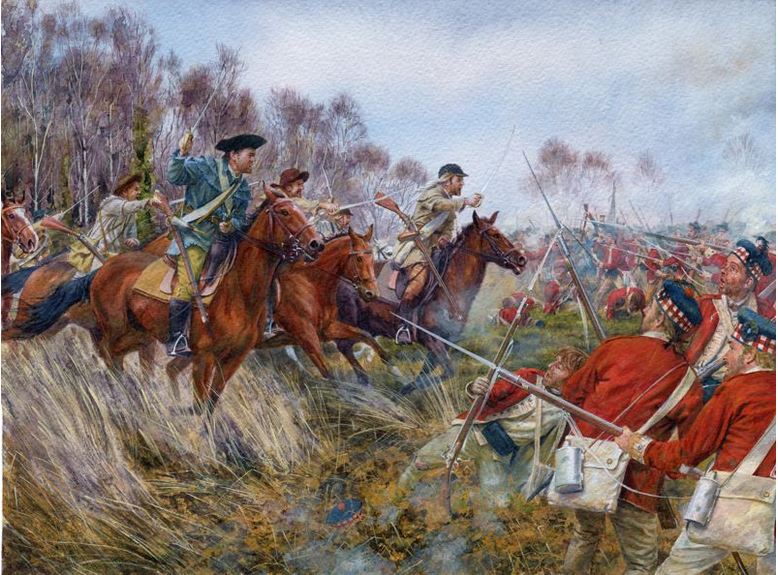
The subsequent battle played out nearly according to Morgan’s original plan. Tarleton, ever the aggressive commander, spurred his British Legion through the night to face Morgan. Upon arrival at Cowpens at about 0700 hours on the morning of January 17th, Tarleton immediately ordered his troops to advance on what he perceived was a centre of the American line. Tarleton did not even bother to reconnoitre the terrain or to ascertain the disposition of Morgan’s troops. With reckless abandonment, Tarleton sent in his cavalry to clear out the American skirmisher, but Morgan had devised a method of dealing with mounted troops. Morgan ordered his men to counter cavalry by holding two men with loaded rifles in reserve while every other one fired. This tactic would ensure that the skirmishers would always have loaded rifles to counter threats from mounted troops.[78] After the cavalry failed to drive off the militia skirmishers, Tarleton ordered in the 7th Regiment and the Light Infantry, who quickly drove off the skirmishers. But upon encountering the first militia line, the British received two devastating volleys of rifle fire. Nearly two-thirds of the British officers were hit during the separate volleys that the militia poured into their ranks with hellish satisfaction. The targeting of the officers helped sow the seeds of confusion among the British command and control structure during the battle. Despite their losses, the British pressed the attack and drove the militia from their positions with glistening steel. Given that the militia knew their orders to retire after two volleys, they withdrew in good order and filed through the main defensive lines at the designated opening in the centre.[79] With each engagement, the British regulars felt that they were closer to victory. They had already driven off two rebel battle lines, and the next one in front of them would surely do the same. Such was the psychological impact of Morgan’s ensnaring battle strategy.

The trap was closed shut as the British reformed to face this new line of Continental infantry. From the onset of the British advance, the Continentals and State Line troops gave them an almost continuous volley of fire. Each American company was firing in echelon to keep a constant torrent of fire upon the advancing British.[80] However, the American militia units on the far right of the main line were slow in reforming after they withdrew from the previous line. It was at this point that Tarleton ordered the 17th Light Dragoons to attack Morgan’s unorganised right. The British Dragoons quickly smashed through the American lines and began to cut the reforming militia to pieces. Such was the effect of this charge that the majority of militia casualties were sustained during this isolated combat episode. The carnage was only halted when Washington’s dragoons surprised the British cavalry and disrupted their assault on the American militia. Washington’s superior force quickly overwhelmed and destroyed the 40-man detachment from the 17th Light Dragoons. Even after the threat was beaten back, order within the militia ranks was only to be restored when Morgan personally took command of the situation and reformed the shaken militia. Amid the chaos, a resolute and disciplined Morgan was witnessed calmly reorganising the militia on his right flank. [81]
Realising that his infantry would need further assistance to break the American line, Tarleton ordered his reserve unit, the 71st Highlanders (Fraser’s Highlanders), against the American left. Tarleton planned to flank the main Continental line and then push horizontally down the position. Noticing their movement, the commander of the left wing of the Continental line, John Eager Howard, ordered his line to wheel right to face this new threat. However, the order was confused or misunderstood in the turmoil of the battle. Instead of wheeling right, the left wing of the line began to retreat.[82] The other officers seeing the wing pulling back thought that they had missed the order and commanded their battalions to retreat as well. The Continental troops disengaged the British and withdrew in good order by battalion. Seeing the line falling back, Morgan rushed from the militia on the right. Screaming obscenities and offering to hang any soldier that passed, Morgan positioned himself where he wanted the new line to form. Sensing victory, Tarleton ordered his troops to press home their advantage and give chase to the Americans. From that point on it was a race to see if the Continental line could reform before the British reached them.[83]
As the Continentals orderly marched to their new positions, the officers had the troops reload their muskets at trail arms. This order to reload was crucial to the outcome of the battle because it meant that when they turned to face the British, they would have loaded muskets. The Continentals’ made it to Morgan’s position just in time to about-face and unload a devastating volley into the British at just ten yards. The effect of that point-blank fire shattered the morale of the British, and they began to falter. Just then the re-formed militia troops descended on the British left while Washington’s cavalry hit the British right. The combined effect of these attacks broke the British’s resolve to win, and the battle became a rout. Seeing the infantry falter, Tarleton attempted to save his men with a cavalry charge, but his reserve units, comprised of former Continentals captured in the Fall of Charlestown, disobeyed the order, and fled from the field in great haste. Morgan’s successful double envelopment had routed the British, and the militia’s actions at Cowpens were credited with having ensured a rare American victory.[84]
As one can observe from the brief account of the engagement, Cowpens was a brilliant tactical and strategic victory over an elite British Legion.[85] Morgan’s plan was a physical and psychological trap, which took advantage of Tarleton’s aggression, as well as the fatigue of his troops. Moreover, it played into the British contempt for the Whig militia by placing the militia in the vanguard, which drew in the infantry. For the duration of the war, the British had witnessed militia break time and again during the Northern Campaign. What was different at Cowpens was the fact that the militia had a commander that had risen from their ranks and understood how to effectively employ them when engaging in European-style battle. Morgan’s positioning of the militia played to their strengths in the area of marksmanship that whittled down the British officer and non-commissioned officer core, which made their troops more difficult to control. Morgan also understood the shortcomings of the militia and limited their exposure to the cold steel of the British regular’s bayonets. Greene would later employ the militia in a similar manner throughout the remainder of the Southern Campaign. One wonders what could have been achieved if Washington would have been humble enough to learn how to effectively employ the militia. Instead, he chose to marginalise and ignore the advice of more tactically sound subordinates like Charles Lee and Benedict Arnold in order to pursue a grand European-style conflict that needlessly prolonged the war. Washington was employing tactics that played to the strengths of the British, while Morgan was tapping into the American militia’s propensity for irregular tactics to great effect, as the actions at Saratoga and Cowpens demonstrate.
The major consequence of the action at Cowpens was that it had the effect of decelerating Lord Cornwallis’s campaign to invade North Carolina by depriving him of his Light Infantry, which would have supported his advance by acting as a critically needed screen against American militia forces. At the tactical level, Lt. Col. Tarleton squandered eighty-six per cent of his forces, which before the engagement consisted of about one thousand one hundred and fifty Regulars along with Tory militia.[86] In actuality, the British suffered ninety per cent casualties. The total British losses at Cowpens in killed, wounded, and prisoners were about eight hundred ninety men.[87] At the operational level, Tarleton’s immediate commander, General Cornwallis, did lament the loss of such a large number of men in the battle, yet it did little to hamper the overall campaign to invade North Carolina. With that said, it was at the strategic level that one observes the battle’s decisiveness because it profoundly damages the British pacification efforts[88] within the Southern Colonies. Coupled with the American victory at King’s Mountain, Cowpens shattered the confidence of Southern Tories in the British’s ability to defeat the rebels. From that point forward, the Tory militia would not turn out in significant numbers, which forced Cornwallis to spread out his regular forces to a further degree and to seek out new regions to support his operations.
Analysing General Morgan’s After-Action Report
Circling back to Babits’s assertions about Morgan’s AAR. Until recently, Morgan’s account of the battle has served as the foundation for almost all of the information that was known about the tactics he used during the battle and of the losses American forces sustained. The document is a standard military report that informs the senior officer of the disposition of the troop, casualties, logistical needs, and the result of the engagement. Nonetheless, Babits’s argues that Morgan’s report demonstrates that he held the view that only the Continental and State Line forces mattered. Moreover, Babits asserts that Morgan might have had an agenda when writing the report. Babits contends that Morgan purposely failed to mention the significance of the militia during that battle to enhance the role of the Continentals. Babits speculates that the reason for that failure was to convince southern states to fund regular infantry units and not rely on the militia for their defence.[89] Babits’s argument seems to be a bit of a stretch because Morgan might have been merely reporting to Greene the losses from the units only under his direct command. In truth, it is doubtful whether Morgan had an accurate count of the militia units that fought at the Battle of Cowpens. The majority of the South Carolina militia units arrived during the night of January 16th. Hence, he may not have even known the actual number of militia casualties because they dispersed so quickly after the battle.
Lack of Information and Time
While Babits admits that Morgan’s report does not agree with the battle sequence, it is also incorrect in the position of his troops. Babits’s argues that he must have used his initial operation order to write the report and did not incorporate the subsequent changes to his battle plan.[90] Morgan wrote the report in the aftermath of the confrontation. Morgan knew that he must move quickly to avoid a potential pursuit by the main body of the British Army under Cornwallis. Further complicating Morgan’s situation, most of his militia unit’s enlistments were due to expire at the end of January. Appropriately, Morgan withdrew the main body of his forces to safety the day of the confrontation. The army crossed the Broad River and marched east toward the North Carolina border. At the border, the Morgan’ Flying Army disintegrated as the Western North Carolina militiamen and South Carolina State Troops departed for home. Morgan intended to link up with the main body of the Southern Continental Army, which was moving toward Salisbury, North Carolina.
On the night of January 19th, Morgan’s force was encamped south of Charlotte on Cain Creek near the infamous Waxhaws. It was at this point that Morgan felt he had put enough distance between Cornwallis’s army and his dwindling command that it was safe to write an official account of the battle for Greene.[91] In drafting the AAR, it seems that Morgan might have used his original order of the night of the 16th of January to construct the written account of the battle. If this theory is correct, then that would account for discrepancies in multiple maps and reports concerning unit positions on the battlefield.[92] Such an occurrence seems highly probable given Morgan’s rapid withdrawal and the fact that most of the South Carolina militia arrived during the night of the 16th. Moreover, Morgan restructured his earlier plan and troop positions through oral orders as militia reinforcements arrived. Therefore, a lack of time and the absence of records may have been the only factors that motivated Morgan to write the report in the manner that he did.
Evidence from the Battle of Cowpens
Another piece of evidence about Morgan’s opinion of the militia comes from the actual battle itself. The confrontation at Cowpens was a linear series of severe combat incidents as Tarleton’s troops encountered different American positions. Morgan brilliantly posted his men by placing them in progressively stronger lines and expertly by utilising the strengths of the militia, which minimised the British strengths, as well as taking advantage of their popularly held belief that a brisk bayonet charge would break the militia. The key to the success of the engagement was how Morgan incorporated the militia into his elaborate battle plan. Morgan counted on the militia to significantly weaken the British before they reached the main line of Continentals and State Troops.[93] The skirmishers and militia lines shot up the British just enough to even the odds for the waiting but understrength Continentals. The consequence of the two lines firing was that the militia killed two-thirds of the British officers and about the same number of privates before they made it to the Continental line.[94] Hence, all the Continentals needed to do was mop up what the militia had left.
Second, Morgan’s use of the reverse slope defence that enhanced the rifle-armed militia and limited their exposure to British fire. Morgan, beginning as a rifleman himself, knew that troops on a hill tend to overshoot their targets. The reason for overshooting is simple, the trajectory, the bullet’s flight path, depends on the horizontal range to the plane of the target, not the line of sight range up or downhill; a concept that only a consummate rifleman would understand. A person’s eye sees the line of sight range from their position to the target, which is longer than the horizontal range. When combined with the British tendency to shoot high, Morgan’s placement of the militia on the reverse slope effectively limited militia casualties.[95] Additionally, by placing the militia on the reverse slope, Morgan negated any overshooting issues for the militia and the charging British infantry would make excellent targets because the morning sun would silhouette them against the skyline. Emerald green and faded red uniforms make an outstanding target against a light blue background.
The third piece of evidence is that Morgan asked the militia to perform a series of complicated manoeuvres on the battlefield, a feat that Washington never mastered. Morgan spent the night of 16th January personally explaining his plan to each militia company as it arrived and encouraged the men.[96] His battle plan called for the skirmishers to fall back to the militia line and to fill in the gaps in the line. In order to allow the skirmishers into the militia line, Hayes’s battalion was positioned slightly ahead of the militia line to allow the skirmishers to pass through. After they had passed, Hayes’s men about-faced and marched back to the militia line. Once the militia line retreated, they were to withdraw in good order back to the main line, which opened in the centre to allow them to reform in the rear, then deploy to the flanks of the Continental line. Such complex manoeuvres are difficult for regular infantry. Despite its complexity, Morgan trusted the militia’s ability to conduct these movements without practice because he explained the effort and he demonstrated personal leadership throughout the battle by intervening at key moments in order to provide guidance as the dynamic tactical situation changed instead of remaining in the rear.
Finally, he told the militia that he only wanted them to fire two or three volleys before they should withdraw back to the Continental line. During the subsequent battle, the militia followed Morgan’s plan to the letter and was only shaken when surprised by the British 17th Light Dragoons. The totality of these pre-battle preparations reveals that Morgan kept his demands of the militia within limits that were acceptable to them, which demonstrates that he understood the defensive temperament of those part-time soldiers. Morgan also understood that the slow loading rifle-armed militia could not slug it out toe to toe with the faster loading musket-armed British regulars. Thus, his genius in giving them an avenue to escape before they were heavily engaged by bayonet-armed regulars. These four points demonstrate that Morgan had full faith and confidence in the militia’s abilities. An officer only had to know how the militia fought to employ them on the battlefield effectively, and Morgan was that officer.
Daniel Morgan, Patronage, and The Militia
The most rational explanation accounting for the way Morgan wrote the AAR comes from Babits’s assertion that he must have used his initial operation order to write the report and did not incorporate the subsequent changes to his battle plan. [97] While Babits’s assessment of the engagement at Cowpens is of the highest quality, his thesis suffers from a lack of context and generalises the notion that all Continental Army officers held the militia in contempt. If one combines this simple explanation with the reasoned arguments put forth in this brief analysis of Morgan’s life, Babits’s argument concerning his supposed agenda to promote the achievements of the Continental infantry is rendered highly questionable by factoring in the important eighteenth-century element of patronage. Thus, Babits neglected to consider that integral component of that society. As a consequence, Babits’s assumptions about Morgan’s motivations are problematic at best.
By fusing the fragmentary pieces of evidence from Morgan’s life, one observes a trend in the way he conducted himself as a receiver and offeror of patronage. The multifaceted socio-political aspects of the militia as an institution served as the framework for Morgan’s advancement, as well as his victories on the battlefield. The vital element of patronage played an important role in raising this man of the “common herd” into the middling sort during the years preceding the Seven Years War. Indeed, it was Morgan’s active participation within the militia that enabled him to rise from the obscure margins of colonial society to a position of authority and leadership. The militia functioned as a conduit for enfranchised males to form social, economic, and familial bonds. This obligational and hierarchical set of friendships culminated in Morgan being chosen to command a rifle company comprised of his neighbours from the Shenandoah Valley. Though records are difficult to obtain, one can infer that Morgan must have utilised bonds of patronage and his reputation as a frontiersman of substance to attract men to fill the ranks of his first command. This company of Valley riflemen, who would follow him to the siege of Québec, were little different than the backcountry militiamen that he commanded at the Battle of Cowpens six years later. Moreover, a similar situation occurred when he recruited men for the 11th Virginia Regiment. The only element that separated Continental Light Troops from those Morgan commanded during Cowpens was the hunting frocks, which were the standard uniform of his regiment.

Furthermore, from the overview of his life, one perceives Morgan for the type of man he truly was, a backwoods rifleman on the make. Morgan had been actively engaged with various militia units throughout the Seven Years War. These experiences during that conflict taught him the value of irregular tactics,[98] which the aboriginals first employed to confront the technologically superior British forces attempting to fight in a European style within the American wilderness. Learning from these valuable life lessons, Morgan’s battlefield tactics at both Saratoga and Cowpens allowed him to employ his men where the enemy did not expect to find them and enabled him to lure his enemy into situations that ensnared them in a deadly engagement that they could not win. Consequently, Morgan was a consummate but ambitious militia commander, who was able to intimately comprehend the socio-political characteristic inherent to that unruly institution. Therefore, Morgan would have expressed such negative views of the militia in order to curry favour with his new benefactor, George Washington. For good or ill, Morgan understood that to secure his rise to prominence, he would have to conform to the thinking of those that controlled his future prospects. Of course, that assertion is pure speculation given the fact that historians cannot truly discern the innerworkings of the mind of the historical actor one is examining. Nevertheless, the aforementioned argument is equally as plausible as Babits’s unsubstantiated assertion. Moreover, that line of reasoning conforms with the dense historiography on the socio-political elements inherent to the militia as an institution.
Despite the discrepancies within Morgan’s official account of the Battle of Cowpens, the importance of his AAR is revealed when one considers the fact that it enabled historians to construct an approximate narrative of the battle sequence. Moreover, it demonstrates the depth and temperament of Morgan’s tactical knowledge in regard to how best to employ the militia during a conventional European-style engagement. Morgan’s skilled employment of the militia stands in stark contrast to other Continental officers who sought to utilise the militia as if they were regular infantry. Such attempts betray the fundamental misconception by supposedly disinterested Continental officers to the prevailing defensive mentality within the militia, which was an innate provision concerning the use of force within the minds of militiamen. Consequently, if one takes Morgan’s military career into account, the Battle of Cowpens is his crowning tactical masterpiece and demonstrates his prominence in furthering the eventual American victory. The fact that he achieved this great victory while suffering from rheumatoid arthritis, sciatica, and haemorrhoids[99] only serve to emphasise his dedication to the cause of liberty regardless of the fact that such service eventually furthered his prospects for patronage through the forthcoming federal system.
Albert Zambone perhaps best encapsulates the intricate forces that fashioned Morgan’s life by arguing that he was “not his own creation…We are also made by everything around us: society, culture, landscape, good fortune, providence. All these things grind at us, goad us, form us, mold us, direct us however much we kick and bite against them.”[100] While Zambone’s assessment contains elements of truth, the life, and exploits of Daniel Morgan demonstrate that his ultimate legacy is the engaging saga of how he utilised the structure of the militia to raise his socio-economic fortunes by seeking bonds of patronage. More importantly, the battles of Saratoga and Cowpens serve as captivating tales about how Morgan sculpted a motley crew of hardboiled regulars, dashing cavalrymen, and rowdy militiamen into a proficient fighting force capable of executing intricate European-style battlefield manoeuvres against highly motivated British regulars. Undeniably, Morgan’s life exemplifies the humble fortitude of the common militiamen defending their hearth and home. It was through the efforts of the independently operating militia working in conjunction with a weakened band of Continental regulars that eventually forced Cornwallis north into Virginia to meet his fate at Yorktown. Both Morgan and Greene learned how to employ the strengths of the militia while accounting for their inherent weakness on the conventional battlefields of eighteenth-century America. After a string of crushing defeats: the ruinous surrender of Charleston, the massacre at Waxhaws, and Gate’s flight for safety after the defeat at Camden, the majority of the Southern Continental Army was annihilated or languishing in disease-infested prisons.[101] There simply were not enough regulars to fight battles in the manner that Washington had in the Northern Campaign, nor did he send significant regular re-enforcements south.[102] As Washington and his army ideally watched over the British entrenchment in Manhattan, the bulk of the fighting in the Southern theatre fell upon the shoulders of small independent bands of hard-hitting militiamen. Appropriately, it was not General Washington or his grim-faced regulars who secured victory during the war in the South. Rather, the martial contest was primarily fought and won by simple people defending their hearths and liberties with commonly owned firearms.
Bibliography
Anderson, Fred. A People’s Army: Massachusetts Soldiers and Society in the Seven Years War. Chapel Hill, NC: University of North Carolina Press, 1996.
Andrew, Rod, Jr. The Life and Times of General Andrew Pickens: Revolutionary War Hero, American Founder. Chapel Hill, NC: University of North Carolina Press., 2017.
Babits, Lawrence Edward. A Devil of a Whipping: The Battle of Cowpens. 1st ed. Chapel Hill, NC: University of North Carolina Press, 1998.
Babits, Lawrence Edward. Long, Obstinate, and Bloody: The Battle of Guilford Courthouse. 1st ed. Chapel Hill, NC: University of North Carolina Press, 2009.
Blackstone, William. Commentaries on the Common Law of England. Vol. 1. 4 vols. Chicago, IL: University of Chicago, 1979.
Boorstin, Daniel J. The Americans: The Colonial Experience. New York, NY: Random House, 1958.
Buchanan, John. The Road to Guilford Courthouse: The American Revolution in the Carolinas. 1st ed. New York, NY: Wiley, 1997.
Busch, Briton Cooper. Bunker Hill to Bastogne: Elite Forces and American Society. Washington, DC: Potomac Books, 2006.
Callahan, North. Daniel Morgan: Ranger of the Revolution. New York, NY: Holt, Rinehart and Winston, 1961.
Clarke, William P. Official History of the Militia and the National Guard of the State of Pennsylvania. Philadelphia, PA: Charles J. Hendler, 1909.
Cress, Lawrence Delbert. Citizens in Arms: The Army and Militia in American Society to the War of 1812. Chapel Hill, NC: University of North Carolina Press, 1982.
Cunliffe, Marcus. Soldiers and Civilians: Martial Spirit in America, 1775-1865. New York, NY: Little, Brown and Company, 1968.
Dederer, John Morgan. War in America to 1775: Before Yankee Doodle. New York, NY: New York University Press, 1990.
Feaster, William Rice, ed. A History of Union County, South Carolina. Union, SC: Union County Historical Foundation, 1977.
Ferling, John E. Almost a Miracle: The American Victory in the War of Independence. New York, NY: Oxford University Press, 2007.
Fischer, David Hackett. Albion’s Seed: Four British Folkways in America. New York, NY: Oxford University Press, 1989.
Foxley, Rachel. The Levellers: Radical Political Thought in the English Revolution. Manchester, UK: Manchester University Press, 2014.
Friedman, Leon. “Conscription and the Constitution: The Original Understanding.” Michigan Law Review 67, no. 8 (1969): 1493-552. doi:10.2307/1287481.
Galvin, John R. The Minute Men: The First Fight: Myths and Realities of the American Revolution. Washington, D.C.: Pergamon-Brassey’s International Defence Publishers, 1989.
Hadden, Sally E. Slave Patrols: Law and Violence in Virginia and the Carolinas. Cambridge, MA: Harvard University Press, 2001.
Hardy, Robert. Longbow: A Social and Military History. London, UK: Lyons Press, 1993.
Higginbotham, Don. Daniel Morgan: Revolutionary Rifleman. Chapel Hill, NC: University of North Carolina Press, 1979.
Higginbotham, Don. “The Early American Way of War: Reconnaissance and Appraisal.” The William and Mary Quarterly 44, no. 2 (April 1987): 230-73. doi:10.2307/1939664.
Hill, Jim Dan, and George Fielding Eliot. The Minute Man in Peace and War: A History of the National Guard. Harrisburg, PA: Stackpole, 1964.
Keegan, John. The Face of Battle: A Study of Agincourt, Waterloo, and the Somme. London, UK: Penguin, 1976.
Lee, Henry. The American Revolution in the South. Edited by Robert E. Lee. New York, NY: Arno Press, 1969.
Mahon, John K. History of the Militia and the National Guard. New York, NY: Macmillan, 1983.
Middlekauff, Robert. “Why Men Fought in the American Revolution.” Huntington Library Quarterly 43, no. 2 (Spring 1980): 135-48. Accessed March 7, 2021. doi:10.4324/9781315244174-1.
Morgan, Daniel, and Nathanael Greene. The Papers of General Nathanael Greene. Edited by E. Wayne Carp, Dennis M. Conrad, Robert E. McCarthy, and Richard K. Showman. Vol. 1. November 1779-31 May 1780. Chapel Hill, NC: University of North Carolina Press, 1984.
Namier, Lewis. The Structure of Politics at the Accession of George III. Basingstoke, UK: Macmillan Press, 1957.
Perkin, Harold. The Origins of Modern English Society. Abingdon, UK: Routledge, 2015.
Royster, Charles. A Revolutionary People At War: The Continental Army and American Character, 1775-1783. Chapel Hill, NC: University of North Carolina Press, 1980.
Rutman, Darrett Bruce. A Militant New World, 1607-1640: America’s First Generation, Its Martial Spirit, Its Tradition of Arms, Its Militia Organisation, Its Wars. New York, NY: Arno Press, 1959.
Shea, William L. The Virginia Militia in the Seventeenth Century. Baton Rouge, LA: Louisiana State University Press, 1983.
Shy, John W. A People Numerous and Armed: Reflections on the Military Struggle for American Independence. Ann Arbour, MI: University of Michigan Press, 2010.
Tarleton, Banastre. A History of the Campaigns of 1780 and 1781, in the Southern Provinces of North America. London: T. Cadell, 1787.
Titus, James. The Old Dominion at War: Society, Politics and Warfare in Late Colonial Virginia. Columbia, SC: University of South Carolina Press, 1991.
White, John Todd. “Standing Armies in Time of War: Republican Theory and Military Practice during the American Revolution.” PhD diss., George Washington University, 1978.
Yassky, David. “The Second Amendment: Structure, History, and Constitutional Change.” Michigan Law Review 99, no. 3 (2000): 588-668. doi:10.2307/1290496.
Zambone, Albert Louis. Daniel Morgan: A Revolutionary Life. Yardley, PA: Westholme, 2018.
Foot Notes
[1] John W. Shy. A People Numerous and Armed: Reflections on the Military Struggle for American Independence. (Ann Arbour, MI: University of Michigan Press, 2010), 31.
[2] See; William P. Clarke. Official History of the Militia and the National Guard of the State of Pennsylvania. (Philadelphia, PA: Charles J. Hendler, 1909).
[3] See; William L. Shea, The Virginia Militia in the Seventeenth Century. (Baton Rouge, LA: Louisiana State University Press, 1983), and James Titus. The Old Dominion at War: Society, Politics and Warfare in Late Colonial Virginia. (Columbia, SC: University of South Carolina Press, 1991).
[4] See; Lawrence Delbert Cress. Citizens in Arms: The Army and Militia in American Society to the War of 1812. (Chapel Hill, NC: University of North Carolina Press, 1982), Charles Royster. A Revolutionary People At War: The Continental Army and American Character, 1775-1783. (Chapel Hill, NC: University of North Carolina Press, 1980), Jim Dan Hill and George Fielding Eliot. The Minute Man in Peace and War: A History of the National Guard. (Harrisburg, PA: Stackpole, 1964), Don Higginbotham. “The Early American Way of War: Reconnaissance and Appraisal.” The William and Mary Quarterly 44, no. 2 (April 1987): 230-73. doi:10.2307/1939664, and John Todd White. “Standing Armies in Time of War: Republican Theory and Military Practice during the American Revolution.” PhD diss., George Washington University, 1978.
[5] John E. Ferling, Almost a Miracle: The American Victory in the War of Independence. (New York, NY: Oxford University Press, 2007), 570-575, and Shy. A People Numerous and Armed, 151, 154-155.
[6] See; Daniel J. Boorstin. The Americans: The Colonial Experience. (New York, NY: Random House, 1958), and Darrett Bruce Rutman. A Militant New World, 1607-1640: America’s First Generation, Its Martial Spirit, Its Tradition of Arms, Its Militia Organisation, Its Wars. (New York, NY: Arno Press, 1959).
[7] See; Sally E. Hadden. Slave Patrols: Law and Violence in Virginia and the Carolinas. (Cambridge, MA: Harvard University Press, 2001).
[8] See; William Blackstone. Commentaries on the Common Law of England. Vol. 1. 4 vols. (Chicago, IL: University of Chicago, 1979), 152, Shea, The Virginia Militia in the Seventeenth Century, 1-4, and Robert Hardy. Longbow: A Social and Military History. (London, UK: Lyons Press, 1993), 128-129.
[9] See; Rachel Foxley. The Levellers: Radical Political Thought in the English Revolution. (Manchester, UK: Manchester University Press, 2014), 120, and Marcus Cunliffe. Soldiers and Civilians: Martial Spirit in America, 1775-1865. (New York, NY: Little, Brown and Company, 1968), 32.
[10] See; Fred Anderson. A People’s Army: Massachusetts Soldiers and Society in the Seven Years War. (Chapel Hill, NC: University of North Carolina Press, 1996), Cunliffe. Soldiers and Civilians, John Morgan Dederer. War in America to 1775: Before Yankee Doodle. (New York, NY: New York University Press, 1990), John K. Mahon. History of the Militia and the National Guard. (New York, NY: Macmillan, 1983), James Titus. The Old Dominion at War: Society, Politics and Warfare in Late Colonial Virginia. (Columbia, SC: University of South Carolina Press, 1991), and William L. Shea. The Virginia Militia in the Seventeenth Century. (Baton Rouge, LA: Louisiana State University Press, 1983).
[11] For an in-depth historical discussion of the implications of the Southern Campaign, see; John Buchanan. The Road to Guilford Courthouse: The American Revolution in the Carolinas. (1st ed. New York, NY: Wiley, 1997), and Ferling. Almost a Miracle, 382-392, 567-568. Additional information on the tactical level of the Southern Campaign, see: Lawrence Edward Babits. A Devil of a Whipping: The Battle of Cowpens. 1st ed. (Chapel Hill, NC: University of North Carolina Press, 1998), and Long, Obstinate, and Bloody: The Battle of Guilford Courthouse. 1st ed. (Chapel Hill, NC: University of North Carolina Press, 2009).
[12] John R. Galvin, The Minute Men: The First Fight: Myths and Realities of the American Revolution. (Washington, D.C.: Pergamon-Brassey’s International Defence Publishers, 1989), 30-31.
[13] Briton Cooper Busch, Bunker Hill to Bastogne: Elite Forces and American Society (Washington, DC: Potomac Books, 2006), 53.
[14] Kemp to Commissioners May 17, 1635, Colonial Office Series. 1/8, f. 167. National Archives, London. https://www.nationalarchives.gov.uk/
[15] Titus. The Old Dominion at War, 16, 28-39, and Shea, The Virginia Militia in the Seventeenth Century, 54-56.
[16] Lawrence Delbert Cress’s work, Citizens in Arms, is the seminal study of the impact of English Radical Whig ideas concerning the central role of the militia within a constitutional republic and the hazards inherent to a standing army, also see; Leon Friedman. “Conscription and the Constitution: The Original Understanding.” Michigan Law Review 67, no. 8 (1969), and David Yassky. “The Second Amendment: Structure, History, and Constitutional Change.” Michigan Law Review 99, no. 3 (2000): 588-668.
[17] David Hackett Fischer. Albion’s Seed: Four British Folkways in America. (New York, NY: Oxford University Press, 1989), 207-256.
[18] See; Lewis Namier. The Structure of Politics at the Accession of George III. (Basingstoke, UK: Macmillan Press, 1957), and Harold Perkin. The Origins of Modern English Society. (Abingdon, UK: Routledge, 2015).
[19] Albert Louis Zambone. Daniel Morgan: A Revolutionary Life. (Yardley, PA: Westholme, 2018), 49, 87-88.
[20] Cress, Citizens in Arms, 15-52, 173-177.
[21] “Daniel Morgan to Nathanael Greene, 19 Jan. 1781,” Showman, Greene Papers, 7:152-55
[22] Banastre Tarleton, A History of the Campaigns of 1780 and 1781, in the Southern Provinces of North America. (London: T. Cadell, 1787), 216.
[23] Babits, A Devil of a Whipping, 151-52.
[24] Babits, 1-10.
[25] Don Higginbotham, George Washington and the American Military Tradition. (Athens: University of Georgia Press, 1985) 12, 14-15, 22, 32-33, 69-70, 104.
[26] Babits, 150-151.
[27] See; North Callahan, Daniel Morgan, Ranger of the Revolution. (New York: Holt, Rinehart and Winston, 1961), and Zambone. Daniel Morgan, 169- 170.
[28] See; Callahan. Daniel Morgan, Don Higginbotham. Daniel Morgan: Revolutionary Rifleman. (Chapel Hill, NC: University of North Carolina Press, 1979), and Zambone. Daniel Morgan.
[29] Higginbotham, Daniel Morgan, 16-100.
[30] Zambone, 9-15.
[31] Zambone, 15-17.
[32] Zambone, 13-14.
[33] Higginbotham, 3.
[34] Callahan, 24.
[35] John Keegan. The Face of Battle: A Study of Agincourt, Waterloo, and the Somme. (London, UK: Penguin, 1976).
[36] James Graham, The Life of General Daniel Morgan of the Virginia Line of the Army of the United States. (New York, NY: Derby & Jackson, 1856) 29-30.
[37] Callahan, 28-29.
[38] Callahan, 35.
[39] Callahan, 30-35.
[40] Zambone, 42-43, 49-50.
[41] Zambone, 34-35, 50-52, 66.
[42] The history of the various rebellions during the Colonial and Early Republic periods are replete with accounts of the militia not preforming their supposed duty to suppress their fellow countrymen. Indeed, Washington, Hamilton, and their train of sycophants used these recent experiences in conjunction with what they thought they observed during the late war to argue for a large standing army that was comprised of hirelings whose sole loyalty was to a central government; preferably controlled by the Federalists. Naturally, that type of mindless obedience to authority was not the mentality of the common militiamen. These men only sought to defend their communities and retained the moral authority to refuse a call to arms that violated their principles. See; Cunliffe, 177-212, Cress, 86-87, 94-109, Hill, and Eliot. The Minute Man in Peace and War, 175-190, Mahon, History of the Militia, 1-78, 138-153, Shea, 51-55, 65, and Titus, 32-51, 63-65.
[43] Zambone, 74-77.
[44] Shea, 105.
[45] Callahan, 48.
[46] Callahan, 44-46.
[47] Callahan, 53-54.
[48] Callahan, 64.
[49] Callahan,72-92.
[50] Callahan,106.
[51] Callahan, 107-08.
[52] Callahan, 109-116.
[53] Callahan, 118.
[54] Callahan, 119-122.
[55] Envelopment: An offensive manoeuvre in which the attacking force press around the enemy’s defensive positions or line to secure their rear.
[56] Callahan, 133-138.
[57] Zambone, 210-216, and Robert Middlekauff. “Why Men Fought in the American Revolution.” Huntington Library Quarterly 43, no. 2 (Spring 1980): 135-48.
[58] Callahan, 189-90.
[59] Babits, 7.
[60] Babits, 23-24.
[61] Babits, 8.
[62] Babits, 7.
[63] Babits, 49-51.
[64] Rod Andrew, Jr. The Life and Times of General Andrew Pickens: Revolutionary War Hero, American Founder. (Chapel Hill, NC: University of North Carolina Press., 2017), 98-102.
[65] Pincer movement: is a military manoeuvre where troops simultaneously attack both flanks of an enemy formation.
[66] Babits, 54.
[67] Babits, 71.
[68] Babits, 81-86.
[69] Military Crest: An area on the forward or reverse slope of a hill or ridge just below the topographical crest from which maximum observation covering the slope down to the base of the hill or ridge can be obtained.
[70] “Daniel Morgan to Nathanael Greene, 19 Jan. 1781,” Showman, Greene Papers, 7:152-55.
[71] Babits, 71-79.
[72] Babits, 77.
[73] Babits, 11-22.
[74] Babits, 87-99.
[75] Babits, 73.
[76] Feaster, William Rice, ed. A History of Union County, South Carolina. (Union, SC: Union County Historical Foundation, 1977), 79.
[77] John Eager Howard, “Account of the Battle of Cowpens,” in Henry Lee. The American Revolution in the South. Edited by Robert E. Lee. (New York, NY: Arno Press, 1969), 96.
[78] Babits, 82-83.
[79] Babits, 92-99.
[80] Babits, 100-103.
[81] Babits, 97-99.
[82] Babits, 107-111.
[83] Babits, 111-114.
[84] Babits, 116-123.
[85] A British legion is a combined arms military unit. The unit contains Line Infantry, Light Infantry, Calvary, and supporting Artillery units.
[86] Babits, 142.
[87] Babits, 93.
[88] A pacification effort is a modern term that describes the process of countering an insurgency through the implication of various measures that attempt to control a given battle space.
[89] Babits, 150-51.
[90] Babits, 74.
[91] Babits, 143-45.
[92] Babits, 74.
[93] Babits, 71.
[94] Babits, 92.
[95] Babits, 73.
[96] Babits, 55.
[97] Babits, 74.
[98] Zambone, 119-120, 126, 135, 141, 143, 158, 165, 172, 181, 209, 212, 216, 221, 242, 251-253, 255.
[99] Higginbotham, 102, 145, 166.
[100] Zambone, 114.
[101] Buchanan, 288.
[102] Ferling, 325, 347, 505.
Appendix A
Letter to Nathanael Greene
Daniel Morgan
Battle of Cowpens
January 19, 1781
Camp near Cain Creek
Dear Sir,
The Troops I had the Honor to command have been so fortunate as to obtain a compleat Victory over a Detachment from the British Army commanded by Lt Colonel Tarlton. The Action happened on the 17th Instant about Sunrise at the Cowpens. It perhaps would be well to remark, for the Honour of the American Arms, that Altho the Progress of this Corps was marked with Burnings and Devastations & altho’ they have waged the most cruel Warfare, not a man was killed, wounded or even insulted after he surrendered. Had not Britons during this Contest received so many Lessons of Humanity, I should flatter myself that this might teach them a little, but I fear they are incorrigible.
To give you a just Idea of our Operations it will be necessary to inform you, that on the 14h Instant having received certain Intelligence that Lord Cornwallis and Lt Colonel Tarlton were both in Motion, and that their movements clearly indicated their Intentions of dislodging me, I abandoned my Encampment at Grindales Ford on Pacolet, and on he 16h in the Evening took Possession of a Post, about seven miles from the Cherokee Ford on Broad River. My original Position subjected me at once to the Operations of both Cornwallis and Tarlton, and in Case of a Defeat, my Retreat might easily have been cut off. My Situation at the Cowpens enabled me to improve any Advantages I might gain, and to provide better for my own Security, should I be unfortunate. These Reasons induced me to take this Post at the Risque of its wearing the face of a Retreat.
I received regular Intelligence of the Enemy’s Movements from the Time they were first in Motion. On the Evening of the 16h Ins they took Possession of the Ground I had removed from in the Morning, distant from the Scene of Action about 12 miles. An Hour before Day light one of my Scouts returned and informed me that Lt Colonel Tarlton had advanced within five miles of our Camp. On this Information I hastened to form as good a Disposition as Circumstances would admit, and from the alacrity of the Troops we were soon prepared to receive them. The Light Infantry commanded by Lt Colonel Howard and the Virginia Militia, under the command of Majr Triplette were formed on a rising Ground, and extended a Line in Front. The 3rd Regiment of Dragoons under Lt Colonel Washington, were so posted at such a Distance in their Rear as not to be subjected to the Line of Fire directed at them, and to be so near as to be able to charge the Enemy, should they be broke. The Volunteers of North Carolina, South Carolina & Georgia under the Command of the brave and valuable Colonel Pickens, were situated to guard the .Flanks. Majr McDowell, of the N C Volunteers, was posted on the right Flank in Front of the Line 150 yards & Major Cunningham with the Georgia Volunteers on the left at the same distance in Front. Colonels Brandon & Thomas of the S Carolinians were posted on the right of Major McDowell and Colonels Hays and McCall of the same Corps, on the left of Major Cunningham. Capts Tate & Buchannan with the Augusta Riflemen to support the right of the Line.
The Enemy drew up in single Line of Battle 400 yds in Front of our advanced Corps. The first Battalion of the 71St Regt was opposed to our Right; the 7th Regt to our Left. The Infantry of the Legion to our Center. The Light Companies on their Flanks. In Front moved two Peices of Artillery. Lt Colonel Tarlton with his Cavalry was posted in the Rear of his Line. The Disposition of Battle being thus formed, small Parties of Riflemen were detached to skirmish with the Enemy, upon which their whole Line moved on with the greatest Impetuosity shouting as they advanced. McDowell & Cunningham gave them a heavy & galling Fire & retreated to the Regiments intended for their Support. The whole of Colonel Picken’s Command then kept up a Fire by Regiments retreating agreable to their Orders. When the Enemy advanced to our Line, they received a well-directed and incessant Fire, but their Numbers being superiour to ours, they gained our Flanks, which obliged us to change our Position. We retired in good Order about 50 Paces, formed, advanced on the Enemy & gave them a fortunate Volley which threw them into Disorder. Lt Colonel Howard observing this gave orders for the Line to charge Bayonets, which was done with such Address that they fled with the utmost Precipitation, leaving the Field Pieces in our Possession. We pushed our Advantage so effectually, that they never had an Opportunity of rallying, had their Intentions been ever so good.
Lt Colonel Washington having been informed that Tarlton was Cutting down our Riflemen on the left Flank pushed froward & charged them with such Firmness that instead of attempting to recover the Fate of the Day, which one would have expected from an officer of his Splendid Character, broke and fled.
The Enemy’s whole Force were now bent solely in providing for their Safety in Flight. The List of their killed, wounded and Prisoners, will inform you with what Effect. Tarlton, with the small Remains of his Cavalry & a few scattering Infantry he had mounted on his Waggon Horses made their Escape. He was Persued 24 miles, but owing to our having taken a wrong Trail at first, we never could overtake him.
As I was obliged to move off of the Field of Action in the mg to secure the Prisoners, I cannot be so accurate as to the killed & wounded of the Enemy as I could wish. From the Reports of an officer I sent to view the Ground, there was 100 non Commissioned officers & Privates & ten commissioned Officers killed and two hundred R and F wounded. We have in our Possession 502 non C. O. & P. Prisoners independent of the wounded, & the Militia are taking up straglers continually. 29 C Officers have fell into our Hands. Their Rank &c &c you will see by an enclosed List. The Officers I have paroled. The Privates I am now conveying by the shortest Rout to Salisburrey. Two Standards, two Field Pieces, 35 Waggons, a travelling Forge, & all their Music are ours. Their Baggage, which was immense, they have in great measure destroyed. Our Loss is inconsiderable, which the enclosed Returns will evince. I have not been able to ascertain Colonel Pickens Loss but know it to be very small.
From our Force being composed of such a Variety of Corps, a wrong Judgment may be formed of our Numbers.
We fought only 80o men, two thirds of which were Militia. The British with their Baggage Guard, were not less than 1150, & these Veteran Troops. Their own Officers confess, that they fought 1037. Such was the Inferiority of our Numbers that our Success must be attributed to the Justice of our Cause & the Bravery of our Troops. My Wishes would induce me to mention the Name of every private Centinel in the Corps I have the honor to Command. In Justice to their Bravery & good Conduct, I have taken the Liberty to enclose you a List of their officers from a Conviction that you will be pleased to introduce such Characters to the World.
Major Giles my Aid & Capt Brookes my Brigade Majr, deserve & have my thanks for their Assistance & Behaviour on this Occasion.
The Baron Glaibeeck who accompanies Major Giles with these Dispatches served with me in the Action as a Volunteer and behaved in such a manner as merits your Attention. I am Dr Sir Yr Ob Servt…
 Tempestuous Seas of Liberty