“Of all the men we meet with, nine parts of ten are what they are, good or evil useful or not, by their education. Tis that makes the great difference in mankind.”
John Locke, Some Thoughts Concerning Education
The principled aims of a prudent education should be to prepare young minds to think independently about complex ideas and to teach them how to conduct themselves virtuously throughout their lives. One ought to be taught the value of selflessly serving our communities and to mould our society with timeless principles that are firmly cemented within the Classical tradition that is infused with Christian values. This type of education maintains fidelity to the spirit of tempered liberty as demonstrated by the Founders of this nation. These great men and women ardently advocated that it is prudent to educate young minds in accordance with a classical liberal arts curriculum that provides them with an academically sound foundation upon which they can pursue the good in all things. Students taught in such a sensible manner will be ardent seekers and defenders of truth. The knowledge that this type of education imparts, arms these young minds to enable them to morally mature as individuals. In the end, living one’s life in accordance with these timeless principles permits one to flourish, and that is the noble aim of a life lived observing God’s Word.
A Prudent Philosophy of Education For Those Who Cherish Their God-Given Liberties
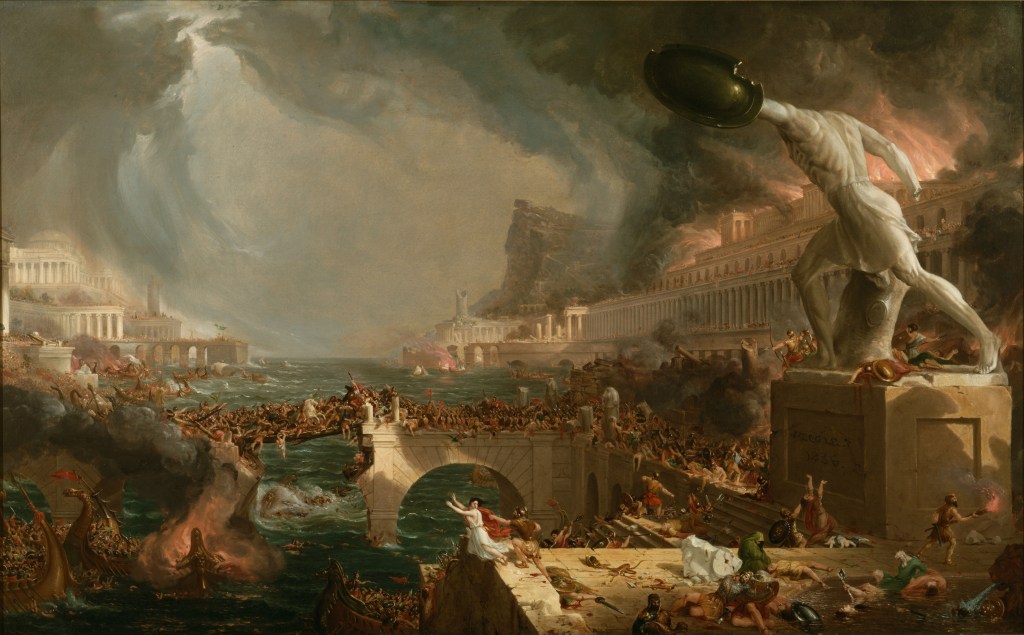
Often, I deeply reflect upon the pressing issues facing our nation and cannot help but to consider how did we arrive at this point in our history, where our society has completely lost its moral moorings. Is our current situation a natural occurrence in the cycle of great nations, as Sir John Glubb (1978) suggests? Perhaps, as Glubb contends, we arrived at this point because our institutions have failed to appropriately and prudently educate nine generations of Americans. Thinking back to my own education, I was never taught the importance of developing virtues that assisted in guiding my thoughts and actions. My education was like most Americans residing within the heartland. Christian religious instruction without any real depth of understanding of the profound lessons contained within the Bible that was combined with progressive educational methodologies and a heavy dose of critical theory. The resulting product was a young man who rejected religion on the grounds of its supposed irrationality, and a mind that could apply a limited form of reason to think about complex ideas, yet those thoughts did not contain appropriate moral sentiments. What was missing from that educational equation was what C.S. Lewis (1988) termed the development of the chest. Lewis’s arguments (1988) are directly descendant from many renowned philosophers of antiquity and the enlightenment, who wished to instil within young minds suitable mechanisms to curtail emotions in order to allow reason to rule the primitive parts of their souls, which are inherently fallen in nature.
Once one acknowledges the significance of this vital element that is absent, the question now becomes what must be done to correct this failure of our current child-centered and outcome-based educational model? More importantly, how can one develop moral sentiments within our children and our own minds? For myself, that journey has been assisted by a natural curiosity, which drives me to seek the truth. Additionally, the exposure to classical ideas has guided my mind to the observation that in order to effect positive change, passionate individuals must take on the responsibility to make sure that a shift in our thinking occurs concerning what is the ultimate aim of education.
Furthermore, the other significant element that has facilitated my conclusion has also been considerably informed by the harsh lessons of a lifetime spent fighting in an endless war that spans the globe. Writing in 431 BC, Thucydides recounts the lessons from participating in and observing, from exile, the social degradation wrought by the century of cruelty that brought Greek society to it’s knees, “War is a violent teacher, and brings most men’s passions to the same level as their circumstances.” Indeed, I had just begun my active duty career when the War on Terror was declared, and I have been on the frontlines of that conflict, in one form or another, since 2001. From the dense humid jungles of Mindanao and the Democratic Republic of Congo to the sun-scorched deserts of Iraq and the towering windswept mountains of the Hindu Kush. Throughout these experiences, I have fought without ever truly knowing the individual liberty I was, supposedly, there to bring to those oppressed peoples. I had no conception of what liberty and God-given rights where. It was only when I had the time to reflect on these experiences, that I began to see with eyes unclouded by the mists of ignorance. I then turned my mind to figuring out the answers to my many inquiries. Since then, the central lessons that I have gleaned from the forthright study of the immensity of human history is continually revealed to my mind. As I sit here typing this appeal to reason, I can still vividly recall the first time that I became aware of these lessons during the initial days of the invasion of Iraq:
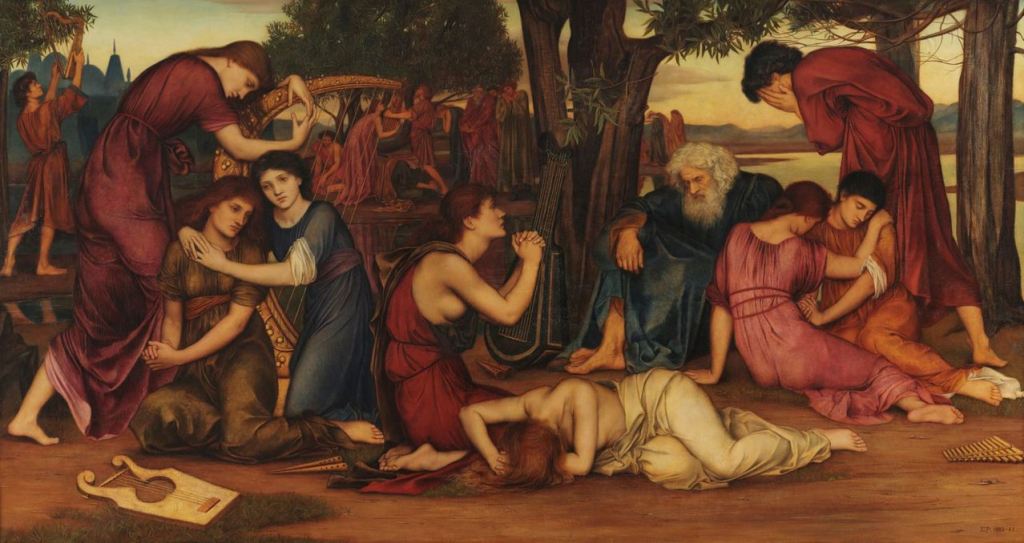
Psalm 137
by Evelyn De Morgan (1882 – 1883)
It had been a harrowing few days in the land of shifting sands and eternal sun. The oppressive heat of the cradle of civilization seemed to overwhelm me from all directions…the stench of burning debris clung to my lungs. A few nights before, we had taken the northern portion of the Rumaila oil fields to prevent the Iraqi Army from setting them alight. The battle had been a quick engagement, but, by daybreak, we had secured most of our objectives with only minor casualties. As the sun rose high on the horizon, I searched the exhausted and sullied faces of my lads. Each had a look of stalwart determination, which left me with a profound sense of pride that blustered my weary heart. A mere two days earlier, I had only unproven young men, but now they had just survived their first contact with the enemy. I too had proven myself as a competent leader, though I had been in combat before I had never led men into battle. The burden of leadership is truly immense when one knows each man on a personal level and has engaged with them in their personal lives. Then to have to order them to perform actions that could potentially cost them their lives is a responsibility that sobers the mind and tempers the rash impulses of a rebellious youth.

Suddenly, something shook me from my thoughts. The wireless had sprung to life with a torrent of chatter; it was command issuing us new orders. We had been tasked to scout out two vital bridges along the north road that passed through Nasiriyah. I shot an apprehensive glance toward my second in command, who sent me a reassuring nod that the men were ready for the task. Taking to heart their show of confidence, I set aside my fears, and I ordered the platoon to mount up.
About three kilometres from the bridges a convoy of U.S. Marines joined our inconsequential platoon and we began our approach to the southern bridge crossing the ancient Euphrates. I could hear short bursts of heavy machinegun fire attempting to find the range of our vehicles. All I could taste was iron and my heart seemed to beat out of my chest. I felt nothing but the icy grip of dread and the numbing pulse of adrenaline. As soon as we were off the bridge, Iraqi forces opened up on us with a mix of small arms, rocket-propelled grenades, and mortar fire. The Marines tracked vehicles instantly peeled off to the east to secure the northern bridge. But the ground was saturated from heavy rains and they became mired in the mud. At that point, an abrupt flash of light disrupts my line of sight, as I seem to float through the air and flames surround my vision. The vehicle I was standing next to was hit by rocket-propelled grenade. When I regained consciousness, all was chaos and there was withering fire being poured into our position from multiple directions. As we took the fight to the insurgents, incoming fire snapped about my permeable body, all I could think about was what was the purpose of all this destruction and did these people even desire to obtain individual liberty?
In the aftermath of that heated clash, we were given the order to maintain a momentary pause close to Nasiriyah, within the rebuilt ruins of Ur. As I approached the steps of the reconstructed Ziggurat of Ur, the setting sun illuminated the temple with crimson hues. Upon summiting the temple, the last beams of light were permeating the Western horizon. The view towards the north-east invoked visions of Mark Twain’s historical rhymes. To the South, brightening the dimming Eastern horizon were violently twisting towers of flame erupting from oilfields and, below us on the plain to the North-east, were the smouldering ruins of modern war. It was in this surreal moment in which the immense burden of human history had been made violently apparent. As if thousands of years of human history had dashed before my weary mind.

In my mind’s eye, I could reconstruct the image of King Mesannepadda laying the foundations of this once great city as merchants and farmers traded goods along the once fertile banks of the Euphrates. Next, I observed King Ur-Nammu initiating the construction of a great temple dedicated to the Mesopotamian gods of the eastern mountains. Ur-Nammu’s son Shulgi would complete the temple and expand the city with magnificent walls that where border by a great canal. As if in a trance, I perceived King Shulgi as he defended those walls from marauding Martu and Elamites invaders from Persia. Then watched as Shulig’s great-grandson failed to protect his inheritance as the Elamites sacked the city and carried him into captivity. Pressing forward through time, I witnessed successive waves of rulers and conquers, who rebuild the great temple only to witness its destruction shortly thereafter. I stood frozen until the sands of the desert reclaimed from humanity what was rightfully hers.
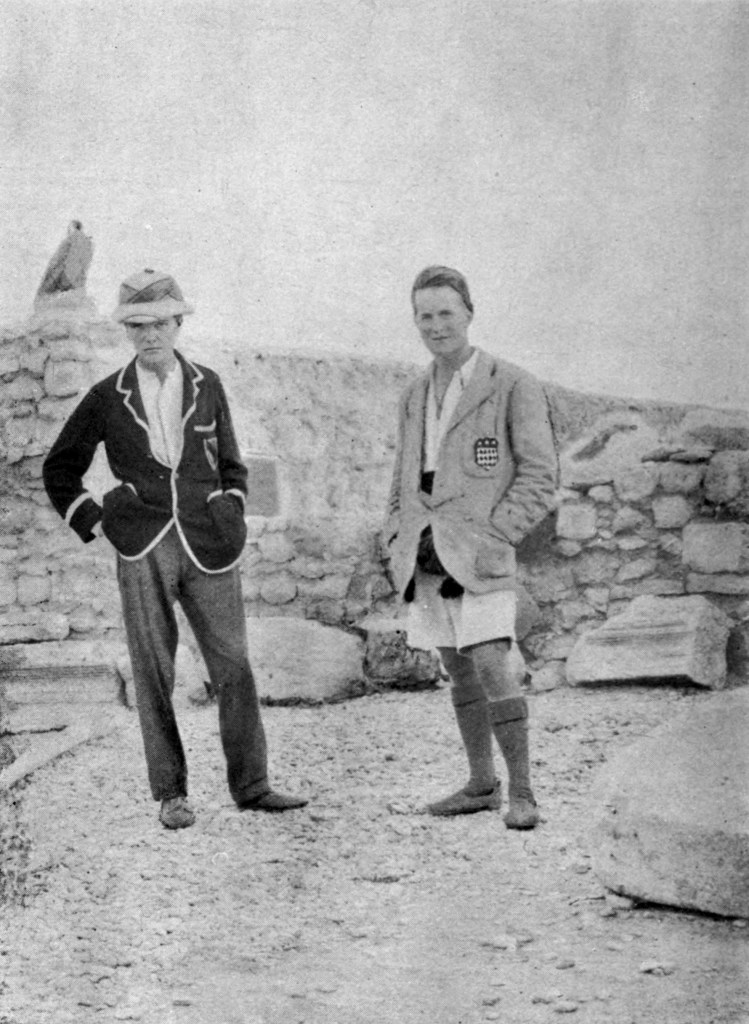
The sands of time remained endless swirling while treasure seekers plunder the ancient tombs until an adventurous Pietro Della Valle was brought over to notice strange inscriptions on mud bricks scarcely visible in the shifting sands. As quickly as Valle arrived, he vanished from my mind’s eye as the sands consumed the ruins. Then upon the horizon, the famed pioneer of modern archeology, Leonard Woolley, appears to reveal the resplendent history of Ur in meticulous detail and to begin to tell the tale of this magnificent ancient civilisation. Before uncovering Ur’s magnificent buried secrets, Woolley worked with T.E. Lawrence excavating the Hittite city of Carchemish in northern Syria and together they worked on The Wilderness of Zin Archaeological Survey, which was intelligence gathering expedition before the outbreak of the Great War.

Shaking my mind free of these historical musings, I recalled a few days earlier as I disembarked from a Sea King into enveloping darkness of the freezing desert air. The tail gunner grabs my arm and yells “What are you reading?” Looking down at the book through my night vision, I handed him a well-worn copy of T.E. Lawrence’s book, The Seven Pillars of Wisdom. The ensuing actions along the ancient banks of the Euphrates and Tigris would turn out to be some of the most intense engagements during the initial months of the invasion. The supposed intent of the mission was to liberate these oppressed people from a tyrant, but a portion of the population forcefully opposed our confused and dubious efforts. In short order, it would become apparent to all, that the Iraqi people had their own notions of government informed by the theocratic principles that lay at the heart of Islam and would begin to plan their response to our interference within their social order. The invasion was ending, but the war was just beginning on multiple fronts.
Over the next few months, a violent Islamist insurgency hastened to fill the power vacuum left by the collapse of all levels of the despotic Hussain government. During the ensuing battles with the Islamist insurgents, both Sunni and Shia, we would lose four men in my section to enemy fire, and one would commit suicide upon our return to barracks. It is one thing to read about turbulent historical events in books from a setting far removed from the actual places where those events occurred, but it is quite another thing to be physically present amidst the ruins of numerous ages as history plays itself out before your eyes. Truly, the physical weight of history can be an abysmal matter to contemplate. Nevertheless, our collective past is very much alive. The consequences of the past are all around us shaping the present and influencing individual decisions that have a clear impact upon the future. Accordingly, these brutal life experiences have demonstrated to me the importance of transmitting to each subsequent generation the essential principles of human freedom that promotes human flourishing and to impart within each young mind an intense desire to persevere our God-given rights.
A Hundred and Thirty Years of Confused Theories Concerning Human Nature

F.A. Hayek in his cautionary book, The Road to Serfdom, advocated for a top-down approach to spreading the principles of individual liberty that form the foundation of classically liberal ideas that were considerably influenced by Judaeo-Christian principles (Hayek, 2007). Yet, since the beginning of the twentieth century, we have gradually witnessed the complete usurpation of our education system by the ideas that have their origins on the far Left. Indeed, at all levels of education, our youth are inculcated with one political worldview that openly neglects alternative perspectives and ignores the duty to objectively teach all sides of the political debate (Martin et al., 1968, Shortt, 2004, Moore, 2013, Hasson, 2018, Horowitz, 2018, & Parker, 2019).
At the core of current notions of child-centred and out-come based education are the philosophical paradoxes of the men who fashioned this progressive educational model; namely Jean-Jacques Rousseau, Karl Marx, Horace Mann, John Dewey, and Michel Foucault. Today’s educational model has inherited the child-centred ideas of Rousseau and Dewey, which were adapted to Mann’s Prussian “scientific” mechanisation model suited to the needs of a nation on the verge of an industrial revolution. By the nineteen sixties this convoluted muddle of theories was further blurred with an infusion of Marxist Frankfurt School’s critical theory, and by Foucault’s postmodernist musing (Ornstein et al. 2017). Consequently, our current model is the most perplexing combination of these approaches. It is lamentable to note that the many misconceptions about human nature that serve as the guiding principles of these far-left educational theories or their complete failure to achieve their stated goals (they have reached their Fabián objectives) have not precluded these ideas from obtaining broad recognition amongst teachers and at all levels of the educational industrial complex. (Martin et al., 1968, Bloom, 1987, Hirsch, 1987, Nord, 1996, Short, 2004, York et al., 2011, Smith et al., 2011, Hasson et al., 2018, Horowitz, 2018, & Caplan, 2019).
What’s more disconcerting is the fact that many of these educators openly declare that parents should be involuntarily coerced by government into handing over their children’s minds to the state to nurture and inculcate them with the “right ideas” of political correctness (Martin et al., 1968, Bloom, 1987, Pestritto, 2008, Hasson, 2018, Horowitz, 2018, & Harris, 2019). Parents indeed have a sacred obligation to raise and educate their children prudently. These parents may also choose to collaborate with government-administered schools to achieve this noble aim. Yet, progressive educators desire to replace the parent’s influence over their children with that of the state. In so doing, the path that our society is heading towards leads us to an authoritarian state where the government dictates every aspect of our lives. The ultimate purpose of government-administered education is to train obedient ideologues, who are incapable of thinking independently about the world around them and, thus, must employ their unbridled emotions to fill the gap within their core knowledge. Such notions ought not to be the aim of education and parents should have the freedom to choose the educational model that reflects their personal values and beliefs.
Another significant issue with the progressive model is the supposition that student choice must not be violated. These notions of student choice are predicated on the idea that the child has enough knowledge to create and define their own educational outcomes. This idea is purely utopian in nature, which only leads to curricular and moral disorientation within the child’s mind; not to mention academic tedium. Any parent can refute this notion by recounting examples of giving their child a choice and the inevitable outcome; eating a whole container of ice cream in one sitting or not eating their vegetables, which stunts their growth. It is puzzling to consider the contradictions that the advocates for student-led and choice models make in regard to this idea. Are choices about education and health any different?
Being obligated to learn something, or to eat your vegetables, when it is not of one’s choosing is not inherently harmful. Consider all the instances you were required to do something that, upon reflection, made you grateful for enduring that task or course. Teaching children self-discipline is one of the greatest gifts that a parent or teacher can impart upon a young mind. The ability to regulate one’s emotions and the petty dictates of desires grants the individual the autonomy to transcend one’s capricious passions. Moreover, there is a most excellent joy to be had in completing an arduous task that does not permit one instant gratification or sparks one’s interest. The implications of these prudent and moderating lessons have constructive consequences that echo throughout a person’s life.
The confusion surrounding the nature of young minds and humans, in general, lays at the heart of the progressive model’s repeated failures to achieve their stated aims. Our fundamental nature is set as Thucydides (2008) observes thousands of years ago in his treatise on human nature within The History of the Peloponnesian War. Indeed, Classical philosophers and Christian theologians ardently contended that we are not blank slates to moulded to suit the will of a self-appointed priest class, nor are we angels. If we were inherently moral and understood the reciprocal nature of our rights, then no government would be necessary. Moreover, if angels were to control the levers of government no limits on the power of government would be required, as James Madison’s persuasively recounts in The Federalist Papers (Bailyn, 1998, pp. 182-186). Humanity has a clear history that is replete with the countless examples of our inherent tendency to steal and to use the coercive power of government to take our neighbour’s wealth that we need not earn from the sweat of their own labour. When stealing from another is more comfortable than acquiring wealth from one’s own labour, limits on government and education that tempers the majority’s unbridled desires are desperately required; as Bastiat (2012) reminds us.
Furthermore, we have a demonstrated history of committing mass acts of horrendous violence on our fellow man, even in societies with a highly educated population (Waller, 2007). As a consequence, we require a moral code of conduct that is tempered with a measured liberty where all person respect the reciprocal nature of our God-given rights, and we have the freedom to fail. Failure teaches a young mind the virtue of perseverance and to have the courage to carry on in the face of adversity. Thus, it is a reckless belief to expect a child to have the appropriate amount of knowledge in order to navigate life’s tribulations and to find the prudent path that leads to moral maturity. The progressive model only leaves young minds in a state of confusion with no moral compass to guide their actions, as our present national malaise unmistakeably demonstrates (Shortt, 2004, Sowell, 2002, 2006, & Smith 2011).
The progressive model clearly has replaced the joy of learning with standardised testing and a state-mandated curriculum, which sucks the lifeblood out of learning. Imagination, curiosity, independent thinking, and the pure joy of learning should be restored to education. Assessments of acquired knowledge should move beyond standardised tests, and more young minds should be offered the opportunity to pursue trade apprenticeships instead of forcing them to endure countless hours of lectures that only prepare them for a droll office jobs or ideologically driven college courses that have little to do with shaping young minds to pursue the good. Additionally, moral instruction should be re-introduced into the classroom to arm these young minds with principles that prudently guide them in their daily conduct. After years of documented failures, we urgently need to reconsider the aims of education and our pedagogical practices (Shortt, 2004, Sowell, 2002, 2006, & Smith 2011).
Setting aside the ever-fleeting trends concerning contemporary notions about what constitutes a proper education, we must take the time to reflect in order to consider the purpose of education, in a way that accounts for human nature. Hence, it is past time to re-examine classical ideas of how to impart knowledge from one generation to the next. Before we discuss what classical doctrines combine to form the pillars of a prudent education, one must answer an essential question about the nature of education: What is the fundamental purpose of education? Depending on how one answers this critical question will dictate a teacher’s educational philosophy. Consequently, if a teacher considers the singular telos, ultimate purpose, of education is to produce young minds that are college and career ready, then there is negligible need for practical lessons that assist students in fostering personal virtues. On the other hand, if the telos of education aims to produce virtuous and moral citizens that can think independently about complex ideas, then prudence dictates that we ought to incorporate a Christian philosophy of education that is infused with classical ideas into our thoughts when answering this fundamental question.
A teacher that strives towards excellence must understand that which answer to the question mentioned above travails will determine what content and morals if any, get taught to our nation’s youth. Thus, the contemplative teacher must endeavour to investigate the differing philosophies of education in order to discover what ethos best suits the ultimate purpose they are attempting to achieve in the classroom. For myself, the product of this examination has led me to the conclusion that the only way out of this increasingly violent national polarisation is to return to a modified Classical model structured on the ideas advanced by classical education scholars in their respective works (Walsh, 1931, C.S. Lewis, 1988, Hicks, 1981, Pangle et al., 1993, Warren Nord, 1995, John Locke, 1996, Littlejohn et al., 2006, Richard Gamble, 2009, York et al., 2011, Terrance Moore, 2012, Kristján Kristjánsson, 2016, & Susan Bauer, 2016). Moreover, this return to the traditional American notion of rational thought must occur first in our primary and secondary schools. Consequently, this struggle must be a bottom-up effort that ought to be comprised of humble men and women, who ardently seek to restore our national heritage to its proper standing, as well as to ignite the flame of liberty within the minds of their students.
The various classical schools’ models that these scholars promote most completely facilitate young minds to recognise who they are as a person and flourish in that uniqueness. The foundation of these schools is based upon a curriculum that is devised to nurture curiosity and inspire creativity so that students discover the pure joy of learning. Classical learning is concerned with the prudent formation of the mind and soul. Indeed, during all junctures of classical education, students quench their curiosity within the Fountain of Living Waters while contemplating, engaging with, and expressing their thoughts about the numerous multifaceted ideas that are deeply embedded within the curriculum.
The subsequent ideas and pedagogical strategies presented in this rumination serve as the author’s guiding ethos that is intended to be a precise mirror image of his current perception of the principles that constitute a proper education, as the Founders of this great nation intended. Moreover, these philosophies also demonstrate the intensity of his understanding of the multifaceted elements that form a prudent education that has been built upon by successive generations of both Classical and Christian philosophers. Lastly, this rumination is a reflection of what the author believes to be the core tenets that encompass what it means to be a teacher, who continually strives towards excellence in pursuit of the good.
Philosophy of Schools & Learning

The Fundamental Purpose of an American Education as the Founders’ Envision
Continuing on the path of discovery, the ardent seeker of Truth must attempt to find an alternative to the current system. Thus, it was during this research that I came across the classical school model. After reading into the history and pedagogical methods that form the foundation of that model, I became convinced that this system is a powerful tool with which to combat the illiberal forces arrayed against those advocating for the freedom of conscience. Consequently, one should prudently recognise the fact that a classical education offers the only way for Christians and liberty-minded parents to ensure that their children receive an objective education that enables them to become virtuous citizens, who know how to think independently about complex ideas and not what to think about those ideas.
To clarify what type of classical education that I am referring to in this elucidation is a model that should be more appropriately characterised as a Traditional American Education. Such an approach is one that is inspired by Classical, Enlightenment, and Judaeo-Christian ideas and principles that informed the Founding generations of this great nation (Walsh, 1935, Bailyn, 1967, Lutz, 1988, Wood, 1991, Pangle et al., 1995, Holmes, 2006, & Fea, 2016). Does that not imply that such an education will produce Americans, who know the limits of governmental power, who are personally responsible for their conduct, are virtuous in demeanour, understand the reciprocal nature of our rights, and remember these fundamental truth “that all Men are created equal, that they are endowed by their Creator with certain unalienable Rights, that among these are Life, Liberty, and the Pursuit of Happiness….?” (Jefferson, 1984). Our Founders’ were humble men and women, who were ardent seekers of Truth. As a consequence, they had a natural sense of wonder that led to an insatiable curiosity, which, in turn, drove them to seek the Truth in order to more perceptively comprehend the elements that form the pillars of a government that attempted to protect the people’s God-given liberties from the inherently fallen nature of humanity.
Our nation’s founding generation established a republican government modelled on Greek theory and Roman practical principles about how government should justly conduct itself. Then these classical ideas of the consent of the governed, limited government, and government to promote liberty were infused with Enlightenment philosophies and Judaeo-Christian values (Rahe, 1994, Pangle et al., 1995, Holmes, 2006, & Fea, 2016). It was this combining of different threads of thought that enabled the Founders to attempt to form a government that would finally enshrine the good as its central function. Nevertheless, this inspired generation knew that such a government would only remain an institution that governs justly, as long as, “We the People” actively embrace and emulate these enlightened values within our daily lives (Shain, 1996, Bailyn, 1998, & Thompson, 2019).
Such an ideal form of government would inherently protect individuals, advance liberty, and constrain humanity’s natural inclination towards tyranny. As historian Gordon S. Wood (1998) notes in his influential book, The Radicalism of the American Revolution, “Such classicism was not only a scholarly ornament of educated Americans; it helped to shape their values and their ideals of behaviour” (p. 49). Accordingly, for the Founders, the “traits of character most praised were classical ones,” and the classics were “crucial to their attempt to understand the moral and social basis of politics” (Rahe, 1994, p. xxvi). Classicism thus, filtered through the experience of the Enlightenment, which in turn inspired the practical intellectuals of early American thought and culture for several generations after the founding. Such notions only began to lose their influence after the exponential growth of the Federal government in the aftermath of the War Between the States and in the wake of urbanisation began to present a once-rural society with challenges that, on the surface, the founding ethos of this nation seemed not to address.
Despite our failure to learn the lessons of the past, with keen curiosity, our Founders were looking into the depths of our human saga for insights to assist them in forming a government that would endure the ages, as well as human nature. In an age of absolute monarchy, there were precious few truly republican forms of government to emulate. Indeed, John Locke’s influential discourse, Two Treatises of Government, was written during his exile from England in the newly liberated Netherlands. Employing Locke’s ideas, the Founders’ wanted to protect citizens against the monarchical rule of great men, who, as Paine (1995) recounts, were the loathsome descendants of lawless “banditti” (p.17) and to make sure that when demagogues found a voice within the majority, a virtuous minority would hold the forces of tyranny at bay.
For the Founders, the ancient chronicles of opposition to tyranny and monarchy depicted in such classical narratives like Plutarch’s Lives of the Noble Greeks and Romans (1975) or the account within the Bible provided vivid illustrations of heroism and virtue. In addition, these autodidactic men admired antiquity’s unparalleled achievements in the political order. From the Greeks, we received the principle of Government by the Governed and that notion that unrestrained democracies are always doomed to degenerate into despotisms. Most notably, our Founders’ desired to replicate the Roman Republican models of law and jurisprudence, better understood today as the principle of the Rule of Law. These, the Founders’ tell us, are the foundations of enlightened liberalism, and as such, deserve our continued respect and must be taught to each generation of Americans. The Greeks and Romans had manifested through bitter trials the principles of just governance, the Rule of Law, liberty, and due process over the course of centuries of human experience. Hence, the Founders’ knew that these first versions of democracy and citizenship were worthy of genuine consideration by all Americans who wish to keep man’s fallen nature within prudent confines.
To briefly illustrate this point, Plutarch’s account of Cato the Younger, adapted was by the great 18th-century playwright Joseph Addison, profoundly influenced the Founders’ as did no other classical narrative. Indeed, in order to spur morale, George Washington produced the play for his troops at Valley Forge. Facing the encroaching Caesar and his divided forces, in the Addison (1984) version, Cato the Younger makes the following speech on liberty:” The hand of fate is over us, and heaven…Exacts severity from all our thoughts: It is not now a time to talk of aught but chains or conquest; liberty or death” (p.43).

The performance does not have a conventional ending that modern readers would find relatable. The hero, Cato, is defeated on the field of battle by the unbridled ambition of Caesar. To retain his honour, Cato commits suicide rather than endure a life of serfdom and submit to the usurpation of the Roman Republic by the unbridled ambition of a despotic Caesar. Cato courageously chose to take his own life rather than suffer a disgraceful surrender, the loss of his liberty, and live to see the destruction of his beloved republic. Cato’s courage in the face of defeat by the forces of tranny was a wellspring of a profound stream of early American thought, one shared by the majority of that founding generation, as historian Gary B. Nash (2007) unintentionally points out in his partisan book, The Unknown American Revolution. Proverbs of “Live free or die” and “Give me liberty or give me death” were not mere pontifications of empty rhetoric. On the contrary, such maxims were honest sentiments of the age, which were informed by internalising the lessons passed on to that revolutionary generation by the Greeks and Romans, as well as the profound teachings contained within the Bible.
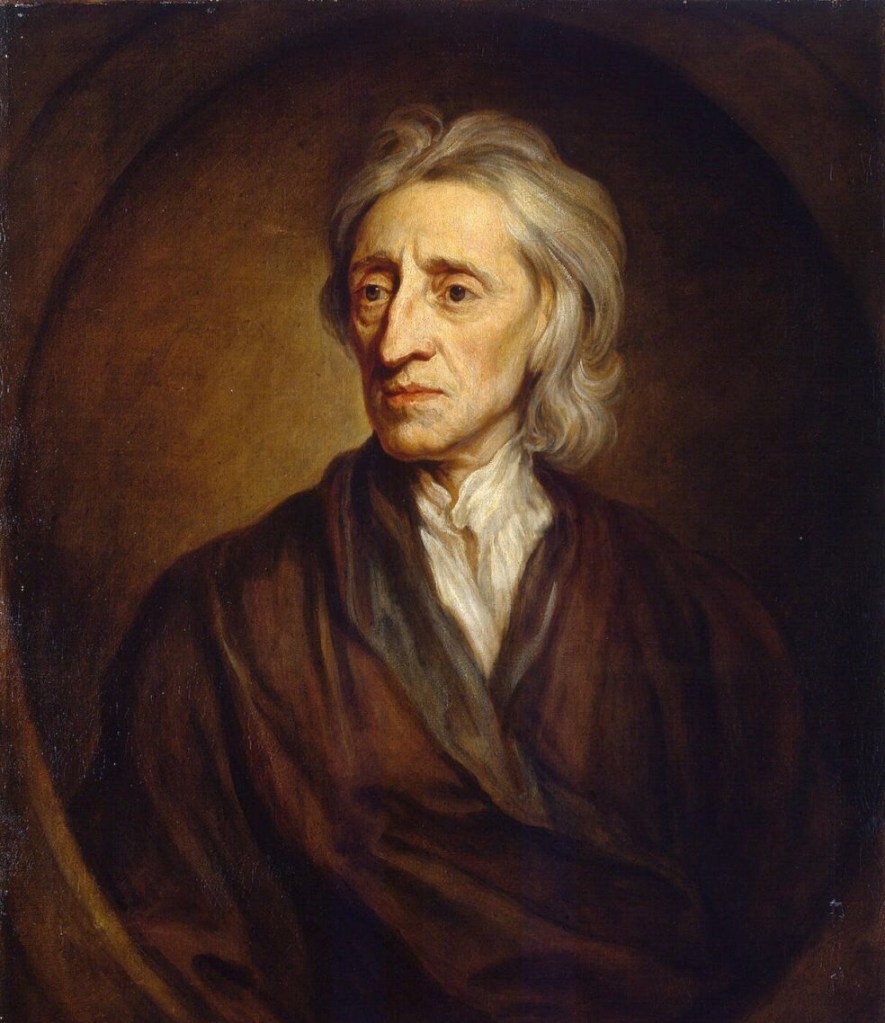
Another of the primary scholarly resources the Founders’ utilised to form their thoughts on a prudent education was John Locke’s Some Thoughts Concerning Education (1996). In that rumination on the proper elements that form an appropriate education for the discerning parent, Locke lays out the central argument that one should raise children not merely to be scholars, but also to create virtuous and rational individuals. Suitably, it is observed that Locke asserts that the ends of education are to create an individual who obeys reason instead of the perplexed dictates of passion (Locke, 1996). In addition, Locke places great emphasis on the nature of that education. For a prudent education to take place, parents and teachers should develop within the child a deep sense of wonder, which spontaneously forces them to be keenly curious about God’s creation. The core tenet that facilitates this type of education is passionate teachers working in conjunction with steadfast parents, who provide a home environment that encourages academic inquest and the development of virtues (Locke, 1996).
The Founders’ also comprehended the value of the continual study of history and the transmission of those prudent lessons onto subsequent generations. Historian R.G. Collingwood (1993) eloquently conveys this notion of the importance of continually studying history in the proceeding quote, “History is for human self-knowledge…the only clue to what man can do is what man has done. The value of history, then, is that it teaches us what man has done and thus what man is” (p.10). The Founders’ might add to that last line: “by extension, history teaches us what man will do in the future.” The Founders’ believed that human nature was set, and the only way to combat our natural predispositions toward tyranny was to develop virtue within the body politic. That is the reason why they attempted to place constitutional mechanisms to limit what they identified as the darker motives of man. Their Enlightenment ideas were tempered with Judaeo-Christian view of human nature, which made them hope that our fallen nature could be limited by prudently instructing our youth in principles of liberty and by creating institutions that would check our unbridled ambition in order to prevent the government from becoming dictatorial as James Madison articulates in The Federalist Papers Nos. 51 and 55 (Bailyn, 1998, pp. 182-186, & 202-207).
At the same time, the Founders’ were under no uncertain misapprehensions about the prospect of developing such ordered liberty within our society without there being some significant level of virtue within the citizenry (Pangle et al., 1995, Shain, 1996, Bailyn, 1998, Thompson, 2019). They realised that is was crucial to recognise that the government could not legislate civic morality. Nor could such notions be produced by a system of incentives provided by the government or adjudicated by a judge. On the contrary, they knew that only institutions of civil society, the complete family unit, dedicated teachers, and faith communities, were the only positive influencers of morality within the body politic. Moreover, they knew that their efforts were untested. Experiments do fail, especially when dealing with the capricious whims of the human soul, and they knew that such an outcome was inevitable if certain ideals were not fostered with the public. Our nation’s Founders arrived at such a conclusion, through the study of history, they knew Democracies and Republics had been attempted before only to have the society lose faith in their institutions, which allowed despotic forces to gain the upper hand.

By identifying the importance of the continual study of the classics, the Founders’ codified these thoughts into our nation’s first laws concerning education. Thomas Jefferson (1984) attempted to influence Virginia’s local education system with his A Bill for the More General Diffusion of Knowledge. Jefferson coherently expresses the sentiment of the age in the preamble his proposed law:
“Whereas it appeareth that however certain forms of government are better calculated than others to protect individuals in the free exercise of their natural rights, and are at the same time themselves better guarded against degeneracy, yet experience hath shewn, that even under the best forms, those entrusted with power have, in time, and by slow operations, perverted it into tyranny; and it is believed that the most effectual means of preventing this would be, to illuminate, as far as practicable, the minds of the people at large,…And whereas it is generally true that people will be happiest whose laws are best, and are best administered, and that laws will be wisely formed, and honestly administered, in proportion as those who form and administer them are wise and honest; whence it becomes expedient for promoting the publick happiness that those person, whom nature hath endowed with genius and virtue, should be rendered by liberal education worthy to receive, and able to guard the sacred deposit of the rights and liberties of their fellow citizens, and that they should be called to that charge without regard to wealth, birth or other accidental condition or circumstance;…”(p. 365).
From Jefferson’s eloquent statement on the intent of education, we can discern two powerful ideas. Through the study of history, he concluded that a virtuous citizenry, acting in their self-interest, was the only real bulwark against the oppression that inherently plagues human nature. The first point is self-evident, yet in our current credentialed society where we continuously defer our personal opinions to experts who allege to hold some specific understanding because they have obtained an expensive piece of paper. We choose not to exercise our own conscience in order to find out for ourselves what is the correct choice or action to take. Such notions of allowing self-espoused experts to dictate to us the meaning of truth is to engage in wilful ignorance and self-deception. Can we not think, read, and make prudent judgments for ourselves? Jefferson would argue that we can, and that is critical that must make those decisions because we are the only ones who are going to be advocates for our rights. Once one accepts Jefferson’s initial argument, then it is logical to agree with his second point concerning a liberal education as a means to facilitate the preservation of a free and vibrant republic.
Historians have hailed Jefferson for his writing that endorsed taxpayer-supported public education, though he later changed his mind on this point and was generally against compulsory education (Honeywell, 1931. pp. 56-60). Jefferson recognised that schools ought to be institutions that assisted in the formation of virtue and the spreading of core knowledge. Jefferson’s (1955) belief in the common man’s ability to employ reason was palpable in a letter to his nephew Peter Carr, “State a moral case to a ploughman and a professor. The former will decide it as well, and often better than the latter because he has not been led astray by artificial rules” (pp. 14-19). Conversely, progressives like John Dewey assumed that it was the institution of the schools that would instruct the student in the values of the society. Personal responsibility and social morals are not qualities that are inherent to the individual, but, instead, such thing ideas are to be trained into blank minds through the schools in order to promote social ends (Pestritto, & Atto, 2008, pp. 125-134).
Apart from Jefferson, there are other examples of the Founders’ intent, such as the Massachusetts School Law of 1789, which mirrors Jefferson’s thoughts on the matter and articulately summarises the Founders’ view of the fundamental purpose of education, as well as the State’s role in guiding the parents whose responsibly it was to organise the schools. The 1789 law lays out these notions in such persuasive language that one cannot find an illustration that more profoundly exemplifies the Founder’s intent:
“Whereas the Constitution of this Commonwealth hath declared it to be the duty of the General Court, to provide for the education of youth; and whereas a general dissemination of knowledge and virtue is necessary to the prosperity of every State, and the very existence of a Commonwealth:
Section 1. Be it enacted by the Senate and House of Representatives, in General Court assembled…That every town or district within this Commonwealth…shall be provided with a School-Master or School-Masters, of good morals, to teach children to read and write, and to instruct them in English language, as well as in arithmetic, orthography, and decent behaviour…And every town or district containing two hundred families, or householders, shall be provided with a grammar School-Master, of good morals, well instructed in Lain, Greek, and English languages…
Section 4. Be it further enacted by the authority aforesaid, That it shall be and it is hereby made the duty of the President, Professor and Tutors of the University at Cambridge, Preceptor and Teachers of Academies, and all other instructors of youth, to take diligent care, and to exert their best endeavours, to impress on the minds of children and youth, committed to their care and instruction, the principles of piety, justice, and a sacred regard to truth, love to their country, humanity, and universal benevolence, sobriety, industry and frugality, chastity, moderation and temperance, and those other virtues which are the ornament of human society, and the basis upon which the Republican Constitution is structured. And it shall be the duty of such instructors, to endeavour to lead those under their care ( as their ages and capacities will admit) into a particular understanding of the tendency of the before mentioned virtues, to preserve and perfect a Republican Constitution, and to secure the blessings of liberty, as well as to promote their future happiness; and the tendency of the opposite vices to slavery and ruin“(pp. 416-421).
In all honesty, after one genuinely reflects upon the core principles that this eloquent law encourages, one would be hard-pressed to find a more comprehensive mission statement for the formulation of the proper telos of a Traditional American education. Our nation’s first laws contain an air of justice and beauty that the majority of laws written during the subsequent progressive waves evidently lack. Perhaps then we should not view education through progressive philosophies, nor should we allow imprudent progressive practices to affect the outcome of the Founders’ noble aims for properly educating of our nation’s youth. The purposes of education should not mechanically produce young persons who are college and career ready. Such a system creates people that are mere carbon copies of each other and crushes the individual under the boot of conformity. What is more, soul-crushing about our current policy is that it removes the pursuit of the good from the educational equation.
Setting aside our current educational systems failing, from an analysis of the 1789 law one can discern a few key points: Firstly, education was understood to be a State and Local matter, thus not under the authority of the Federal government. A local approach to teaching was a commonly held enlightenment principle. There is no doubt that Jefferson (2012) adhered to the widespread belief of the age that a “general diffusion of knowledge” is vital to a citizenry maintaining a society based on individual liberties. Jefferson (2012) expounds upon this notion further by arguing that,
“if a nation expects to be ignorant & free, in a state of civilisation, it expects what never was & never will be. the functionaries of every government have propensities to command at will the liberty & property of their constituents. there is no safe deposit for these but with the people themselves; nor can they be safe with them without information. where the press is free and every man able to read, all is safe” (pp. 328–331).
From Jefferson’s Notes on the State of Virginia (2012), we learn that his education model called for a highly dispersed approach in which consisted of minor “districts of five or six miles square” that were tasked to create and manage their own schools. Jefferson advocated for local control because he had an inherent apprehension about centralised power. After all, an unchecked government always degenerates into arbitrary abuses if the people no longer hold the officials within the government accountable.
Consequently, Jefferson (2012) thought it most imprudent for the government to “take this business into its own hands” (p.10). Indeed, he considered the idea of government-run school to be so profoundly foolish that he stated, “any authority of the government, then by the parents within each ward…is a belief against all experience.” Such an observation that the government can no more administer schools than it can manage “our farms, our mills, and merchants’ stores,” was blatantly evident to the Founders’ because the regulation of such things was outside the purview of just government (pp. 435–439). In that same thread of thought, Jefferson (2012) wrote in his “Plan for Elementary Schools,” he once again cautioned that if government bureaucrats were able to centralise the administration of schools under one governing agency, “were these schools to be established on the public funds, & to be managed by the Gov, & council, or the Comm,…they would be badly managed, depraved by abuses, & would exhaust the whole literary fund” with little achieved by such efforts (p. 10-15).
Does this situation sound remarkably familiar? An honest reflection upon our current public-school system and its ranking with other nations clearly demonstrate the truth of Jefferson’s arguments. Perhaps we need to take a step back, breathe, then apply logic and reason without emotion to inform our decision before we contemplate a path forward. Rigours and uniform standards will not solve this nation’s educational issues. National standards do not take into account local realities and the needs of individual communities. What works in one community rarely works in another. It is rational to conclude then that the credentialisation of teachers and their training requirements should be tailored to the local community’s needs. Top-down solutions have not worked. The test scores from American schools since 1971 (NAEP, 2012) stand as a testament to the failure of Federal education programs. On the State level, things are not much better, considering teachers unions and special-interest groups have devoured funds that should be earmarked to address the pressing issues facing our public schools (Governing, 2016).
The second sensible proposal to consider within the 1789 law is the detailed attention to morals and virtue for both the teachers and their students. The law cogently explained what the Founders’ meant by virtue and is one of the fundamental purposes of education was to foster such character development within the student body. The Founders’ understood that there is a strong, reciprocal relationship between law and the social-cultural constitution of a society. The critical foundation of public morality and civic virtue is necessary to support our Constitution. Without such attributes, the Constitution cannot operate successfully or endure. Accounting for this observation, the Founders’ understood that an education in civic virtue is essential to the perpetuation and flourishing of our constitutional republic. Accordingly, moral principles diffused amongst the citizenry serve to unite and bolster humanity’s inclination to the peaceful observance of the law. Indeed, our Founders’ revealed, from the study of history, that the raw materials for the exercise of proper governance are citizens who can act ethically without coercion, who do not intentionally violate the rights of others, and who cherish their liberty enough to demand that government’s inclination towards the use of force is curtailed to the extreme.
Such freedom, the Founder’s believed, were upheld on three great pillars: (1) Natural law and unalienable natural rights that are granted by God, as well as, the understanding that those individual rights are reciprocal in nature. (2) A written constitution assures the there is a government of laws, not of man, and that document should serve as a manual for the people against their government. It should sever as a continual point of reference that the people can point to during times where the government turns despotic. (3) A virtuous citizenry is the most excellent defence against tyranny and the arbitrary rule of man. Thus, voting for the lesser of two evils naturally leads to a malevolent government that is populated by bureaucrats that do not adhere to just laws. Instead, such a government promotes the Rule of Man, where the law is whatever a majority says the law should be, which is devoid of any underlying principles; accept the notion that might makes right.
These values can be taught to some extent in school, but the deepest and most profound moral and social learning takes place within the home, and that moral order is strengthened with the study of God’s Word. While moral instruction within the home is vital, it is within a school setting that students learn to be tolerant and to respectfully cooperate with others even when they may not get along. They learn the essential principles of patience, honesty, and prudence, all of which are required for any significant enterprise involving multiple persons is to succeed. They learn that failure is not an end state. Instead, they must have the courage to pick themselves back up and to persevere in the face of adversity. It is for these reasons that the Founders’ advocated the development of personal virtues within the student body and why students must observe the differences between conflicting political beliefs. With this combination of virtue and a non-partisan evaluation of diverse political ideas, it is hoped that the students will make up their own minds as to which path is the correct one to follow. It is evident that the Founders’ thought the economic and political lifeblood of the Republic inherently depended on knowledge and virtue.
The third point that one observes in the 1789 law is that it calls for the teaching of classical languages, which enables the mastery of the English language. Learning Latin not only gives the student a richer conception of the origins of the English lexicon, but it also cements within student’s mind the language footings required to learn other languages that are branches of Latin. Additionally, the study of Latin grammar solidifies the student’s awareness of the justifications for, and the use of, the components of speech that are taught in their current English Language Arts classes (e.g., plurals, nouns, verbs, prepositions, direct objects, tenses). The mastery of English language in conjunction with leaning Classical languages makes sure that these young minds have the oratory skills with which to explain complex ideas proficiently and to convey those ideas through the use of cogent speech persuasively. Moreover, those who can write a compelling argument or delight a reader with beautifully written stories will be sought after in our increasingly digital world (Kopff, 2001).
Finally, we observe with the 1789 law that if these principles are not the proper aims of an education system; they will lead to slavery and ruin. This last point is a genuinely poignant prognostication for our own time. Jefferson’s (2012) intense decentralisation was the linchpin of the Founder’s intent for public schools, and he cautioned the people of the potential consequences should this vital element be disregarded:
“No, my friend, the way to have good and safe government, is not to trust it all to one; but to divide it among the many, distributing to everyone exactly the functions he is competent to. let the National government be entrusted with the defence of the nation, and it’s foreign & federal relations; the State governments with the civil rights, laws, police & administration of what concerns the state generally; the Counties with the local concerns of the counties; and each Ward direct the interests within itself. it is by dividing and subdividing these republics from the great National one down thro’ all it’s subordinations, until it ends in the administration of every man’s farm and affairs by himself; by placing under everyone what his own eye may superintend, that all will be done for the best. what has destroyed liberty and the rights of man in every government which has ever existed under the sun? the generalising & concentrating all cares and powers into one body, no matter whether of the Autocrats of Russia or France, or of the Aristocrats of a Venetian Senate. and I do believe that if the Almighty has not decreed that Man shall never be free, (and it is blasphemy to believe it) that the secret will be found to be in the making himself the depository of the powers respecting himself, so far as he is competent to them, and delegating only what is beyond his competence by a synthetical process, to higher & higher orders of functionaries, so as to trust fewer and fewer powers, in proportion as the trustees become more and more oligarchical (pp. 435–439).
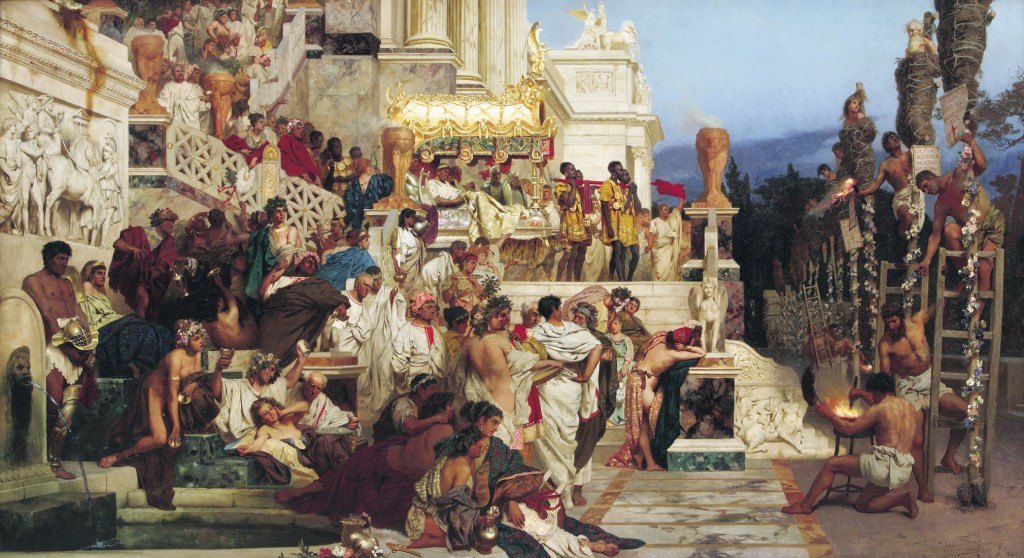
As one can discern, Jefferson maintained that the proper allocation of power among federal, state, county, and local agencies were crucial to the nation’s federalist system prudent limits on the power of government. Moreover, when citizens are emboldened to control their fortunes at the regional level, “where every man is a sharer in the direction of his ward-republic, or of some of the higher ones, and feels that he is a participator in the government of affairs not merely at an election, one day in the year, but every day” (p. 39). Such moral and virtuous citizens will then safeguard their hard-won liberties; “when there shall not be a man in the state who will not be a member of some one of its councils, great or small, he will let the heart be torn out of his body sooner than his power be wrested from him by a Caesar or a Bonaparte.” (p.39). One must bear in mind, that human history is replete with humanity’s systematic, arbitrary abuse, and control of the coercive power of government by elites who think they are more suited to rule over the masses than the ordinary person. Historians writing hundreds of years from now might view the individual liberties that have existed for such a minuscule fraction of humanity’s population, for such a woefully brief period, as a historical novelty that naively attempted to defy human nature. These same historians might also notice with equal curiosity that such a time was only a transient spectacle before humanity succumbed to its natural state, the abuse of force by an arbitrary government controlled by those who know what is best for you.
Given the prudent arguments and the intent of the Founders’, the sensible person recognises that the task that now lays before us is to take responsibility for our local communities in order to afford the children living in that area a truly awe-inspiring education that awakens within them their inherent sense of wonder. Once the free thinker makes the internal moral and mental adjustments to their thought processes, all interested parties must become keenly involved in that process. With this in mind, it is prudent for us to consider the thoughts the renowned nineteenth-century classically liberal statesman, Auberon Herbert (1885), who made the following argument:
“He who voluntarily sacrifices his own interests to send his child to school is on the road to raise himself and the society to which he belongs, but he who simply pays mechanical obedience to a law, condemns himself – and all others, as far as his influence is concerned – to drowse on forever with unawakened senses” (p.49).
Both Herbert, Locke, the Founders’, and modern classical school advocates are stressing the fact that having dedicated teachers is only one side of the equation. Parents who wish to have their children prudently educated must take charge of that effort and seek out a curriculum that achieves their desired educational outcome. Gone are the days when parents could blindly put faith in their local educational institutions. As a consequence, both teachers and parents must work hand in hand to make sure that their school actually does teach what they purport in their mission statement. Additionally, both parties ought to ensure that all students are afforded the educational resources they require to become ardent seekers of Truth, who view the world around them with curious minds and emphatic hearts that contain a stalwart resolve to pursue the good in all their endeavours.
If even one element of the equation is missing the odds of a single teacher assisting one wayward student is limited. In my mind, the only way forward is for teachers to work with other liked mind individuals within their communities to make a positive change within their localities. There is a fundamental truth that can be observed when a community thrives on a moral level; all within the bounds of that social group flourish as well. In the end, is that not the ultimate goal of human life to pursue the good in all things and, by so doing, we flourish as individuals who aim at spiritual rewards and not at temporal ones? Why have we forgotten such wisdom in our current age of pedagogical theories driven by innumerable and, often, contradicting studies? Has humanity profoundly changed so much that fundamental Truths no longer apply?
Instructional Practice
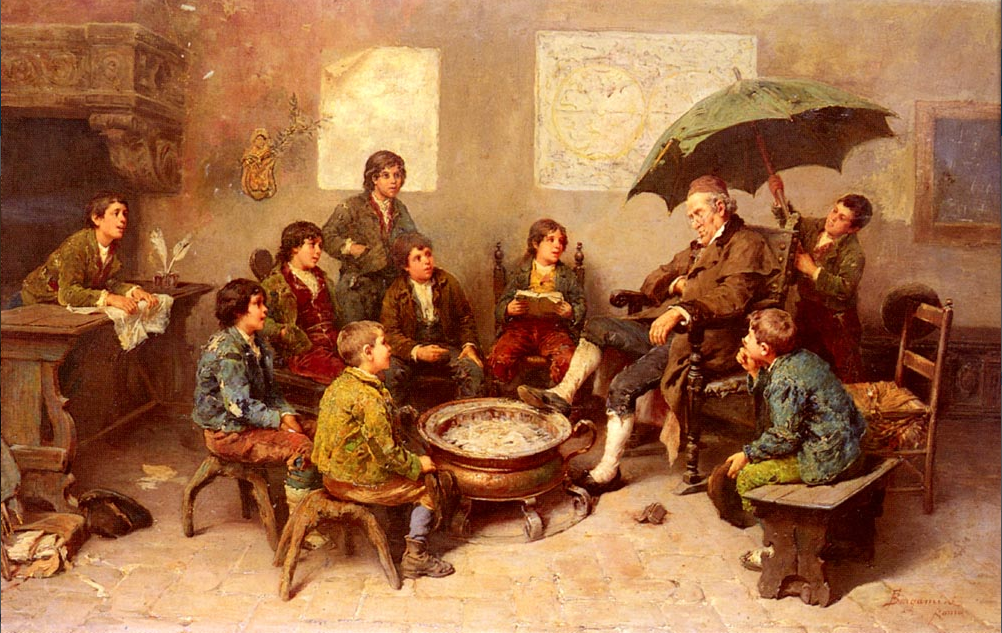
Judicious Pedagogical Approaches for Creating a Stimulating History Class
Considering the fact that there appears to be no proven relationship between the amount of time one spends in school and the degree of genuine learning one archives at the end of that time (Caplan, 2019), it stands to reason that so much of that learning depends on the school’s composition and the calibre of the teachers. Thus, we must once again circle back to the question concerning the fundamental purpose or telos of education. Depending on how one answers this essential question will dictate a teacher’s educational philosophy. As previously established that I adhere to the rational and sound principles that lay at the heart of a classical approach to education. One must attempt to explain what that looks like in the classroom.
At the core of my educational philosophy, is a commitment to providing a learning environment that is content-rich, stimulating, and engaging, while encouraging students towards attaining increasing levels of academic achievement. This philosophy is one that motivates students to be ardent seekers of knowledge and defenders of truth. Moreover, my goal is to demonstrate that the study of history is a creative endeavour that seeks to apply a reasoned analysis of the historical evidence, which results in a “dialogue” between the historian and the historical actors being examined. By understanding that process, the students will rationally comprehend the notion that history is the logical arrangement of all the pieces of information that encompasses human action. It embraces all human activities in their infinite complexity and diversity. It is, on the one hand, the study of our grand human saga and, on the other, it examines profound ideas that have guided the acts of man, then meticulously assesses the outcome of those actions.
Through such scholarly investigations, the students will realise that our human epic was shaped by imperfect individuals, very much like ourselves, who, in some cases, did not entirely recognise the implications of nor anticipated the consequences of the actions they undertook. Intermingled among the innumerable illustrations of humanity’s failings are exceptional historical actors, who made choices that positively changed the course of human events and furthered human flourishing. As a consequence, students who understand that the present is the result of individual actions are better equipped to act as mindful and virtuous actors themselves once they leave my classroom.
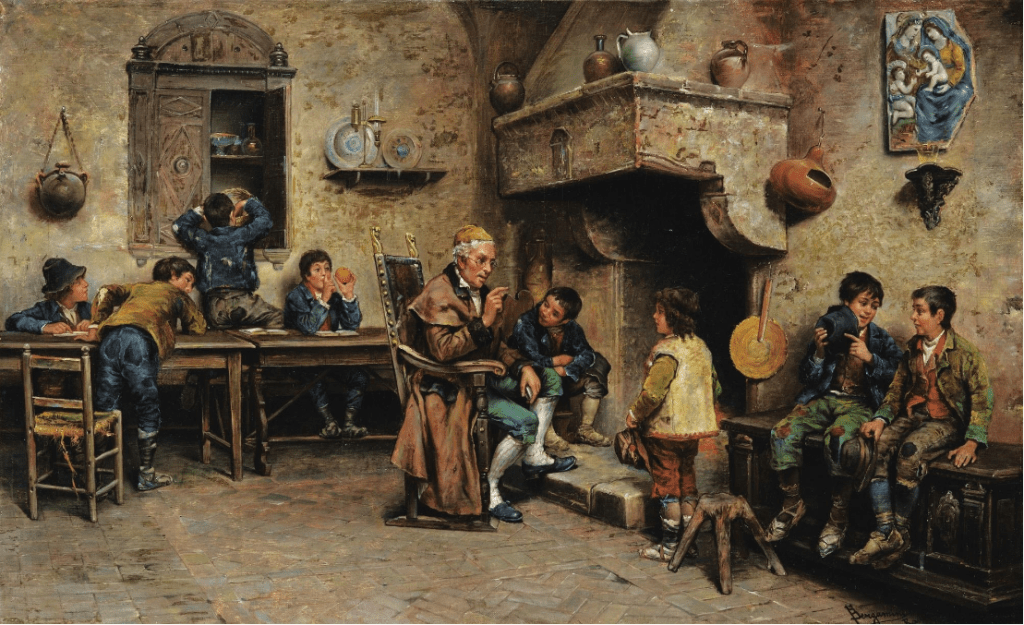
A teacher striving for excellence employs a variety of methods to encourage discussion and interaction with the material. The teacher’s role is to serve as the student’s guide through the origins of Western and World History. Accordingly, teaching history to students should be akin to the way our ancestors gathered around firesides to share tales of the hero’s journey. The use of compelling historical narratives, combined with the handling of artefacts, and historically inspired play, is a time-tested way of teaching children about critical historical narratives (Locke, 1996, Littlejohn, et al., 2006, Moore, 2012, & Bauer, 2016). Stories captivate the thoughts of children by making them curious, and stories stimulate their imaginations, which helps them to enter the otherworld that is the past. Stories can also communicate lots of information in ways that make history accessible to their level of comprehension. More importantly, children love stories that enable them to engage with the material in a way that makes it enjoyable. By utilising good storytelling, a history teacher can instil within their students a lifelong inquisitiveness that will spur them to become ardent seekers of knowledge.
In order to increase students’ core knowledge, they should be taught to acquire a set of historical focusing lenses through which they can comprehend the complex motivations behind the individual actions taken by historical actors. Liken these lenses to the device used by an optometrist to check one’s vision by exchanging the various lens, but the first lens always stays the same. Indeed, the multiple disciplines within education are merely unique lenses that assist the student in viewing each in their proper light. Nevertheless, these are not the telos of a Classical Christian education. The telos of such an education aims to produce virtuous and moral citizens that can think independently about complex ideas, who live in accordance with God’s Word.
Students must learn to critically evaluate those personal motivations and assess the magnitude of those actions. By employing primary source readings, contradictory questioning, and Socratic discussion, students are encouraged to scrutinise the reasons behind those past actions. Through such analysis, students are able to discern what lessons, if any, can be gleaned from history. In order to facilitate that process, students are asked a series of questions contrasting different viewpoints about the nature and effect of the historical event in question. Juxtaposing ideas in the classroom creates contradictions that compel the students to employ what they have learned; meaning they are encouraged to think for themselves in a way that is based on facts and with the appropriate level of emotion. Naturally, a student then asks which viewpoint is correct. To that statement, my reflexive response is always the same: I am not here to teach what to think about these complex ideas. I am here to assist you to think about these ideas so that you can make up your mind. To formulate your thoughts, you must think about the facts involved in an argument to inform your reasoning, with the appropriate emotional control (Littlejohn, et al., 2006, York, et al., 2011, Kristjánsson, 2016, & Bauer, 2016).
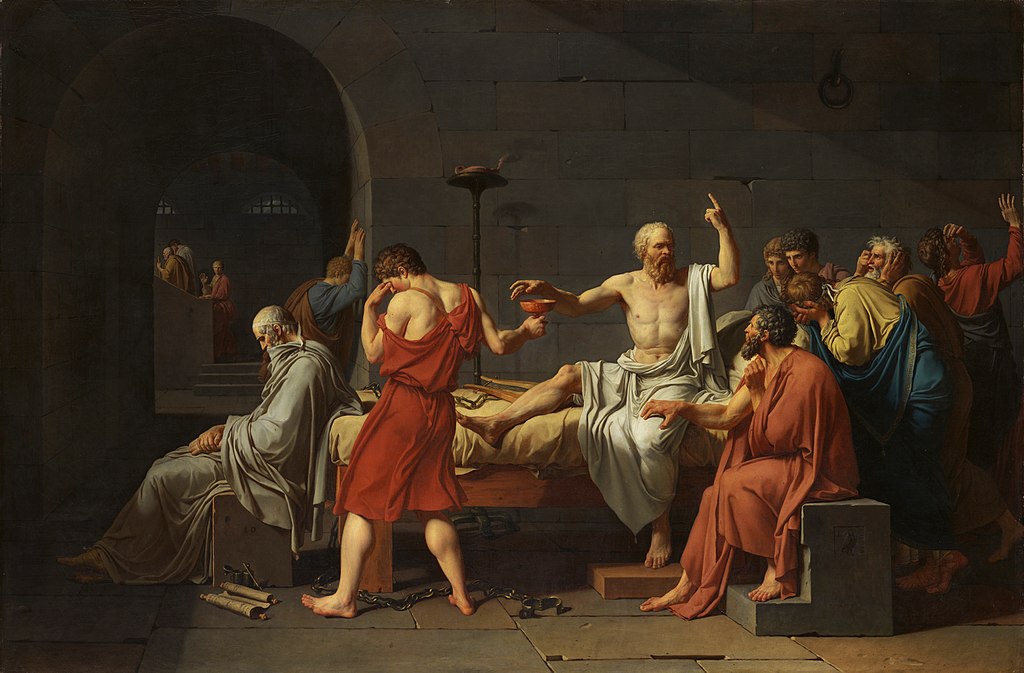
“The Death of Socrates” by Jacques-Louis David (1787)
When necessity obliges a lecture-based approach, I intermingle primary sources into my conversational lecture with questions intended to facilitate reflection on and a brief discussion of the central ideas that have been raised. One of the essential elements for the development of independent thinking is to allow the students to read the words of historical actors so that the students can hear that person’s voice without it being filtered through myself or another historian. When assisting students in their thinking about the reasons behind a historical actor’s actions, one must understand what they intend, in their own words, then contrast that to their effects. Such notions are then flushed out through articulate discourse by asking the students to support or oppose the arguments promoted by certain historians to reveal the creative process involved in historical analysis.
For myself, teaching makes available an opportunity for continual learning and intellectual development. One of my main aspirations is to inspire within the students a desire to develop a keen sense of inquisitiveness and a love of learning, as I share my passion for history with them. Such traits will assist these young minds in thinking independently about the complex ideas that are already assailing them. Moreover, I comprehend the fact that there is a desperate need for honourable and dedicated individuals, who are passionate about their disciplines to join in this worthy calling. In our increasingly fragmented polity, it is vital for students to not only receive a proper education that provides them with a firm grounding in the cultural literacy of Western Civilisation, but they must be taught by an educator who is aware of the importance of the task at hand. I believe that I am such a person. Perhaps, through my humble efforts and that of other dedicated individuals, we might rekindle the flame of liberty within the minds of the youth of this nation. As one can observe, my pedagogical aspirations and approaches to teaching have some keenly sound methodology that is firmly grounded in the prudent wisdom of our nation’s Founders, as well as Enlightenment principles that are immersed with the Judaeo-Christian tradition. One will be hard-pressed to find a better mission statement for a teacher who attempts to embody the principles of this nation as was so eloquently articulated in our first legal document, The Declaration of Independence. Indeed, I continually struggled to personify the virtues that I wish my students to emulate. All the while, I worked towards the good by offering students the most exceptional and enjoyable learning within the discipline of History that I am capable of providing.
Teacher-Student Relationships
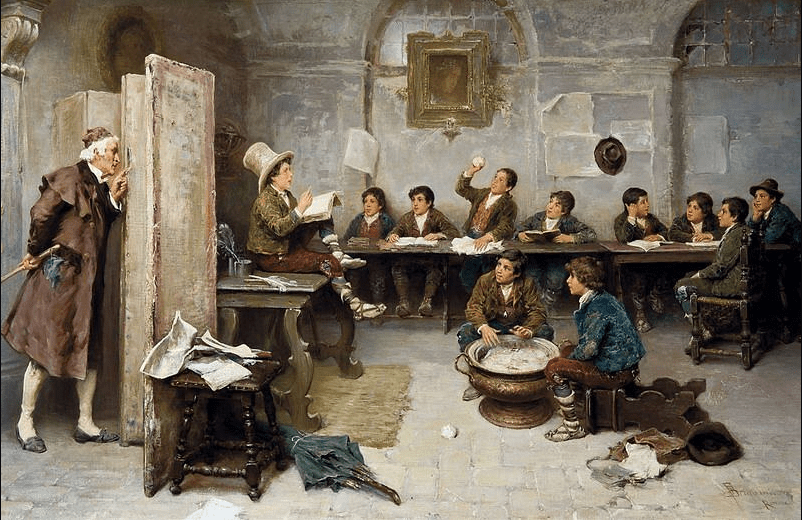
The Importance of Developing Intrinsic Motivation within Young Minds
Positive teacher-student relationships form the foundational link to a student’s ability to achieve academic success if they freely choose to engage with the teacher and the curriculum positively. The classically liberal philosopher, John Locke, wrote about the need for teachers to be knowledgeable and exemplars of moral character. Equally important, Locke emphasised that teachers also need to be passionate about their subjects, as well as compassionate and encouraging to their students. Locke maintains that the reason a teacher takes a genuine interest in their students is to ensure that they have the proper motivation to attain the highest-level academic success and moral growth they are able to achieve (Locke, 1996). It seems that the education establishment must again re-learn these timeless principles of how to facilitate a moral and supportive teacher-student relationship in order to address the significant issues facing our education system.
When ruminating upon all my Primary and Secondary school teachers, I have been forced to endure. I cannot recall one that had a supportive demeanour or a positive classroom environment. It was not until university that I meet inspiring teachers that encouraged me to learn for the pure joy of learning. Before that, I detested school and made every effort to escape its doldrums. Looking back, I wonder what type of historian and soldier I would be today if I had teachers as passionate as some of my university professors. A lesson taught in an appealing manner lingers with a person for life. Indeed, I can attest to this truth of this point from my own educational experiences. The two teachers that I admire the most were unorthodox and rough around the edges, which forced me to alter my motivation from extrinsic to intrinsic.
These teachers had a passion for their discipline, as well as the depth of knowledge required to make the content genuinely captivating. These teachers sincerely cared about what I had to say and took a truthful interest in me as an individual who had his own ideas to express. Moreover, they made their classrooms a safe place, where an honest debate of ideas could occur unencumbered by emotions or political correctness. As a consequence, it was their simulating approaches to teaching that made their lessons remain in my mind all these years later. I have attempted to model my own teaching style on their examples.
A teacher’s demeanour in the classroom has a considerable impact on student performance. For too long, the American education system has neglected this essential aspect of the teacher-student relationship. Thus, teachers who support and inspire their students to new levels of achievement is one of the most critical elements that contribute to motivating students positively. The teacher-student relationship plays a vital role in the development of core knowledge and skills, from Primary through to the Upper School grades. In conjunction with parents, the teacher operates as socialising/regulatory agent who has substantial impacts upon students’ cerebral and emotive experiences that can have lasting effects on a students’ motivation to learn and their ability to achieve academic success. Students who have passionate teachers that foster positive and supportive classrooms have higher levels of self-esteem, purpose, take more significant intellectual risks, and have significantly better academic achievement (Highet, 1969, Whitt et al., 1999, Littlejohn et al., 2006, Gregory et al., 2014, & Arthur et al., 2016).
Accordingly, a teacher must meet the demands of students’ need for competence, relatedness, and autonomy in order for them to develop the abilities of self-regulating emotions, developing personal motivation, and realising their true self-worth. When the teacher facilitates the students’ fundamental psychological needs and offers an engaging classroom. The students tend to display increased levels of the characteristics mentioned above if they understand and are properly motivated. Motivation put simply, is the multifaceted reason behind why people do the things they choose to do. Students who have higher levels of educational success employ learning strategies that enable them to develop a stronger desire to learn and to set higher educational aspirations. Motivation is divided into two categories: intrinsic and extrinsic. An intrinsically motivated student will learn for the pure joy of learning. Conversely, students who are extrinsically motivated learn to attain a reward or is compelled to do so in order to achieve an end state (Highet, 1969, Whitt et al., 1999, Littlejohn et al., 2006, Gregory et al., 2014, & Arthur et al., 2016).
The implications of these two motivating factors are essential for a teacher to understand what type of motivation a student is utilising in the classroom. Teachers who encourage students to employ intrinsic motivation by fulling students’ emotional needs in conjunction with a positive and stimulating classroom environment are inherently more successful learners. To foster intrinsic motivation, teachers should consider allowing students a measure of autonomy that enhances student perceptions of mastery and reduce instances of behavioural issues; not to mention it alleviates intellectual stagnation. Students who approach a lesson with the belief that they can achieve success and have some autonomy over the direction of the learning process demonstrate consistently higher levels of academic performance. From this one can only conclude that students who believe they can succeed working in tandem with supportive teachers plays a vital role in student motivation to learn and informs their underlying motivational beliefs (Highet, 1969, Whitt et al., 1999, Littlejohn et al., 2006, Gregory et al., 2014, & Arthur et al., 2016).
Enthusiastic teachers who provide limited autonomy to engage the personal interests of student improve their confidence, attention span, problem-solving, mastery, and self-esteem. These factors combine to motivate the student to achieve the highest level of academic success that they are able to attain, and these aspects are practically important throughout the Primary School grades. If a series of teachers fail to achieve the proper amount of student engagement and interest within the Primary grades, there can be lasting learning scars that the child may never overcome (Highet, 1969, Whitt et al., 1999, Littlejohn et al., 2006, Gregory et al., 2014 & Arthur et al., 2016).
With this realisation, one can infer that teacher motivation is closely linked to student success. Accordingly, a teacher’s mental well-being, the extent of developed virtues, spiritual foundation, and classroom demeanour all have a direct effect on their students. Hence, if a teacher does not come into the classroom ready to give their all for the majority of the time, then they will be a significant inhibitor to their students’ ability realise the pure joy of learning new ideas. Teacher mental health and motivation to be passionate about their disciplines are factors. All teachers ought to continually re-evaluate/re-energise themselves in order to maintain a character that demonstrates virtue and moral conscience. Closely linked is the notion that teachers ought to strive to maintain a positive and engaging learning environment that enables the students to flourish. Given the fact that this calling has significant implications on the future outcomes of the young minds placed in our care, it is our duty to be mindful of the aims of this noble endeavour and humbly teach in a manner that adheres to God’s Word (Highet, 1969, Whitt et al., 1999, Littlejohn et al., 2006, Gregory et al., 2014, & Arthur et al., 2016).
A Note Concerning Diversity

An Appreciation of the Wondrous Variety within God’s Creation
The United States has always been a nation whose citizenry comprises a rich and complex mixture of peoples from across the globe. While we have not always treated these various ethnicities in accordance with the Bible or the principles of this nation as eloquently articulated in the Declaration of Independence, we have made great strides towards increasing equality of opportunity and advancing equality under the law. Because of successive generations efforts to adhere to the founding principles of the great nation, we have an even more diverse population as opportunity seeking and freedom-loving peoples flee to this last bastion of human liberty. We want liberty-minded people trapped in despotic nations to have a chance to improve their lives and the lives of their descendants. Moreover, the majority of these diverse peoples contribute to the tremendous economic prosperity of this nation. It stands to reason then that a Traditional American Education would be most fitting, given the underlying reason why people pour into our country every year, the right to pursue happiness. Moreover, as Christians, we are called to aid our fellow man temporally, as well as spiritually (Littlejohn et al., 2006). What more efficient way to adhere to that principle than to offer these distinct peoples a Classical Christian education that aims to shape young Americans, who conduct themselves virtuously and are taught how to think about complex ideas, not what to think.
Furthermore, diversity within a Classical Christian school enhances the faith and conviction in the truth of God’s Word in several essential ways. The exposure of students and teachers from various ethnic and social backgrounds demonstrates to all involved that the principled aims of this type of education transcend our differences. Diversity in God’s children enriches the students’ learning environment by exposing them to various ethnicities, languages, faiths, personal talents, and learning styles. A diverse student body offers students the opportunity to engage with a variety of ideas and experiences that foster students to think independently by introducing differing perspectives, which facilitates introspective thought. Additionally, contact to these variations informs the teaching of virtuous habits that assist the students’ in fostering a sense of rational equality, humility, compassion, temperance, and integrity when interacting with a person from diverse cultural backgrounds (Littlejohn et al., 2006).
We all desire to feel respected and appreciated by those who are essential in our lives. Students who are taught to respect and find the beauty in other cultures are more suited to be a force for good in a world that is often filled with sorrow and hate. However, this approach does not imply moral relativism. On the contrary, students are armed with timeless principles that are found within the Great Books curriculum by reading poet-philosophers such as Horace, who waves lessons on virtue and morality all the while delighting the reader with compelling stories. The study of the Bible also reveals that Christ and the writers of the Old Testament delivered their moral lessons in short narratives that are rendered attractively and poetically so that persons from diverse backgrounds could comprehend the profound ethical truths contained with those stories. One such principle is tolerance, but that virtue does not equate to accepting without questioning all choices and modes of behaviour. Truth exists and can be discovered through articulate discourse, faith, and scholarly inquest. Moral relativism is inexorably antagonistic to the idea of an omnipotent God who created the universe and who transcends His creation and is the wellspring of all Truth (Littlejohn et al., 2006).
Another one of the core ideas that this type of educational model promotes is the belief that we are all Americans, we just happened to hail from various regions of the world, but we all believe in the founding principles of this nation. Our principles bind us together and transcend our cultural differences. This idea prepares students to benevolently and respectfully interact with the rich diversity of cultures within God’s creation. Contact with various cultures and perspectives teaches young minds to appreciate the beauty and goodness in the variety of God’s human creation because we, as individuals, are more than the arbitrary physical characteristic of our birth. Moreover, it enables students to see the good and beauty of these cultures, despite humanity’s fallen nature. The curriculum archives these noble goals through the in-depth study of these cultures. Students are encouraged to analyse ideas through articulate discourse that strips away superficial definitions to reveal the truth. Then they are pushed to delve deeper to find the more significant meanings and insights into how these cultures fit into God’s creation. Through such examinations, students learn the essential lesson that we are all part of God’s creation, which necessitates the requirement for us to live in harmony with one another as best we are able (Littlejohn et al., 2006).
Teaching Virtues

A Life Lived in Accordance with Virtue Leads to Happiness and Flourishing
With the purpose of a Traditional American education, as the Founders’ intended, and the proper pedagogical approach to teaching history in mind, the first step towards establishing classically inspired behavioural standards within an educational setting is to identify a set of virtues that the school desires to foster within the student body. The list should be kept short, include the four classical and three Christian theological virtues, then add one or two more from the Enlightenment. Next step is most crucial. Teachers must ardently demonstrate those virtues to the students and consistently hold them accountable to those noble ideals of human moral behaviour. Additionally, faculty must also exemplify those virtues in their daily lives both on campus and while out in the general public. While at school, the staff should embody the virtues and espouse our First Principles in their daily interactions with all parties. If they do not, then they should be held accountable for their consistencies, and strongly encouraged to hold firm to the ideas they claim to embrace. The school board and administration should also exemplify the school’s stated virtues. A Dean of Educational Philosophy and a respected member of the community should be appointed to make sure the faculty at levels is adhering to and demonstrating those virtues. The consequences of not enforcing the moral standards have dire implications for the community that encompasses the school. Any hypocrisy will be observed and noted by all, which will undermine the school’s rules and demonstrate to the rudderless students that there is no point in making an effort to develop virtues because the supposed moral adults do not even practice what they preach. Young minds are very keen at pointing out the hypocrisy of adults who abide by the arbitrary dictum of “Do I say and not as I do.”
Next, one has to consider the question if virtues can even be taught. Such a query has been the subject of a heated debate that has raged across many ages. Great minds from Plato to Confucius and beyond have all contributed to this debate. Not wanting to write a dissertation, I encourage the reader to explore these fascinating arguments for the pure joy of learning new or in this case, old ideas. In any case, Plato’s Meno (1997) being with a torrent of contemptible queries levelled at Socrates by the cheeky and exasperated young man from whom the dialogue is named. Meno asks Socrates if virtue can even be taught or is it something that one can acquire through arduous training? If neither is the case, then are this attribute something only a consequence of birth? Naturally, Socrates responds with a broadside of his own questions intended to guide Meno’s thoughts in order to facilitate a provisional assumption. Socrates directs Meno to the idea that if one can locate a teacher who exemplifies virtues, then one might be able to teach such principles. However, if one cannot find noble teachers or if societal mores promote unvirtuous norms that will inhibit the students’ receptiveness to achieving human excellence, then virtues cannot be taught (Plato, 1997, pp. 870-897).
Pressing on, I have chosen to utilise the Aristotelian approach to character education. The classical theory on this topic, as advocated in Aristotle’s Nicomachean Ethics (1941), is a comprehensive and vigorous philosophical treatise. Instilling virtue within students consists of imparting upon their minds a few essential capabilities and aptitudes. Namely, teachers ought to aim at developing within the students the capacity to recognise when situations call for the employment of virtue, the ability to make use of phrónēsis (practical wisdom) to make rational moral decisions, the aptitude to have the appropriate emotional controls so that such passions do not interfere with one’s ability to utilise reason, and the ability to conduct one’s self in a virtuous manner base on the appropriate motivations (Kristjánsson, 2016). If teachers have modelled these virtues adequately, their students will begin to see the rationale behind these prudent lessons and will make virtue a profound component of their character (Aristotle, 1941). Much like the case of Meno, the use of lively Socratic dialogue with a Harkness table enables students to discover and appreciate the significance of developing virtue (Kristjánsson, 2016).
Fostering virtues within student creates balanced natures that are intended to make sure that their possessor conducts themselves in a virtuous manner in almost all of life’s turbulent situations. Given our fallen nature, humans are not naturally moral, nor are we inherently savage, but we have the capacity to be both under the right set of circumstances. Society is only a thin veneer, and it only takes a small scratch to reveal what lays beneath. Thus, the need to acquire and hone virtue through habituated actions (Aristotle, 1941). Reason then dictates the need for schools to teach morality, so that our society is comprised of citizens who are appropriately guided in their thoughts, conduct, and emotional responses by a set of timeless principles that enables them to pursue the good throughout their lives. A life lived in accordance with virtue sets the foundation that facilitates human flourishing and the forthright pursuit of the good.

Now that we have briefly discussed the reasons that teachers ought to encourage students to develop virtues. We must next examine the definitions of the four classical and three Christian theological virtues in order to understand their nature better and to being to foster them within our lives:
1. Prudence is the classical virtue that influences practical reason in order to determine the path that leads to the good in all situations and enables one to decide the appropriate means of achieving that good freely. Prudence then establishes the guidelines that inform the other virtues and advises one’s conscience (Kristjánsson, 2016).
2. Justice is the classical virtue that encourages one to respect the reciprocal nature of our God-given rights. Justice fosters within our relationships a sensible concord that stimulates a sense of fairness in regard to all of God’s creation and the common good (Kristjánsson, 2016).
3. Fortitude is the classical virtue that confirms one’s determination when faced with life’s tempestuous seas and solidifies one’s faithfulness in the pursuit of the good. Fortitude reinforces our strength of character to avoid compulsions and to conquer life’s inevitable barriers. Fortitude empowers us to maintain control of our fears and to courageously face life’s many tests (Kristjánsson, 2016).
4. Temperance is the classical virtue that is often referred to as moderation and sobriety within the Bible. Temperance regulates the allure of pleasurable indulgences and affords one a sense of equilibrium that enables a person to be a good steward of God’s creation. Temperance guarantees that one has full command of their impulses and holds desires within their proper limits (Kristjánsson, 2016).
5. Faith is the theological virtue and an act where one believes in God with all their being. God infused virtue into the souls of the faithful to render with them the ability to conduct themselves as His children, who merit eternal life. Faith enables one to follow all of the teachings that He has revealed to us because God is the source of all Truth. Faith calls one to profess its Truth and assertively bear witness to it in order to achieve salvation (Fairbairn, 2009).
6. Hope is the theological virtue by which one desires to obtain the joy of salvation and eternal life in the kingdom of heaven. Hope is also an aspiration to have a measure of happiness in this life. Hope purifies our thoughts and holds despair in check by reminding us that God will grant the faithful, eternal beatitude (Fairbairn, 2009).
7. Charity is the theological virtue by which we love God and His creation for the pure joy of glorifying Him. Charity enables us to keep the commandments of God. The fruits of charity are joy, reconciliation, and compassion. Charity demands that one conduct themselves with generosity, beneficence, and to foster caring relationships that are reciprocal in nature (Fairbairn, 2009).
Implementing these virtues is a painstakingly long process that begins in Kindergarten and must be reinforced by parents within the home. This sensible wisdom of Proverbs 22:6, “Give a lad a training suitable to his character and, even when old, he will not go back on it,” (Jones, 1966) demonstrates the path we ought to teach moral standards to this nation’s youth. Indeed, if teachers can artfully inspire and demonstrate the worthiness of developing virtues to their students, then things will naturally begin to fall into their proper place. Students will not need any outside motivations to pursue Truth or to conduct themselves prudently. They will perform these tasks out of the pure joy of doing the good.
Of course, the students will fail at times, but the charitable teacher is ready to prudently remind them that they are not acting in accordance with virtue. The atonement for minor infractions is minuscule but has the effect of reinforcing virtue development. Direct the wayward student to write out George Washington’s one hundred and ten Rules of Civility (1989). When that failure is significant enough to warrant greater punishment, one should assign the student to type up a research project comparing two of the lives found in Plutarch’s Lives (1975), and have the student explain Plutarch’s lesson concerning the virtue or lack of for both lives. These remediations offer students an opportunity to learn from their failures and to atone in a way the promotes the good. It is also wise to make sure the students know that you are a work in progress as well and that we all fail. What is important is that we are honest with ourselves about our shortcomings. Then we must have the courage to pick ourselves back up and persevere in the face of our failures. In so doing, we learn that failure is not an end state. Instead, failures are another opportunity to seek redemption, to learn from those mistakes, and mature as a person attempting to live in accordance with God’s Word.
Conclusion
If one’s principles dictate that you glorify God and cherish the liberties, He grants us, then one of the various Classical Christian school models is the only way we can aim at heaven while making this temporal world a less tumultuous place. Moreover, to confront the multiple issues facing our public schools, it is prudent to allow parents to choose which educational model best suits their child’s needs. In order to make that critical decision, one must answer the question about what is the fundamental purpose of education? For myself, the telos of education should take into account our inherently fallen nature and promote the good in all things. The most sensible way to account for that is to utilise one of the various adaptations of the Classical Christian model that most adequately addresses the parent’s requirements. While not student-led or centred, this type of education genuinely assists students in figuring out who they are through the development of virtue and inspired academic inquest that enables them to flourish. The curriculum is devised to nurture inquisitiveness and to foster creativity that allows students to realise that learning concerned with the formation of the soul and mind.
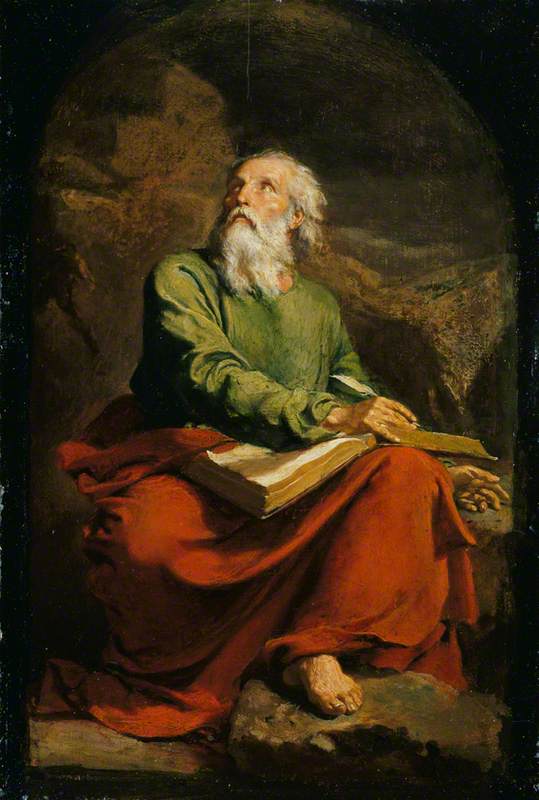
A Classical Christian model should pay fidelity to the inspired and erudite statesmen who founded this great nation. Such a Traditional American education permeates young minds with a sense of wonder and emphasis transcendent truths. The model’s premise states that the purpose of a prudent education is to prepare young minds to think independently about complex ideas and to teach them how to conduct themselves virtuously throughout their lives. Moreover, it is a pedagogy that is devoted to engaging the minds of all involved to seek the truth, beauty, and goodness through the study of great books, virtues, language, history, math, and science. More specifically, a Traditional American education analyses the excellent works of thought and writings that have been produced spanning the entirety of known human existence. Acceptance into university or landing a grand career are merely by-products of this educational model, but not the ultimate purpose. Classical education is an intense labour of the mind and soul that moulds young minds into virtuous citizens, who pursue the good in all their endeavours. Upon completion of this epic educational journey through the human saga, these young minds will understand that we live in a world filled with immense beauty, but one that is also fallen where truth is obscured and must be divorced from what is fallacious. While this model cannot heal all the festering wounds within our society, with the mental and spiritual aptitudes that classical education offers a person, one can realise that a good life can be archived in this world by espousing truth, goodness, and beauty.
A concluding notion that the reader should appreciate is the fact that none of these ideas are original thinking on my part. Instead, these thoughts are a consequence of a Guiding Hand that has set my mind on this path and any Truths I may have uncovered were revealed to me by God’s grace. Therefore, I cannot take ownership of anything that I have written on this matter, for the glory of Truth has its wellspring within God. I am merely a humble and profoundly flawed human attempting to embody His Word as best I am able, given my inherently fallen nature.
References
Act to provide for the instruction of youth, and for the promotion of good education, June 25, 1789, ch. 19, 1789 Mass. Acts 416-421.
Addison, J. (1984). Cato: A tragedy and selected essays. (M. E. Yellin & C. D. Henderson, Eds.). Indianapolis, IN: Liberty Fund.
Arnn, L. P. (2016). One Vital Way How the Role of the Federal Government in Education Has Changed. Retrieved from http://blog.hillsdale.edu/online-courses/one-vital-way-how-the-role-of-the-federal-government-in-education-has-changed
Aristotle. (1941). The basic works of Aristotle. (R. McKeon, Ed.). New York, NY: Random House.
Arthur, J., Kristjánsson, K., Harrison, T., Sanderse, W., & Wright, D. (2017). Teaching character and virtue in schools. New York, NY: Routledge.
Bailyn, B. (1998). The debate on the Constitution: Federalist and Antifederalist speeches, articles, and letters during the struggle over ratification. New York, NY: Library of America.
Bailyn, B. (1967). The ideological origins of the American Revolution. Cambridge, MA: Belknap Press.
Bastiat, F. (2012). “The Law,” “The State,” and other political writings, 1843-1850. Indianapolis, IN: Liberty Fund.
Bauer, S. W., & Wise, J. (2016). The well-trained mind: a guide to classical education at home. New York, NY: W.W. Norton & Company.
Beck, S. (2018, February 15). Teaching Virtue. Retrieved from https://thevirtueblog.com/2018/02/15/teaching-virtue/
Bloom, A., & Bellow, S. (1987). The closing of the American mind: how higher education has failed democracy and impoverished the souls of today’s students. New York, NY: Simon & Schuster.
Caplan, B. D. (2019). The case against education: why the education system is a waste of time and money. Princeton, NJ: Princeton University Press.
Collingwood, R. G. (1993). The idea of history. (J. van der. Dussen, Ed.). Oxford, UK: Clarendon Press.
Democratic vs. Republican occupations. (2016). Retrieved from http://verdantlabs.com/politics_of_professions/index.html
Fairbairn, D. (2009). Life in the Trinity: an introduction to theology with the help of the church fathers. Downers Grove, IL: InterVarsity Press.
Fea, J. (2016). Was America founded as a Christian nation?: a historical introduction. Louisville, KY: Westminster John Knox Press.
Gamble, R. M. (2009). The great tradition: classic readings on what it means to be an educated human being. Wilmington, DE: The Intercollegiate Studies Institute.
Glubb, J. B. (1978). The fate of empires and search for survival. Edinburgh, SCT: William Blackwood and Sons.
Gregory, J. M., Wilson, D., & Stephenson, L. (2014). The seven laws of teaching. Moscow, ID: Canon Press.
Guroian, V. (2002). Tending the heart of virtue: how classic stories awaken a child’s moral imagination. Oxford, UK: Oxford University Press.
Harris, D. N. (2019, July 5). Do the current Democratic politics spell doom for charter schools? Retrieved from https://www.brookings.edu/blog/brown-center-chalkboard/2019/06/10/do-the-current-democratic-politics-spell-doom-for-charter-schools/
Hasson, M. R., & Farnan, T. (2018). Get out now: why you should pull your child from public school before it’s too late. Washington, DC: Regnery Gateway.
Hayek, F. A. von., & Caldwell, B. J. (2007). The road to serfdom: text and documents: the definitive edition. Chicago, IL: The University of Chicago Press.
Herbert, A. E. W. (1978). Right and wrong of compulsion by the state. Indianapolis, IN: Liberty Fund.
Hicks, D. V. (1981). Norms and nobility: a treatise on education. New York, NY: Praeger.
Highet, G. (1969). The art of teaching. New York, NY: Alfred A Knopf.
Hirsch, E. D. (1987). Cultural literacy: what every American needs to know. Boston, MA: Houghton Mifflin.
Holmes, D. L. (2006). The faiths of the founding fathers. Oxford, UK: Oxford University Press.
Honeywell, R. J. (1931). The educational work of Thomas Jefferson. Cambridge, MA: Harvard University Press.
Horowitz, D. (2018). The black book of the American left (Vol. 1-9). Los Angeles, CA: Second Thoughts Books.
Jefferson, T. (1984). Thomas Jefferson: writings. (M. D. Peterson, Ed.). New York, NY: The Library of America.
Jefferson, T. (2012). The papers of Thomas Jefferson. (J. J. Looney, Ed.) (September 1815 to April 1816, Vol. 9). Princeton, NJ: Princeton University Press.
Jefferson, T. (2012). The papers of Thomas Jefferson. (J. J. Looney, Ed.) (1 September 1817 to 21 April 1818, Vol. 12). Princeton, NJ: Princeton University Press.
Kopff, E. C. (2001). The devil knows Latin: why America needs the classical tradition. Wilmington, DE: Intercollegiate Studies Institute.
Kristjánsson Kristján. (2016). Aristotle, emotions, and education. London, UK: Routledge Taylor & Francis Group.
Lewis, C. S. (1988). Essential C.S. Lewis. (L. W. Dorsett, Ed.). New York, NY: Macmillan Publishing.
Littlejohn, R., & Evans, C. (2006). Wisdom and eloquence: a Christian paradigm for classical learning. Wheaton, IL: Crossway Books.
Locke, J. (1996). Some thoughts concerning education and, of the conduct of the understanding. (N. Tarcov, Trans., R. W. Grant, Ed.). London, UK: Hackett Classics.
Lutz, D. S. (1988). The origins of American constitutionalism. Baton Rouge, LA: Louisiana State University Press.
Martin, R. L., & Wright, L. (1968). Fabian freeway: high road to socialism in the U.S.A., 1884-1966. Santa Monica, CA: Fidelis.
Moore, T. O. (2013). The story-killers: a common-sense case against the Common Core. United States: Terrence O. Moore.
Moore, T. (2012). Limits of the Trivium. Retrieved from https://www.hillsdale.edu/educational-outreach/barney-charter-school-initiative/
Moore, T. (2012). A classical education for modern times. Retrieved from https://www.hillsdale.edu/educational-outreach/barney-charter-school-initiative/recommended-reading/
Nash, G. B. (2007). The unknown American Revolution the unruly birth of democracy and the struggle to create America. London, UK: Penguin Books.
Nord, W. A. (1996). Religion and American education: rethinking a national dilemma. Chapel Hill, NC: University of North Carolina Press.
Ornstein, A. C., Levine, D. U., Gutek, G., & Vocke, D. E. (2017). Foundations of Education (13th ed.). Boston, MA: Cengage Learning.
Paine, T. (1995). Thomas Paine Collected Writings. New York, NY: Library of America.
Pangle, L. S., & Pangle, T. L. (1995). The learning of liberty: the educational ideas of the American founders. Lawrence, KS: University Press of Kansas.
Parker, K. (2019, August 19). Views of higher education divided by party. Retrieved from https://www.pewsocialtrends.org/essay/the-growing-partisan-divide-in-views-of-higher-education/
Plato, & Hutchinson, D. S. (1997). Plato complete works. (J. M. Cooper, Ed.). Indianapolis, IN: Hackett Publishing.
Pestritto, R. J., & Atto, W. J. (2008). American progressivism: a reader. Lanham, MD: Lexington Books.
Plutarch. (1975). Plutarch’s lives / the Dryden translation. (J. Dryden, Trans., A. H. Clough, Ed.). New York, NY: Modern Library.
Rahe, P. A. (1994). Republics ancient and modern. constituting the American regime. Chapel Hill, NC: University of North Carolina Press.
Shain, B. A. (1996). The myth of American individualism: the Protestant origins of American political thought. Princeton, NJ: Princeton University Press.
Shortt, B. N. (2004). The harsh truth about public schools. Vallecito, CA: Chalcedon Foundation.
Smith, C., Christoffersen, K. M., Davidson, H., & Herzog, P. S. (2011). Lost in transition the dark side of emerging adulthood. Oxford, UK: Oxford University Press.
Sowell, T. (2002). The quest for cosmic justice. New York, NY: Free Press.
Sowell, T. (2006). Black rednecks and white liberals. New York, NY: Encounter Books.
Thompson, C. B. (2019). Americas revolutionary mind: a moral history of the American Revolution and the Declaration that defined it. New York, NY: Encounter Books.
Thucydides, & Hanson, V. D. (2008). The landmark Thucydides a comprehensive guide to the Peloponnesian War. (R. Crawley, Trans., R. B. Strassler, Ed.). New York, NY: Free Press.
Waller, J. (2007). Becoming evil how ordinary people commit genocide and mass killing. Oxford, UK: Oxford University Press.
Walsh, J. J. (1935). Education of the founding fathers of the Republic: scholasticism in the colonial colleges: a neglected chapter in the history of American education. New York, NY: Fordham University Press.
Washington, G. (1989). George Washington’s Rules of civility & decent behavior in company & conversation. Carlisle, MA: Applewood Books.
Whitt, E. J., & Blimling, G. S. (1999). Good practice in student affairs: principles to foster student learning. San Francisco, CA: Jossey-Bass.
Wood, G. S. (1969). The creation of the American republic: 1776-1787. Chapel Hill, NC: University of North Carolina Press.
Wood, G. S. (1991). The radicalism of the American Revolution. New York, NY: Alfred A. Knopf.
York, J. G., Strauss, L., Drury, S. B., Fennell, J., McDonough, T., Meier, H., … Zuckert, M. (2011). Leo Strauss, education, and political thought. (M. A. Peters, Ed.). Madison, NJ: Fairleigh Dickinson University Press.
 Tempestuous Seas of Liberty