If you read history you will find that the Christians who did most for the present world were just those who thought most of the next. The Apostles themselves, who set on foot the conversion of the Roman Empire, the great men who built up the Middle Ages, the English Evangelicals who abolished the Slave Trade, all left their mark on Earth, precisely because their minds were occupied with Heaven. It is since Christians have largely ceased to think of the other world that they have become so ineffective in this. Aim at Heaven and you will get earth “thrown in”: aim at earth and you will get neither.
C.S. Lewis, Mere Christianity

A person’s weltanschauung is a somewhat poetic term to articulate one’s philosophical framework or one’s unconscious approach toward life. Simply put, weltanschauung is a worldview that is comprised of a comprehensive series of assumptions or a set of ideas about one’s relation to the universe. Such beliefs are essential to human life and are influential in informing all the decisions that people make in their ephemeral lives. Appropriately, people employ their worldviews to inform their attempts to solve the problems of our existence, which grants them a measure of meaning and value in an otherwise indifferent world. Suitably, a person’s worldview forms the foundation of their notions concerning life and how to navigate the difficulties of this turbulent world when faced with life’s inevitable challenges (Sire, 1990, pp. 29-34).
While there is a multitude of differing worldviews, one of particular importance to the perpetuation and maintenance of Western Civilisation is the Judaeo-Christian beliefs centred on the teaching found within the Bible. There are many prudent lessons contained within the Scriptures about how Christians or Jews are instructed to conduct themselves in their daily lives and their personal interactions. These lessons are particularly significant for Christian teachers because of the fact that their actions in the classroom influence and leave profound impacts upon the lives of their students. Moreover, the Bible contains countless lessons on the subject of how education should be adequately grounded in the Word of God. These passages offer teachers foundational beliefs that have influenced education in the West for thousands of years.
Accordingly, it is prudent for the reader to be able to distinguish the elements of a Biblical worldview. As well as to comprehend how such beliefs ought to influence a teacher’s approach to education. Lastly one must consider what the ramifications of those beliefs are for Christian teachers who are increasingly compelled to maintain a wall of separation between their worldview and a progressively temporal curriculum that the state mandates be taught to the students placed in their charge. A notion that is even more lamentable, is the fact that Christian teachers are obliged to teach an educational narrative and political ideology that seeks to undermine the very foundations of Western Civilisation. These topics and more will be the subject of this brief reflection on the nature of a Biblical worldview and its relation to education in postmodern America.
Biblical Worldview

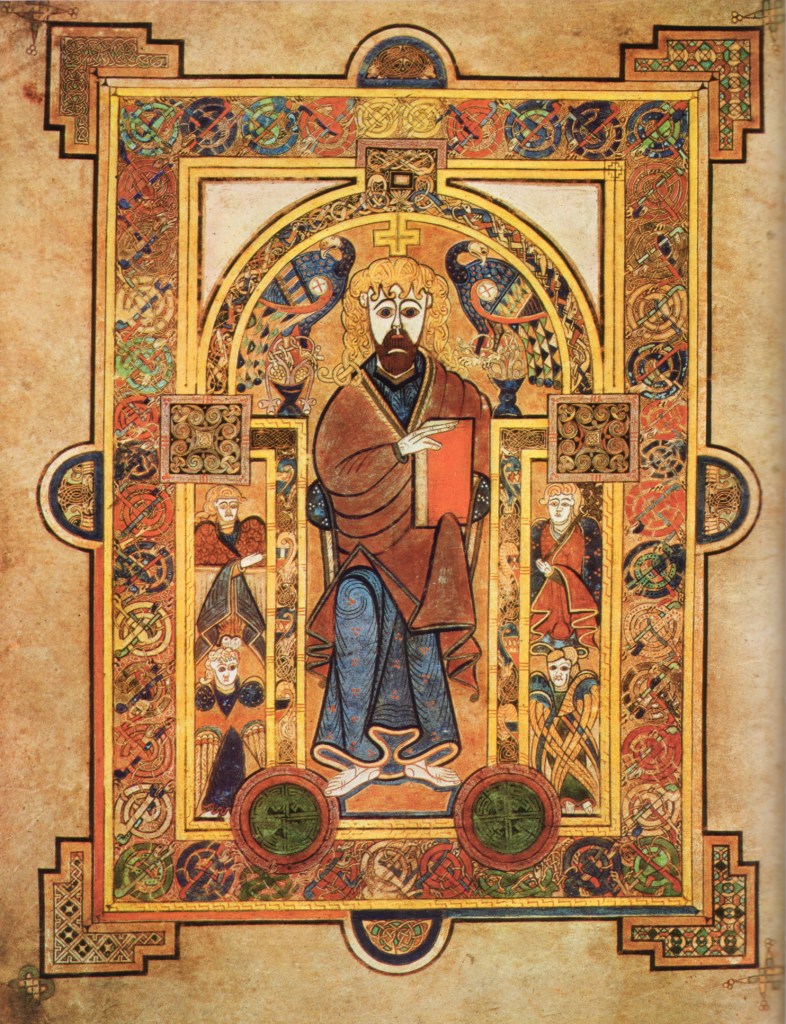
The Frontispiece of Bible Moralisee (1220-1230)
As Christians, we should structure our worldview to be philosophically consistent with the Word of God. Moreover, we must strive to be virtuous and pious because evil constantly seeks to corrupt our resolve to live our lives according to the teachings of Christ. Therefore, prudent Christians must maintain a biblical worldview so that they can mitigate and shield themselves from the immoral influences that are pervasive in this temporal world. Indeed, much of what our progressive society believes directly contradicts and is openly hostile to the very ideas of God and Truth.
Despite these secular challenges, a person that adheres to a Biblical worldview should recall the prudent wisdom found within Romans 12:2: “Do not model your behaviour on the contemporary world but let the renewing of your minds transform you, so that you may discern for yourselves what is the will of God — what is good and acceptable and mature” (Jones, 1966). Prudent Christians must take these words to heart because a life that is centred on the teachings of Christ will assist us in deciphering what path one should take in life or what particular action one ought to take in a complicated situation. Such beliefs ought not to be confused with the attitudes of the majority of our contemporaries. These persons might act in a specific manner that adheres to familiar notions of morality. However, these actions are not biblical even if those secular principles found within Classical Liberalism are deeply rooted within the Judaeo-Christian tradition.
Furthermore, when considering the central pillars of a Biblical worldview, one must comprehend the notion that holding such views means that one can observe life from a Christian perspective. Such a worldview is a coherent way of thinking and ordering one’s life within the teaching found in the Bible. By viewing the world in these terms, our lives are given meaning and purpose. Our belief in these Truths become the central galvanising force in our lives; the word of God grants us a sense of His plan and purpose for us in this arduous life. Accordingly, a Christian worldview offers us a concrete foundation for moral reasoning that shapes our identities and how we conduct ourselves (Graham, 2009, & Tackett, 2006).
Lastly, a Christian worldview also contends that God is set apart from and transcends his creation. Nevertheless, it also maintains that God is a purposeful God who creates us in freedom and has granted us the liberty to choose to follow His Word. In creation and in God’s provision and preservation for creation, He is working out His ultimate purposes for humanity through His Word. The consequence of this fact intrinsically implies that human life is meaningful, significant, intelligent, free-willed, and purposeful. This notion affirms the overall unity and intelligibility of the universe. In this intricate design, we see God’s greatness, goodness, and wisdom (Graham, 2009, & Tackett, 2006). Thus, it is prudent for His creation to recognise His gifts of freedom and intelligence by attempting to live a meaningful life guided by the lessons contained within the Bible.
A Christian Philosophy of Education
Now that one has a brief, but firm, foundation in the elements that comprise a Biblical worldview, we ought to examine the implication of those guiding principles for teachers, who adhere to the Word of God. Before one attempts to translate one’s Biblical worldview into the classroom, one must first ask an important question: What is the fundamental purpose of education? Depending on how one answers this critical question will dictate whether a teacher or school adheres to the Scriptures. Consequently, if one believes that the sole purpose of education is to produce young minds that are college and career ready, then there is little practical need for such moral teachings. If, however, education aims to produce virtuous and moral citizens that can think independently about complex ideas, then prudence dictates that we ought to incorporate a Christian philosophy of education into our thoughts when answering that question.
As one might conclude from the title of the concept, a Christian philosophy of education is predicated upon the same guiding principles and beliefs that inform a Biblical worldview. Appropriately, teaching in accordance with these principles means applying these timeless Truths that form an encompassing arrangement of beliefs that has its wellspring within the Word of God. Those ideas then inform all the classical disciplines of study, with applications for all of life. Christian teachers should purposefully nurture a positive learning environment that promotes awareness of the Scriptures in their content area, but one that will also presents and promote godly principles in a way that honours our Heavenly Father. Consequently, such a philosophy requires teachers to apply Biblical Truths to the entirety of the learning process. By so doing, they demonstrate that there are precise links to the principles found within the Scriptures that can be directly tied to the curriculum. Additionally, teachers ought to conduct themselves in a manner as Titus 2:7-8 instructs: “you yourself set an example of good works, by sincerity and earnestness, when you are teaching, and by a message sound and irreproachable” (Jones, 1966). By modelling proper behaviours that are in accordance with those principles, teachers demonstrate to their students how a Christian engages a world that is dominated by ideas that conflict with their deeply held beliefs (Van Brummelen, 2009).
Furthermore, it is essential to understand that this approach does not mean that a teacher impedes their students’ curiosity and natural wonder. Nor do these principles grant teachers an unearned authority over an idea. On the contrary, a Christian philosophy of education encourages students to explore and openly engage with ideas forthrightly. Naturally, a teacher that strives to promote the good should urge students to attempt to understand the complex ideas that are already assailing them and grapple with the moral implications of those ideas. Teachers and students do not have to agree with these various ideas, but they should attempt to understand them on their own terms (Nord, 1996, Osborn, 2017, & Gibbs, 2018).
As aforementioned, this philosophy does not grant its practitioners licenses to dismiss an idea only after a superficial acquaintance. Such notions are not genuine learning, but merely cataloguing of the ill-formed prejudices. Accordingly, the pillar of toleration that supports this philosophy encourages the debate of ideas, which enables students to learn the crucial lesson that ideas have real consequences. We live in a world that is shaped by post-Christian theories. Given that fact, it is logical to conclude that Christians have to understand those ideas, their origins, and learn how to faithfully follow God’s Word in such a world (Nord, 1996, Osborn, 2017, & Gibbs, 2018).
Above all else, teachers who adhere to this philosophy must develop thought processes that reflect the lessons contained within the scriptures and foster the skills that enable them to juxtapose ideas articulately. Additionally, the prudent practitioner of this philosophy must nurture within their students a sense of wonder about the nature of ideas, mentally engage with them, debate them, and to realise the seriousness of these ideas, as it relates to how a person ought to live their life. In conjunction with the debate of ideas, Christian teachers should inspire students to be good stewards of creation, foster behaviours that encourage the personal development of virtues, and offer them opportunities to seek Truth. All of these elements, working together promotes learning on a profound level within the minds and souls of students. If teachers humbly and ardently employ a Christian philosophy of education, then they are living the Scriptures in fulfilment of God’s Will (Graham, 2009).
Implications for Educational Practice

When one considers the fact that teachers have children in their care for extensive periods throughout a student’s long academic career, it becomes evident why many independently minded citizens might desire to send their child to a school that attempts to adhere to a Biblical worldview. Indeed, for the majority of human existence, families imparted morals and skills onto their children. Such a troubling situation has only occurred within the last two hundred years, that teachers have gained such an unprecedented amount of influence over the minds and moral development of children. Students currently spend as much as forty per cent of their lives in a school environment (Craw, 2018). Consequently, teachers hold a considerable capacity to influence the thought patterns, beliefs, and behaviours of their students. With that point in mind, the discerning parent ought to consider the positive and practical aspects that a Christian philosophy of education offers their child.
Taking into consideration the previous section’s rich connotations for a Biblical worldview within education, one must consider the reality that the majority of school boards and administrators uncritically adhere to the Supreme Court ruling in Everson v. Board of Education (1947). The Everson ruling’s general acceptance as canonical law overtly ignores one hundred and seventy-two years of almost uniform thought concerning the supposed wall that separates church and state. Despite the Founder’s intent, the trend towards the exclusion of traditional American and Christian ideas within the public-school system has continued to proliferate unrestrained. Education has devolved into a petty battleground for competing philosophies, which has led to the sharp decline of moral and academic standards.
As consequence, it is increasingly difficult and perilous for Christian teachers to speak openly about the word of God in our postmodern education system. This relativist approach has led to a system that does not address the moral development of students, nor does it promote the search for Truth. Sadly, that system merely considers the student to be a blank slate that only needs to be transcribed with information that is deemed politically correct and teaches children that all truth is a matter of personal attitudes (Graham, 2009). Only concepts that promote naturalism, scientism, and socialism are to be taught. Such notions stand in stark contrast to the teachings of the Bible.
The system’s failure to address the moral development and the search for truth is an area where Christian teachers can offer their students Biblical guidance. One of the main goals of a prudent education is the search for truth, of which God is the ultimate source. Accordingly, teachers can prudently interweave essential moral teachings throughout activities, lectures, historical storytelling, or during Socratic discussions so that students can engage with Scriptural lessons. Naturally linked to these moral lessons, is the idea that Christian teachers should conduct themselves in a manner that reflects the Scriptures through their interactions with students and serve as a model for them to emulate.
Such an approach is not preaching a religious message. Instead, the teacher is acting as a catalyst that provides alternate viewpoints for the students to consider as they learn and create their own meaning in life (Van Brummelen, 2009). Within this construct, students are not merely being taught factual truths. Instead, they are afforded the occasion to think independently and have the opportunity to apply these ideas to all subjects. Thus, the chief aim of exploring ideas and the external world is to allow students to uncover the rational order and fundamental Truths that have been imposed on our world by God. The outcome of these approaches fosters within students a desire to develop virtues and to be keenly curious about God’s creation.
Conclusion

As one can infer from this brief discussion, Christian teachers have a distinctive and beneficial role in the forming and training of young minds. Teaching is a noble calling, and it is a most difficult one. Christian teaching calls one to even higher standards of personal and academic achievement. Such a notion becomes significant when considering the often-hostile atmosphere within the public education system. Given that fact, Christian teachers should be ideal moral models to and advocates for all students, who continually strive to uplift them morally. The rational development of the individual cannot be appropriately pursued apart from students emotional and moral advancement. Accordingly, Christian teachers guide and cultivate students through moral teachings, just admonishment, the opportunity for redemption, and by personal example. This process seeks to encourage the moral development of students since these principles will form the foundation for their intellectual, social, and personal development.
Christian teachers must also facilitate students’ intellectual curiosity and develop within them the desire to be ardent seekers of Truth. The intellect is a manifestation in humanity, of one of God’s characteristics, wisdom, which must be cultivated, arranged, and regimented. In support of that noble aim, teachers must promote a positive learning environment where knowledge is continually being tested against, and integrated with, a Biblical worldview.
The individual grows and matures as a whole. The aim then, of a Christian teacher, is to develop their students in every facet that comprises a person, by every reasonable and effective means. Therefore, a prudent teacher must not only provide factual truths and direction, but they must create a setting in which students’ souls have the ability to flourish. If the Christian teacher has dutifully fulfilled the exalted aims that lay at the heart of their philosophy of education, then they will have fostered within their students’ a deep understanding of what it means to a responsible citizen; not only in the temporal realm but also in God’s spiritual kingdom. May the Lord grant these sensible men and women the wisdom to teach His Word justly and may they labour patiently with humility.
References
Craw, J. (2018). Statistic of the Month: How Much Time Do Students Spend in School? National Center on Education and the Economy. Retrieved from http://ncee.org/2018/02/statistic-of-the-month-how-much-time-do-students-spend-in-school/
Gibbs, J. (2018). How to Be Unlucky: Reflections on the Pursuit of Virtue. Concord, NC: CiRCE Institute.
Graham, D. L. (2009). Teaching Redemptively: Bringing Grace and Truth Into Your Classroom. Colorado Springs, CO, CO: Purposeful Design Publications.
Jones, A. (1966). The Jerusalem Bible. New York, NY: Doubleday.
Nord, W. A. (1996). Religion and American Education: Rethinking a National Dilemma. Chapel Hill, NC: University of North Carolina Press.
Osborn, R. E. (2017). Humanism and the Death of God: Searching for the Good After Darwin, Marx, and Nietzsche. Oxford, UK: Oxford University Press.
Oyez (Ed.). (n.d.). Everson v. Board of Education of the Township of Ewing. Retrieved from https://www.oyez.org/cases/1940-1955/330us1
Sire, J. W. (1990). Discipleship of the Mind. Downers Grove, IL: InterVarsity Press.
Tackett, D. (2006, January 1). What’s a Christian Worldview? Retrieved January 26, 2020, from https://www.focusonthefamily.com/faith/whats-a-christian-worldview/
Van Brummelen, H. (2009). Walking with God in the classroom: Christian approaches to teaching and learning (3rd ed.). Colorado Springs, CO: Purposeful Design Publications.
 Tempestuous Seas of Liberty