Stand your ground, don’t fire unless fired upon, but if they mean to have a war, let it begin here.
Captain John Parker
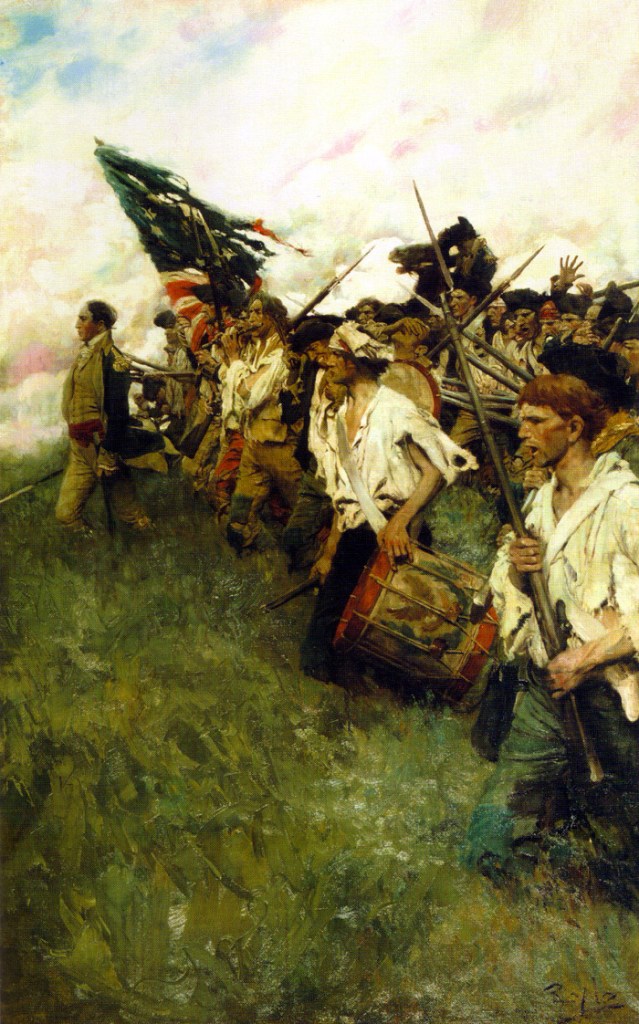
Brandywine Museum
As another Patriots Day slips into the raucous milieu of our national malaise and internal strife, I sit here gazing out my office window at the Hopkinson’s Standard fluttering in the chilly western wind. While I keenly watch it confidently navigate the tempestuous gusts, I cannot help but ruminate on the arduous task that our forebears undertook on this cold April morning in 1775.
After a long night of riding many desperate miles, Paul Revere, William Dawes, and a young Doctor Prescott successfully alerted an intricate network of personal associations that would rally the men of New England to stand in defence of their cherished liberties. While the recent rancorous political contest over the nature of the British constitution in relation to the colonies was the centrepiece, the events of the night of the 18th of April were concerned with more than just the right to define tax policy. Principally, the God-given right to defend one’s person, family, community, and property with privately-owned arms was at stake as General Gage’s regulars stealthy marched towards Lexington and Concord. Fundamentally then, the American War of Independence was touched off not solely for abstract arguments about just governance. Rather, hostilities began because of the British government’s desire to restrict the Colonist’s God given Right to Life.
Our forebears understood that free men and women have the natural right to preserve life with commonly held arms, which included firearms utilised by the military. Consequently, no temporal human institution could arbitrarily seek to control or deprive individuals of such a fundamental right without the due process of law that was grounded in timeless principles of just government. We must also recall that, while the British colonists had begun to develop a sense of an American identity in the years preceding The Seven Years War, they still considered themselves to be inheritors of traditional British liberties. Those liberties flowed from the wellspring of Judeo-Christian principles that were complemented with the civil advancements of the Enlightenment philosophers. The confluence of these ideas resulted in these humble peoples being resolved that they should govern themselves in order to retain their God-given rights and temporal liberties, no matter the cost.
The turbulent events of April 19th began in the wee morning hours, around 0430, a time when New England is bleak, and the ashen countryside was just beginning to brighten with the first pale light of dawn. A long column of soldiers in faded red uniforms silently marched toward their objective shrouded in gloom. They left their urban stronghold to disarm the unruly rural populace by raiding a privately held militia supply depot and to capture two outspoken critics of the King’s government; Samuel Adams and John Hancock. As the daylight improved, an apprehensive Lieutenant Sutherland observed “a vast number of country militia going over the hill with their arms for Lexington.” In the distance, the weary soldiers began to hear the ringing of church bells, the firing of alarm guns, and the rhythmic roll of military drums beating out the call to muster.
Within minutes the column rounded a soft corner on the Concord Road, at the base of Merriam’s Hill, and the humble community of Lexington came into view. The soft morning light was behind the pallid rose-coloured column of Irish conscripts wearing the uniform of their conquerours, and the village that they sought lay scarcely visible. In the half-light, the regulars could see Captain Parker’s undermanned militia forming a solemn line on the town green behind a great oak tree. The regulars in the vanguard could, perhaps, observe two men, Paul Revere and John Lowell, labouring to carry a large trunk filled with the secret correspondences of the leaders of the Sons of Liberty across the green as they marched past the town’s modest meeting house. Inside the building, a young Joshua Simonds barricaded himself in the powder magazine on the upper story of the building with his flintlock thrust into a powder keg, resolved to ignite the powder should the regulars force entry. Neither party knew what the other would do when they confronted one another that fateful day. Yet, both sides understood that events had been building up this moment when the bonds of kinsmen would be shattered and the resolve of freemen would be tested.
On Lexington’s green, Captain Parker, knowing full well the consequences of firing on the King’s Troops, watched as a company of mixed light infantry formed a line of battle, and calmly ordered his men to “Let the troops pass by…Don’t molest them, without they being first.” As regulars energetically marched closer, Captain Parker knew that the time for abstract debate was at an end and grimly give the order that “the first man who offers to run shall be shot down…Stand your ground! Don’t fire unless fired upon! But if they want to have a war let it begin here!” In vanguard of the advancing regulars a keen pistol wielding Royal Marine officer, Lieutenant Adair, shouted: “lay down your arms, you damned rebels!” Shortly after Adair’s command to surrender, the report of a firearm was heard by all on the green. The regulars, naturally responding as they were conditioned, with single shots that quickly erupted into a roar of flame and smoke.
Out of the dense cloud of sulphurous white smoke stumbled a morally wounded Jonathan Harrington. From Harrington’s house across the green, his wife and son watch in abject terror as he fell to his knees with his life’s blood streaming from a massive hole in his chest from the .75 calibre ball fired from a regular’s short land pattern musket. Rising from the ground Harrington attempted to make his way home but fell once more. Resolved to make it to his family, Harrington painfully crawled across the length of the green amidst the chaos. Within arm’s reach of his home, he finally succumbed to blood loss and died on his doorstep.[1]
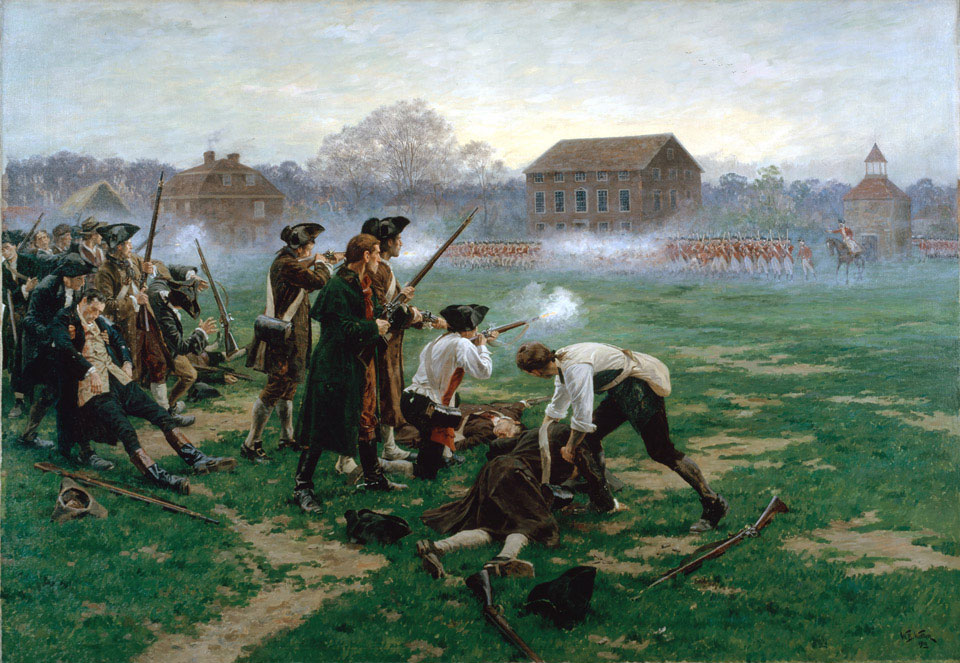
National Army Museu
In the subsequent actions on that bloody day, the familial bonds between kinsmen would be blown apart by the ragged thunderclap of the regulars’ firelocks upon Lexington’s green, and freemen, with grave faces, would answer the call to defend their ancient inheritance of individual liberty. Yet, the freemen that bore arms in devout resistance to tyranny that day did not adhere to our current notions of liberty, where individual sovereignty and personal entitlement reign supreme. Instead, they had inherited a tradition of ordered freedom, which placed a significant emphasis on God’s Word, the rule of law, self-government, free association, public duty, communal and individual rights, as well as the essential virtue of personal responsibility.
Their approach to liberty resulted in a set of principles that were both communal and individual. While the founding generation’s conception of liberty evidently recognised the individual nature of rights, they also placed great prominence upon the integrity of the community. Those essential personal qualities that encompass civic virtue were embedded within the minds of that generation in a variety of ways. Ministers preached these ideas from the pulpit, teachers taught them in single-room schoolhouses across the Colonies, and they were read aloud by families sitting around the hearth. Indeed, such was the spirit of the age that ardent seekers of knowledge consumed these ideas by studying the Bible in conjunction with Classical and Enlightenment thinkers by candlelight, then openly debated those ideas in public-houses or in pamphlet debates nailed to liberty poles. As a consequence, they interpreted Thomas Jefferson’s somewhat vague reference to the “pursuit of happiness” not as an individual endeavour, but rather the correct meaning of those words was the pursuit of social cohesion that is firmly cemented in the recognition of the reciprocal nature of liberty. Such a concept is intrinsically entwined with the principle of civic duty, which Cotton Mather maintained was an element that comprised one of the oars that individuals needed to pull in order to row their way to heaven. If a person only pulled on one oar alone, the boat would merely spin in circles.
It was that combination of individual rights, that are reciprocal in nature, with the now forgotten principle of social happiness that led men like seventy-year-old Samuel Whittemore to drop his plough and take up arms defence of his community’s liberties. Severely crippled by age and wounds from the Seven Years War, Whittemore slew three regulars before the brigade that he single-handedly engaged assaulted his position. After the brutal engagement at Menotomy, Whittemore was found still alive after being shot in the face and suffering from fourteen bayonet wounds.[2] He would survive his wounds and live to the ripe old age of ninety-six; his descendants still honour his stubborn bravery. The moral courage of yeomen like Samuel Whittemore or the lame school teacher James Hayward demonstrated their ardour for ordered freedom and the extent of their civic duty, as well as the depth of their commitment to that noble cause of human flourishing. Is it not a lamentable thought to consider how many of our apathetic and wilfully ignorant neighbours or family members would respond to such a situation in our own time? Moreover, as a nation, do we have the same oars with which to row or are we even in the same boat as our forebears? Might it also be true that a significant portion of the population is rowing us towards a utopian ideal that does not account for human nature because they are inculcated into an ideology that only has one historically demonstrated outcome; the mass enslavement and wanton slaughter of millions of innocent people?
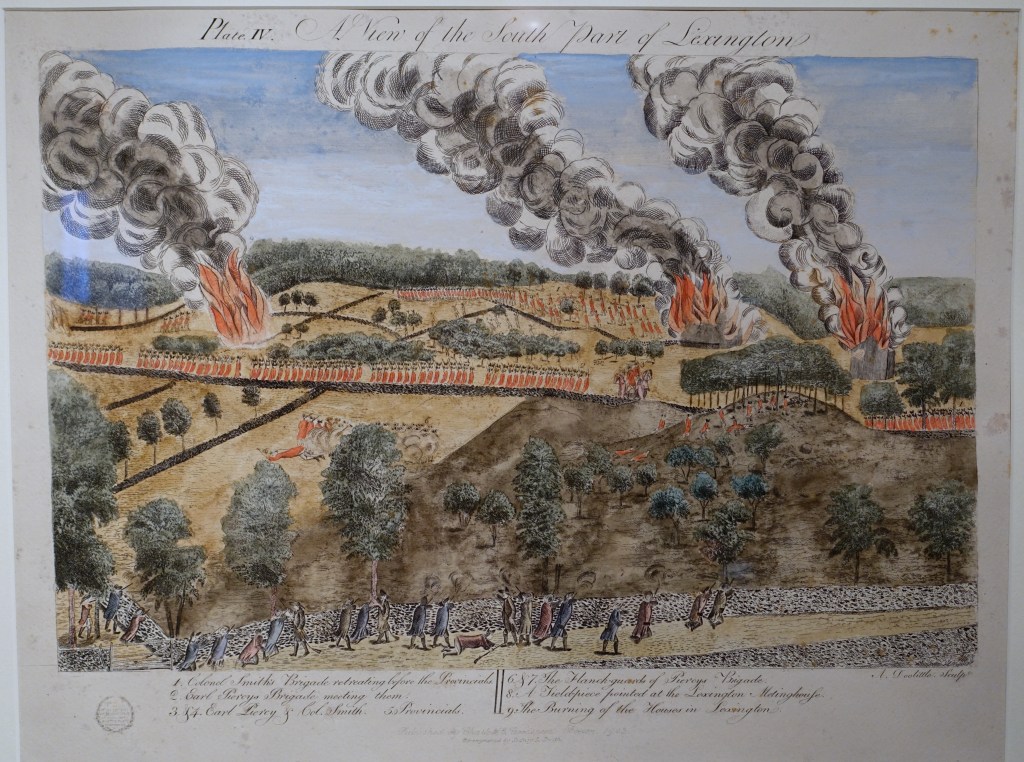
Humanity has a demonstrated history of committing mass acts of horrendous violence upon our fellow man,even in societies with highly educated or religious populations.[3] Thousands of years ago, Thucydides observed the true nature of humanity within his quasi-historical treatise, The History of the Peloponnesian War. In essence, Thucydides argued that humans will always be greedy, have unbridled ambition, and lust for power. In spite of these powerful flaws within humanity, he also noted that we also have a profound sense of justice and, at times, genuinely seek Truth.[4] We can observe these human forces at play within our own time when we witness the selflessness of humanity working against the overwhelming tide of our inescapable callousness.
In ages past, Classical philosophers and Christian theologians ardently contended that we are not merely tabula rasa that can be moulded to suit the will of a self-appointed priest class, nor are we angels. Moreover, if angels were to control the levers of government, there would no need for limits on the power of the state because no government would be required, such was the the point that James Madison persuasively recounts within The Federalist, No. 51 and 55.[5] Lamentably, humanity has a palpable history that is replete with countless examples of our inherent tendency to use the coercive power of government, in all its forms, to murder and take our neighbour’s wealth. As Bastiat reminds us, humanity has the propensity to steal from another, whether through force of arms or the ballot box when it is more amenable than acquiring wealth from one’s labour. Only prudent limits on government and a proper education that tempers our unbridled desires can curtail this propensity.[6] As a consequence, humanity requires a moral code of conduct that is tempered with a measured liberty where all persons respect the reciprocal nature of our God-given rights.
Despite humanity’s failure to learn the lessons of the past, with keen curiosity, our Founders’ earnestly investigated the sullen depths of our collective human saga for insights that would assist them in forming a government that sought to account for the inherent flaws within human nature. It is in their efforts that we observe humanity’s natural propensity for justice and to seek Truth bearing fruit amongst the dislocation that occurs within this fallen world. From these academic labours, our Founders learned some of the prudent lessons of the past and advanced our understanding of the fact that we are all created equal, as well as endowed with certain inalienable rights that are granted to us by our Creator. Building upon this exchange of ideas, the Founders’ believed that human nature was set, and the only way to combat our natural predispositions toward tyranny was to develop virtue within the body politic. That is the reason why they attempted to place constitutional mechanisms to limit what they identified as the darker motives of mankind. Their Enlightenment ideas were informed by the Classical-Judaeo-Christian view of human nature and the totality of the human experience, which made them hope that our fallen nature could be mitigated by a series of prudent checks and balances that hinged upon a moral society. This could be achieved by prudently instructing the nation’s youth in principles of God’s Word in combination with secular notions of liberty and by creating institutions that would check our unbridled ambition in order to prevent the government from becoming tyrannical.[7]
At the same time, the Founders were under no uncertain misapprehensions about the prospect of developing such ordered liberty within our society without there being some significant level of virtue within the citizenry. What good is a devout population when they blindly follow the dictates of a fallen ideology, as well as corrupt civil or religious institutions that do not keep God’s Commands?[8] They realised that, through an almost untraceable series of exchanges, it was crucial to recognise that a government or religious institution could not legislate morality. Nor could such an outcome be produced by a system of incentives provided by the government or adjudicated by some form of earthly judge. On the contrary, they understood that only institutions of civil society, the complete family unit, dedicated teachers, and faith communities, were the only positive influencers of morality within humanity. They also comprehended that their efforts were untested. Experiments do fail, especially when dealing with the capricious whims of the human soul. Consequently, our Founders understood that such an outcome was inevitable if certain principles of liberty were not fostered within the body politic.
Again, one must bear in mind that human history is brimming with humanity’s systematic arbitrary abuse and control of the coercive power of government by elites who think they are more suited to rule over the masses rather than the ordinary God-fearing individual. Historians writing hundreds of years from now, might view the individual liberties that have existed for such a minuscule fraction of humanity’s population, for such a woefully brief period, as a historical novelty that naively attempted to defy human nature. These same historians might also notice with equal curiosity that such a time was only a transient spectacle before humanity succumbed to its natural state. Namely, the abuse of free peoples by the arbitrary and capricious whims of a government that is controlled by those who think they know what is best for you.
Without a doubt, the enemy of free peoples is actively perusing a war-footing towards all those that oppose their godless and tyrannical socio-political agenda. Consequently, Scripture and prudence mandate that we prepare ourselves accordingly. If we wish to have a rebirth of liberty within this nation we must zealously strive to reproduce a comparable communal effort in our own time and cease to mindlessly adhere to our selfish dictates. The first step in that worthy cause must be to seek out God and honestly repent for the sins of our nation. Second, we must ensure that the youth of our nation receives a proper American education in order to disseminate the faith, knowledge of Truth, and virtue necessary to reconstruct the foundation upon which our Republican Constitution was erected. Third, if the reader, much like the author, is a victim of indoctrination at the hands of acolytes of a statist ideology within some defunct government “school,” then it is our task to rediscover our Founding literature and return to the wisdom found within the Bible so that we may mentally arm ourselves for the fight that is already being waged within our communities. Fourth, once we have done our due diligence, we must take action and, in a martial manner, forge ourselves into leaders within our localities. Prudence demands that we begin by addressing the issues within ourselves and within our communities before shifting our attention towards the national stage. Principally, that means we must get involved politically at the local level and demand that our rights be respected by those within our communities. One must realise that no one is going to protect your cherished liberties but you, and, in order to secure those rights, one requires community, as well as God’s blessings. Appropriately, this is a contest that is both temporal and spiritual in nature. It stands to reason then, that one should forthrightly seek the wellspring of our liberties and beseech Him to intercede on our behalf by granting His remnant the moral courage to stand in defence of His gifts as those humble militiamen did on the morning of April 19th, 1775.
Join the fight and may the armaments of God protect you in the battles to come.
Bibliography
Bailyn, Bernard. The Ideological Origins of the American Revolution. Cambridge, MA: Belknap Press, 1968.
Bailyn, Bernard. The Debate on the Constitution: Federalist and Antifederalist Speeches, Articles, and Letters During the Struggle over Ratification. Vol. 1. New York, NY: Library of America, 1998.
Bastiat, Frédéric. “The Law,” “The State,” and Other Political Writings, 1843–1850. Edited by Jacques De Guenin. Indianapolis, IN: Liberty Fund, 2012.
Fischer, David Hackett. Paul Reveres Ride. Oxford, UK: Oxford University Press, 1995.
Naimark, Norman M. Genocide: A World History. Oxford, UK: Oxford University Press, 2017.
Pangle, Lorraine Smith., and Thomas L. Pangle. The Learning of Liberty: The Educational Ideas of the American Founders. Lawrence, KS: University Press of Kansas, 1995.
Panné, Jean-Louis, Andrzej Paczkowski, Karel Bartosek, Jean-Louis Margolin, Nicolas Werth, and Stéphane Courtois. The Black Book of Communism: Crimes, Terror, Repression. Edited by Mark Kramer. Translated by Jonathan Murphy. Cambridge, MA: Harvard University Press, 1999.
Rummel, R. J. Death by Government: Genocide and Mass Murder Since 1900. Abingdon, UK: Routledge, 2017.
Shain, Barry Alan. The Myth of American Individualism: The Protestant Origins of American Political Thought. Princeton, NJ: Princeton University Press, 1996.
Strauss, Leo. Natural Right and History . Edited by Colen José and Svetozar Minkov. Chicago, IL: The University of Chicago Press, 1953.
Thompson, C. Bradley. America’s Revolutionary Mind: A Moral History of The American Revolution and The Declaration That Defined It. New York, NY: Encounter Books, 2019.
Thucydides, and Victor Davis. Hanson. The Landmark Thucydides: A Comprehensive Guide to The Peloponnesian War. Edited by Robert B. Strassler. Translated by Richard Undefined Crawley. New York, NY: Free Press Publishing, 1998.
Waller, James. Becoming Evil: How Ordinary People Commit Genocide and Mass Killing. Oxford, UK: Oxford University Press, 2007.
West, Thomas G. The Political Theory of the American Founding: Natural Rights, Public Policy, and the Moral Conditions of Freedom. Cambridge, UK: Cambridge University Press, 2018.
Wood, Gordon S. The Radicalism of the American Revolution. New York, NY: Vintage Books, 1993.
Wood, Gordon S. The Creation of the American Republic 1776-1787. Chapel Hill, NC: Univ. of North Carolina Press, 1969.
Foot Notes
[1] David Hackett Fischer, Paul Reveres Ride. (Oxford, UK: Oxford University Press, 1995), 191-201.
[2] Fischer, Paul Reveres Ride, 257.
[3] For a deep dive into the gore and depravity of humanity, amongst others, see; Norman M. Naimark, Genocide: A World History. (Oxford, UK: Oxford University Press, 2017), Jean-Louis Panné, Andrzej Paczkowski, Karel Bartosek, Jean-Louis Margolin, Nicolas Werth, and Stéphane Courtois. The Black Book of Communism: Crimes, Terror, Repression. Edited by Mark Kramer. Translated by Jonathan Murphy. (Cambridge, MA: Harvard University Press, 1999), R. J. Rummel, Death by Government: Genocide and Mass Murder Since 1900. (Abingdon, UK: Routledge, 2017), and James Waller. Becoming Evil: How Ordinary People Commit Genocide and Mass Killing. Oxford, UK: Oxford University Press, 2007.
[4] See; Thucydides, and Victor Davis. Hanson. The Landmark Thucydides: A Comprehensive Guide to The Peloponnesian War. Edited by Robert B. Strassler. Translated by Richard Undefined Crawley. New York, NY: Free Press Publishing, 1998.
[5] Bernard Bailyn, The Debate on the Constitution: Federalist and Antifederalist Speeches, Articles, and Letters during the Struggle over Ratification. Vol. 1. (New York, NY: Library of America, 1998), 182-186.
[6] Frédéric Bastiat, “The Law,” “The State,” and Other Political Writings, 1843–1850. Edited by Jacques De Guenin. (Indianapolis, IN: Liberty Fund, 2012), 107-147, 266-276.
[7] Bernard Bailyn, The Debate on the Constitution: Federalist and Antifederalist Speeches, Articles, and Letters during the Struggle over Ratification. Vol. 1. (New York, NY: Library of America, 1998), 182-186, 202-207.
[8] See; Barry Alan Shain. The Myth of American Individualism: The Protestant Origins of American Political Thought. (Princeton, NJ: Princeton University Press, 1996), C. Bradley Thompson. America’s Revolutionary Mind: A Moral History of The American Revolution and The Declaration That Defined It. (New York, NY: Encounter Books, 2019), and Lorraine Smith Pangle, and Thomas L. Pangle. The Learning of Liberty: The Educational Ideas of the American Founders. (Lawrence, KS: University Press of Kansas, 1995).
 Tempestuous Seas of Liberty